





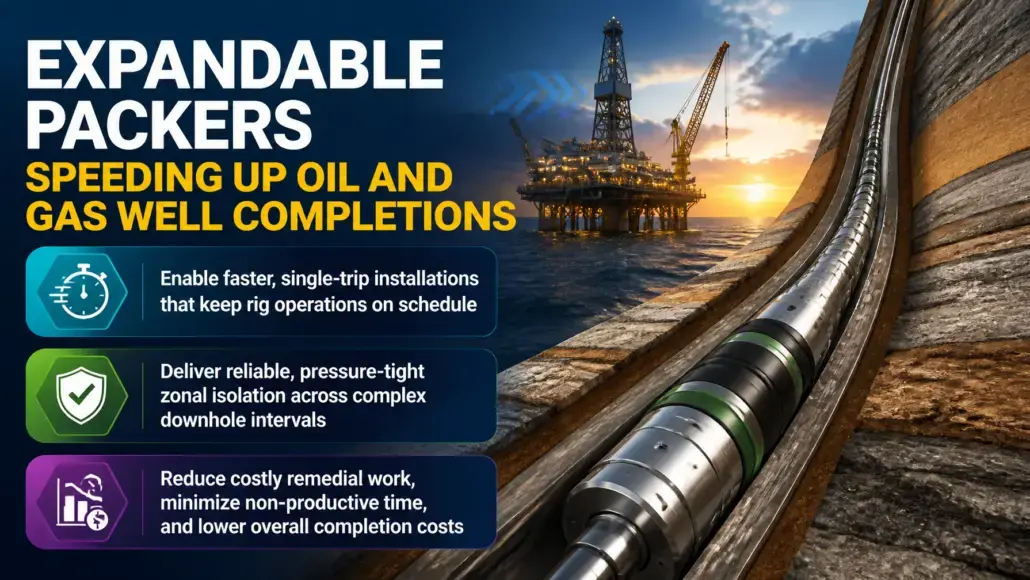
Completing modern oil and gas wells requires establishing permanent, pressure-tight barriers across complex downhole intervals without compromising rig operational timelines. In long horizontal wells, multi-layered deepwater reservoirs, and mature fields requiring selective water shutoff, traditional cementing and mechanical slip packers frequently face severe operational bottlenecks. Remedial squeeze cementing, complex multi-trip mechanical runs, and micro-annular gas channels inflate rig spread rates and postpone initial hydrocarbon production.
The rapid adoption of expandable technology addresses these mechanical challenges directly. A primary catalyst driving this expansion is operator demand for simplified completion sequences that eliminate casing hardware while providing reliable long-term zonal isolation. Utilizing expandable packers for well completions allows operating companies to streamline installation procedures, minimize downhole mechanical risks, and accelerate asset delivery schedules across both deepwater and mature fields.
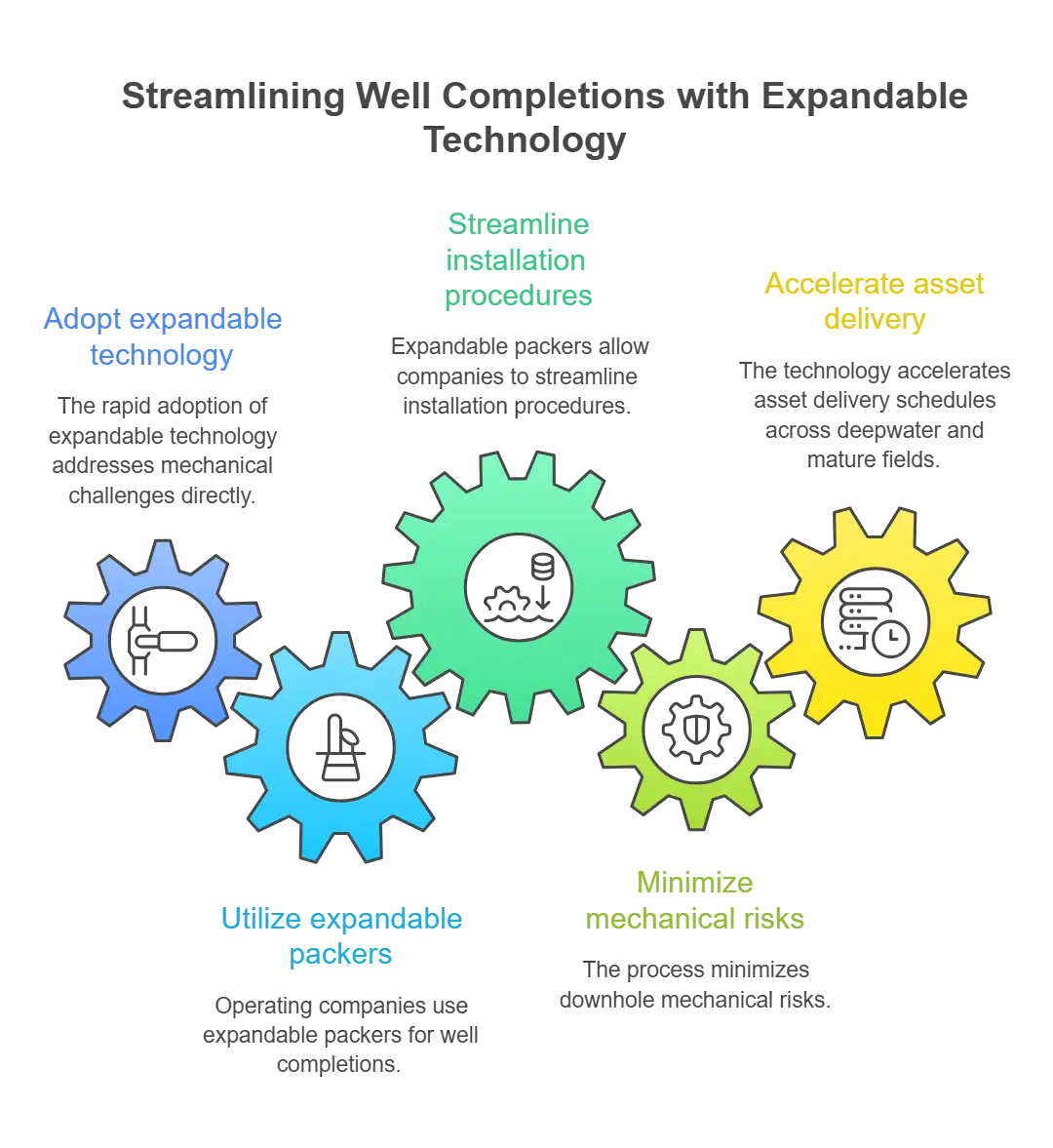
Oil & Gas Advancement observes that by replacing multi-component mechanical slips and complex cementing assemblies with compliant expanding metal sleeves and reactive elastomer matrices, expandable packers transform downhole completion mechanics.
Mechanics of Expandable and Swellable Zonal Isolation
Conventional completion packers rely on mechanical slips that bite into the host casing and compressed rubber elements that squeeze outward when exposed to hydraulic or mechanical set loads. In openhole completions or irregular borehole geometries, these rigid mechanical systems often struggle to achieve complete circumferential sealing, creating leak paths along washed-out intervals. Furthermore, running mechanical packers through tight doglegs risks premature setting, creating severe stuck pipe situations that require costly fishing operations.
Expandable packer systems deploy two primary expansion mechanisms to achieve continuous circumferential sealing against the formation or casing wall:
- Direct hydraulic or mechanical expansion of solid metal tubulars that deform plastically against the wellbore, creating high-contact anchoring and permanent sealing.
- Chemically reactive swellable elastomer elements that absorb surrounding downhole fluids, expanding in volume until they conform perfectly to irregular rock profiles.
In swellable applications, specialized elastomer matrices are engineered to react with specific fluid media. Oil-swelling elastomers incorporate ethylene propylene diene monomer or nitrile rubber compounds that absorb hydrocarbons through physical diffusion. Water-swelling elastomers integrate superabsorbent polyacrylate polymers into the rubber compound, drawing in water molecules via osmosis. Formulators can adjust curing agents, cross-link density, and polymer morphology to control swelling delay times, allowing liners to reach total depth before expansion begins.
Unlike mechanical packers that seal over narrow longitudinal contact areas, swellable and metal-expandable systems provide continuous seal lengths spanning tens of feet. This distributed sealing area reduces localized stress concentrations on the rock face, eliminates mechanical moving parts, and creates a durable hydraulic seal that withstands differential pressures exceeding 10,000 pounds per square inch.
Replacing Primary Cementing in Extended Lateral Profiles
Primary cementing in long horizontal wells presents significant operational hurdles. Centering long liner strings in extended lateral boreholes is technically difficult, often leaving mud channels on the low side of the hole. When cement slurry is pumped, these un-displaced mud pockets compromise cement sheath integrity, allowing gas or water to migrate between productive reservoir zones. In addition, cement shrinkage and formation breakdown during pumping create long-term well integrity risks that require expensive remedial work.
Deploying openhole expandable packers allows operators to eliminate primary cementing across the reservoir section entirely. By spacing expandable packers along the liner string alongside inflow control devices or sand screens, engineers compartmentalize the lateral section into isolated production compartments:
- Eliminates expensive cement pumping spreads, curing waiting time, and casing drill-out runs.
- Prevents chemical wash and fluid filtrate contamination of delicate hydrocarbon-bearing formations.
- Provides immediate mechanical isolation that conforms dynamically to natural wellbore washouts and rugosity.
- Accommodates long-term reservoir subsidence, thermal cycling, and tectonic movement without cracking.
The operational savings achieved by skipping cementing in extended horizontal sections can save several days of high-cost rig time per well, significantly accelerating production ramp-up. Furthermore, openhole compartments allow operators to shut off unexpected water encroachment selectively by closing downhole sliding sleeves between packers, safeguarding overall reservoir recovery factors.
Commercial Innovations and Global Field Deployments
Major oilfield equipment manufacturers have developed highly engineered expandable liner hanger and openhole isolation portfolios to serve both deepwater and land development projects:
- Halliburton continues commercial deployments of its VersaFlex expandable liner hanger system, engineered for offshore and deepwater wells, which eliminates mechanical slips, tieback packoffs, and moving parts to set in a single operational trip.
- Baker Hughes deployed its TORXS expandable liner hanger systems and metal-expandable openhole packers across high-pressure offshore fields, allowing operators to rotate liners while reaming to total depth and expand the hanger body reliably upon landing.
- SLB expanded its portfolio of swellable and mechanical openhole isolation packers, deploying customized elastomer compounds that provide permanent sealing under extreme differential pressure and elevated bottomhole temperatures.
- Weatherford advanced its expandable casing and sand screen isolation technology, integrating compliant metal seals that conform to out-of-round openhole intervals in complex offshore completions.
These commercial systems illustrate how expandable technology simplifies mechanical deployment, enabling operators to achieve reliable zonal isolation in complex geological settings while cutting overall well construction duration.
Operational Synergy with Real-Time Downhole Telemetry
Installing modern completion hardware requires precise depth placement, especially when straddling productive fracture networks or isolating water-bearing fault zones. Setting an expandable packer in an enlarged washout or across an active fracture can compromise isolation integrity and damage the completion string. Conversely, setting packers inside under-gauge hole sections can lead to mechanical hanging or premature swelling before the completion string reaches design depth.
To ensure exact bottomhole assembly placement and verify mechanical integrity before landing completion liners, operators increasingly integrate high-speed downhole data streams. Drilling and evaluating the reservoir interval using wired drill pipe technology provides high-resolution borehole caliper images, lithology logs, and pressure profiles along the entire horizontal section. This high-speed telemetry allows completion engineers to position expandable packers within perfectly gauged, competent rock sections, ensuring complete seal formation and preventing premature swelling during deployment.
Combining high-speed reservoir mapping with robust expandable completion hardware creates a seamless workflow that optimizes production delivery while minimizing subsurface risk. Real-time data validation gives asset teams complete operational confidence when installing expandable packers for well completions across critical deepwater horizons.
Remedial Applications, Workovers, and Life-of-Field Economics
Beyond initial well completions, expandable technology plays a vital role in brownfield rejuvenation and wellbore intervention. In mature producing fields, casing integrity frequently deteriorates due to corrosion, wear from drillstring rotation, or perforation damage. Leaking casing strings allow formation water to flood productive zones or allow high-pressure gas to charge shallow aquifers, posing severe environmental and safety hazards.
Traditional casing repair requires squeezing cement into casing leaks or running a smaller-diameter casing string from surface to bottomhole. This remedial approach severely restricts the internal wellbore diameter, reducing production tubing size and limiting artificial lift options. Installing traditional nested casing strings can choke well productivity permanently, turning a productive well into an uneconomic liability.
Expandable patch systems provide an efficient alternative for remedial repairs. An expandable steel sleeve clad with elastomer seals is lowered across the damaged casing section and expanded mechanically against the host pipe. This process seals off perforations, water breakthrough zones, or split casing sections with minimal loss of internal drift diameter.
The operational and financial advantages of expandable patches include:
- Rapid deployment via wireline, coiled tubing, or workstring in a single intervention trip.
- Preservation of internal casing diameter, allowing standard production logging tools and artificial lift pumps to pass through.
- Permanent high-pressure sealing that resists aggressive hydrogen sulfide and carbon dioxide environments.
- Elimination of surface cement handling, chemical additives, and expensive cleanout operations.
Oil & Gas Advancement believes that by simplifying initial completion operations and providing high-integrity remedial solutions throughout the productive life of the reservoir, expandable packers for well completions deliver exceptional capital value, driving sustainable operational performance across global oil and gas developments. Operating companies adopting these systems consistently report lower lifecycle intervention costs, improved reservoir recovery, and accelerated asset returns.
References
- “Expandable Liner Hanger System Market Research Report 2034” – Dataintelo
- “VersaFlex Expandable Liner Hanger System Operational Guide” – Halliburton
- “TORXS Expandable Liner Hanger and Well Completion Solutions” – Baker Hughes
- “Openhole Zonal Isolation and Swellable Packer Engineering Review” – SLB
