













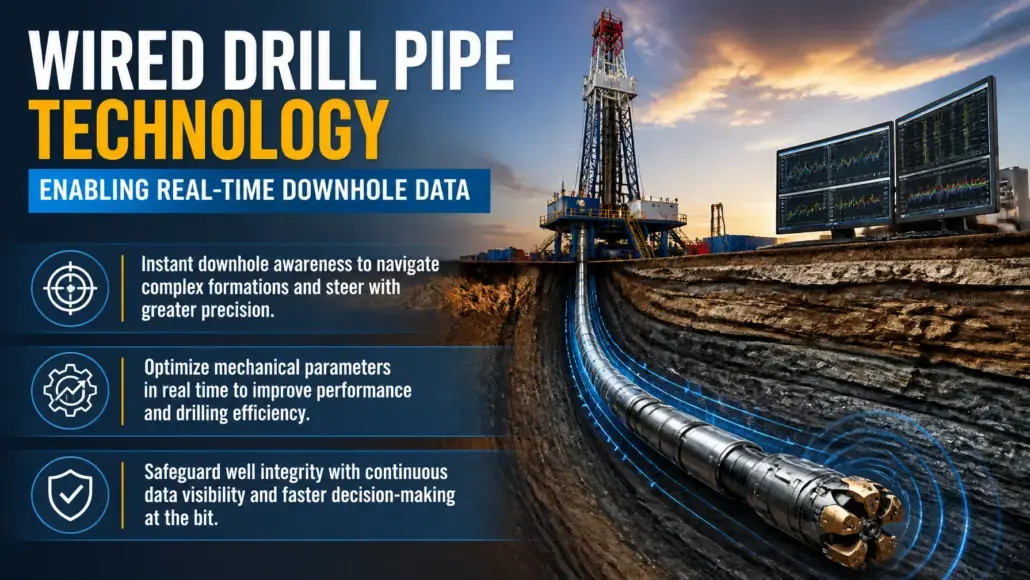
Navigating complex geological formations requires instantaneous downhole awareness to steer directional assemblies, optimize mechanical parameters, and safeguard well integrity. For decades, the upstream industry has relied almost entirely on mud pulse telemetry to transmit logging and measurement data from the drill bit to surface computers. Mud pulse systems transmit data by generating acoustic pressure waves within the circulating fluid column, achieving transmission rates of only 1.5 to 10 bits per second. In deep, extended-reach horizontal wells, this limited bandwidth creates severe operational latency, forcing drillers to make steering and well control decisions based on delayed, low-resolution data packets.
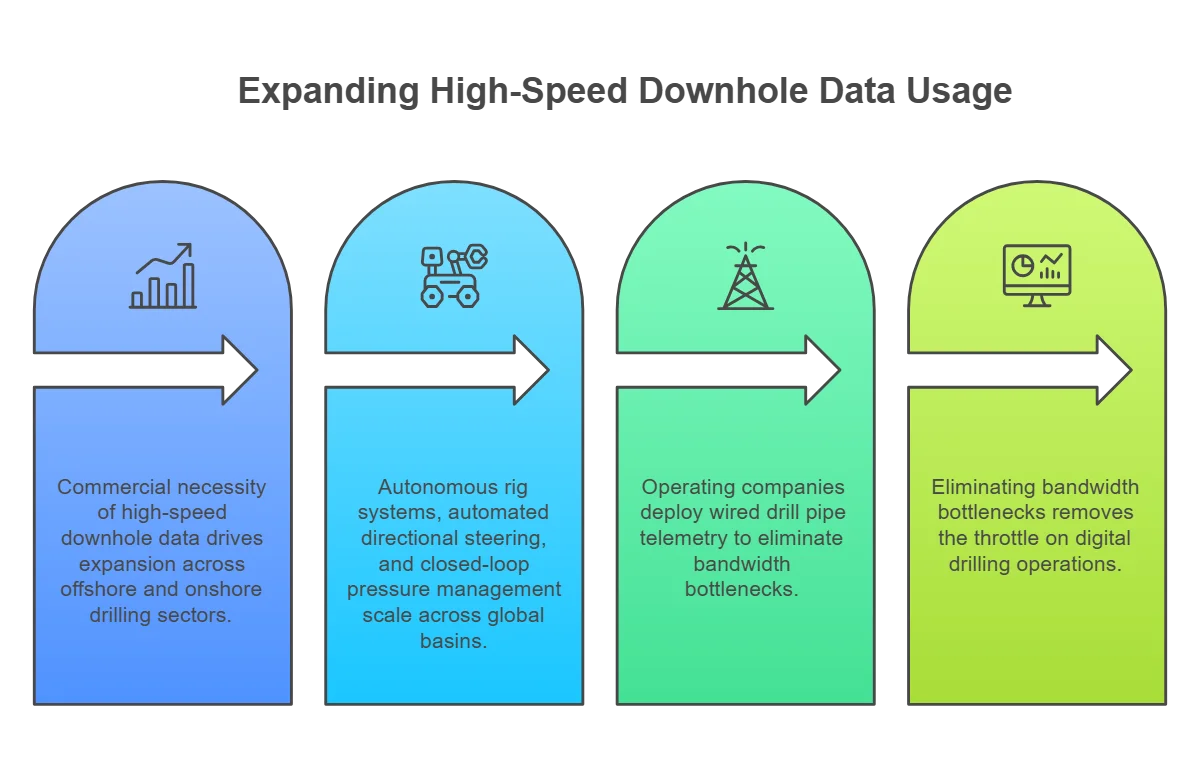
The commercial necessity of high-speed downhole data is driving significant market expansion across both offshore and onshore drilling sectors. As autonomous rig systems, automated directional steering, and closed-loop pressure management scale across global basins, operating companies are increasingly deploying wired drill pipe telemetry to eliminate the bandwidth bottlenecks that throttle digital drilling operations.
Oil & Gas Advancement observes that by embedding high-capacity inductive telemetry cables directly within armored drill pipe tubulars, wired drill pipe transforms the mechanical drillstring into a continuous, bi-directional broadband transmission highway.
Inductive Coupling and Broadband Downhole Architecture
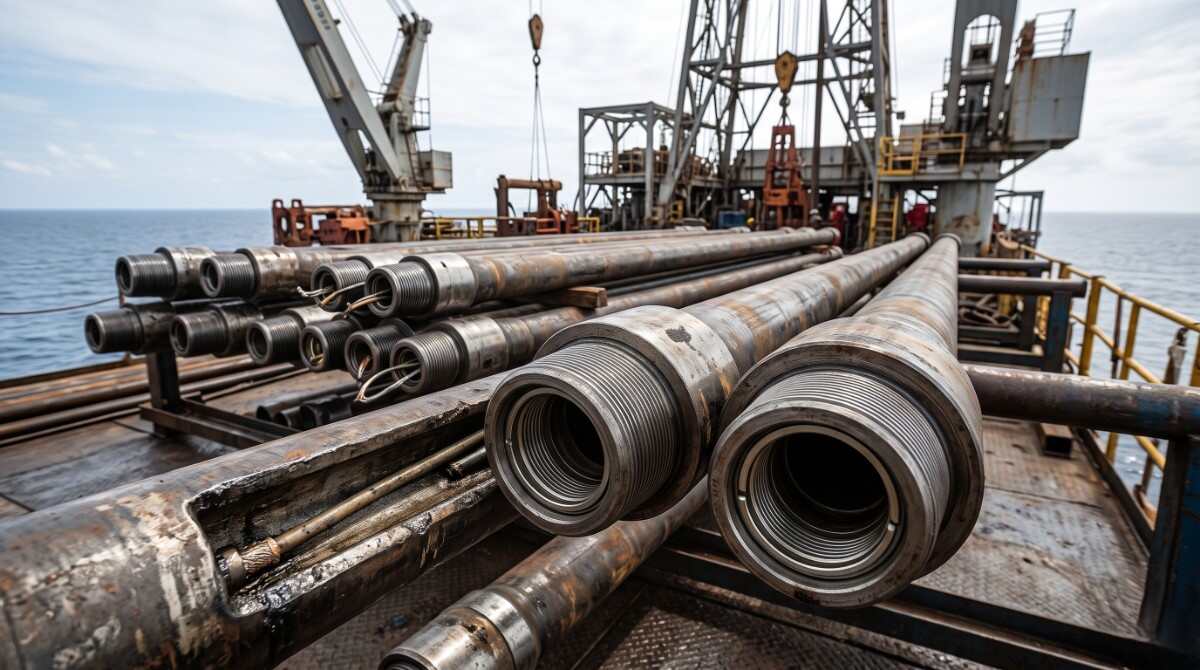
Wired drill pipe replaces fluid-borne acoustic pulses with high-frequency electromagnetic data transmission. Each standard range-2 or range-3 drillpipe joint is manufactured with an armored coaxial cable running along the inner wall or embedded within the pipe body. At each tool joint pin and box connection, an inductive coil is housed within a protective groove cut into the secondary torque shoulder.
When two pipe joints are screwed together on the rig floor, the inductive coils align face-to-face across a microscopic mechanical gap without requiring physical pin-to-socket electrical contact. Electrical signals pass between pipe joints through high-frequency magnetic induction, creating a continuous electrical network across kilometers of drillstring:
- Transmits bi-directional data at continuous speeds reaching 57,600 bits per second, representing a ten-thousand-fold increase over mud pulse telemetry.
- Eliminates vulnerable metal electrical pins, wet-connect plugs, and exposed wires that degrade under harsh field handling and corrosive mud environments.
- Operates independently of mud circulation, transmitting high-frequency data during pipe connections, tripping, and flow stops.
- Incorporates electronic booster repeaters spaced every 1,000 to 1,500 feet along the string to regenerate signal strength and prevent attenuation in deep wells.
This continuous network architecture allows surface automation platforms to communicate directly with downhole sensors and rotary steerable tools without operational interruptions. Rig crews handle the pipe joints using standard iron roughnecks and slips, eliminating special makeup procedures or delicate electronic assembly steps on the rig floor. The mechanical robustness matches standard premium drill pipe, ensuring high torque capacity and fatigue resistance during aggressive rotary drilling.
Instantaneous High-Resolution Geosteering and Reservoir Mapping
Navigating thin, fault-stratified reservoir targets demands immediate logging feedback to keep the drill bit positioned within the sweetest hydrocarbon-bearing pay zone. When operating with traditional mud pulse telemetry, drillers receive gamma ray, resistivity, and density measurements several minutes after the bit has cut the rock, especially when penetration rates exceed 150 feet per hour. This delay often results in late steering corrections, leading to accidental exits from the reservoir into barren shale or water-bearing sands.
Wired drill pipe telemetry delivers continuous, high-definition downhole images and azimuthal measurements the instant the bit encounters formation boundaries:
- Streams uncompressed, high-resolution azimuthal gamma ray and density images directly to surface geologists.
- Detects geological boundary beds up to 15 feet ahead of and around the bit, allowing proactive geosteering adjustments.
- Maximizes reservoir contact ratios, frequently exceeding 95 percent in-zone drilling across undulating lateral sections.
- Enables immediate detection of micro-fractures, fault planes, and unexpected fluid contact transitions.
Furthermore, broadband downhole telemetry allows real-time measurement of drillstring dynamics, vibration, and mechanical strain along multiple along-string measurement nodes, enabling drillers to mitigate stick-slip and whirl before bottomhole assemblies suffer catastrophic mechanical fatigue. Early vibration detection prevents costly tool failures, reduces cutter wear, and preserves directional steering accuracy during extended lateral runs. Petrophysicists can evaluate bed boundaries and reservoir fluid contacts instantaneously, adjusting target inclinations on the fly rather than waiting for post-drilling memory dumps.
Commercial Deployments and Offshore Field Milestones
The adoption of wired drill pipe has moved beyond isolated technical pilots into full-scale commercial field operations across the North Sea, offshore Norway, the Gulf of Mexico, and the Middle East:
- NOV continues the global expansion of its IntelliServ wired drill pipe platform, supporting high-speed telemetry across thousands of commercial offshore and deepwater drilling operations globally.
- SLB expanded commercial deployments of its NeoLink real-time downhole wired drillpipe telemetry and measurement systems, integrating broadband telemetry with advanced directional drilling and formation evaluation tools.
- Reelwell secured a significant commercial agreement with Vår Energi in January 2025 for the deployment of its DualLink wired drill pipe system on the Norwegian Continental Shelf, validating the demand for high-speed data transmission in harsh offshore environments.
- Baker Hughes deployed integrated wired pipe systems with advanced rotary steerable assemblies, enabling downhole closed-loop steering and dynamic rib steering automation in complex extended-reach wells.
These commercial developments demonstrate that major operators recognize broadband telemetry as a critical enabler for reducing non-productive rig time and safeguarding deepwater investments. Operating data from these deployments reveals measurable reductions in reaming hours and significant improvements in well placement accuracy across multi-well platform campaigns.
Downhole Closed-Loop Integration and Drilling Fluid Optimization
High-speed telemetry provides critical operational value when drilling through hydraulically narrow or thermally severe formations. Downhole annular pressure sensors connected to a wired string stream instantaneous equivalent circulating density measurements back to surface control systems without the multi-minute latency inherent in acoustic pulsing. This instantaneous feedback is particularly vital when managing narrow margins between pore pressure and fracture gradients.
In these sensitive hydraulic environments, operating companies frequently evaluate their fluid selection, comparing chemical stability and cuttings transport using insights gained from comparing oil-based and water-based drilling fluids to prevent barite sag, reduce friction, and avoid excessive annular pressure build-up. Integrating wired drill pipe telemetry with thermally stable drilling muds allows operators to detect annular loading and cuttings pack-off instantly, prompting prompt operational adjustments before pipe sticking occurs.
Real-time downhole pressure data also enables automated surface choke systems to modulate backpressure dynamically during connections, eliminating pressure fluctuations that trigger wellbore wall collapse. Continuously measuring along-string temperature and annular pressure provides early warning of gas migration inside the wellbore, transforming conventional kick detection into an exact engineering science. Well control teams can identify and isolate gas influxes while they remain small and manageable, preventing gas expansion inside marine risers.
Automated Drilling Rigs and the Digital Well Construction Future
The long-term value of wired drill pipe telemetry extends beyond data visualization to the total automation of well construction processes. Modern automated drilling rigs rely on complex artificial intelligence algorithms to optimize weight on bit, top-drive rotary speed, and mud pump flow rates. However, machine-learning control algorithms cannot operate safely or effectively when starved of real-time sensory data.
Broadband telemetry bridges the digital divide between downhole reality and surface automation. By feeding thousands of downhole sensor streams per second into autonomous control systems, the rig can execute closed-loop autonomous drilling:
- Surface top drives automatically adjust rotary speeds to eliminate torsional stick-slip vibrations detected at the bit.
- Automated drawworks modulate weight on bit dynamically to maximize rate of penetration while preserving cutter life.
- Downhole rotary steerable systems receive continuous downlink steering commands without interrupting mud pumping or drillstring rotation.
- Predictive maintenance platforms identify impending downhole motor or sensor failures days before mechanical breakdown occurs.
Oil & Gas Advancement notes that by transforming wellbore telemetry from slow acoustic pulses into an instantaneous digital stream, wired drill pipe telemetry establishes the digital foundation for safe, efficient, and autonomous well construction across the global energy industry. Energy operators adopting broadband drillstrings reduce total well delivery times, protect reservoir recovery potential, and minimize surface energy consumption across challenging exploration campaigns.
References
- “Wired Drill Pipe Market Size, Share and Industry Report 2026-2034” – Fortune Business Insights
- “IntelliServ Wired Drill Pipe Technology and Broadband Network Review” – NOV
- “NeoLink Real-Time Downhole Wired Drillpipe Control System Specification” – SLB
- “DualLink Wired Drill Pipe System Deployment Agreement with Vår Energi” – Reelwell and Industry Reports
