








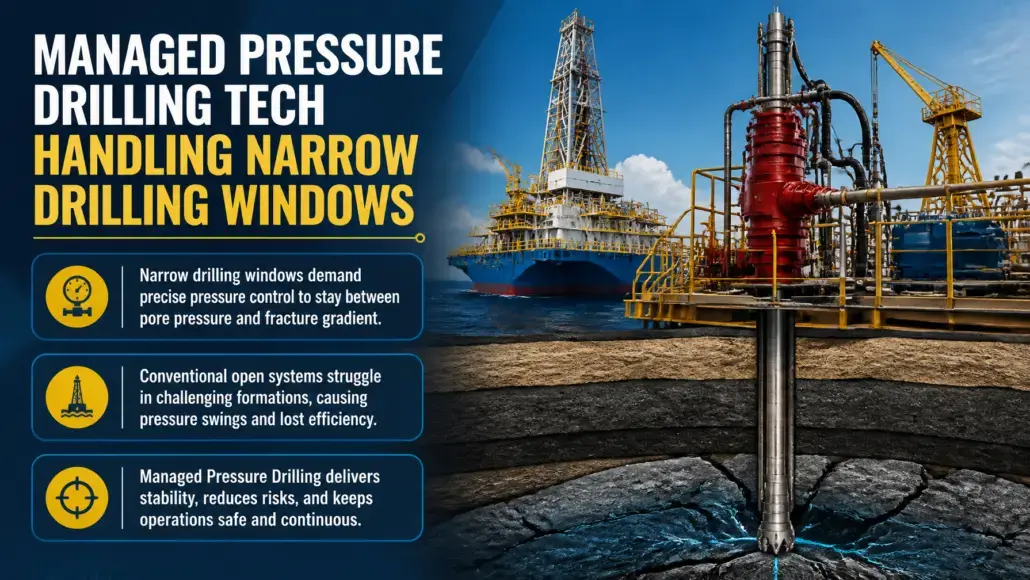
Drilling through depleted reservoir sands, deepwater subsalt formations, and fractured carbonates forces drilling engineers to confront razor-thin drilling margins. In these challenging geologies, the operational window between the pore pressure required to prevent formation fluid influx and the fracture gradient that triggers rock breakdown narrows to less than half a pound per gallon. Conventional open-to-atmosphere drilling systems struggle in these environments, frequently alternating between kicks and severe mud loss, escalating well construction costs and jeopardizing wellbore stability.
The operational urgency of this challenge is driving rapid capital adoption across global drilling campaigns. Market valuation data published by FactMR in late 2025 indicates that the global market for managed pressure drilling services reached approximately 4.3 billion dollars in 2025 and is projected to expand significantly over the next decade as offshore exploration targets deeper, high-pressure reservoirs. Drilling contractors increasingly treat closed-loop pressure systems not as specialized contingency tools, but as primary well construction infrastructure. Implementing modern managed pressure drilling technology allows operators to drill through geologically sensitive horizons with enhanced safety margins and predictable expenditures.
Oil & Gas Advancement observes that by converting the drilling wellbore into a closed, pressurized hydraulic system, managed pressure drilling technology provides real-time control over bottomhole annular pressure, allowing operators to drill previously undrillable wells with high safety and operational efficiency.
Mechanical Mechanics of Closed-Loop Pressure Control
Traditional drilling operations manage downhole pressure primarily through static mud weight adjustments made at surface pits. This static approach creates inherent vulnerabilities whenever mud circulation stops during pipe connections or tripping operations. Dynamic annular pressure loss, which contributes significantly to equivalent circulating density while pumping, vanishes the moment the mud pumps ramp down. This loss of circulating pressure causes bottomhole pressure to plunge toward static hydrostatic levels, potentially allowing formation fluids to enter the wellbore.
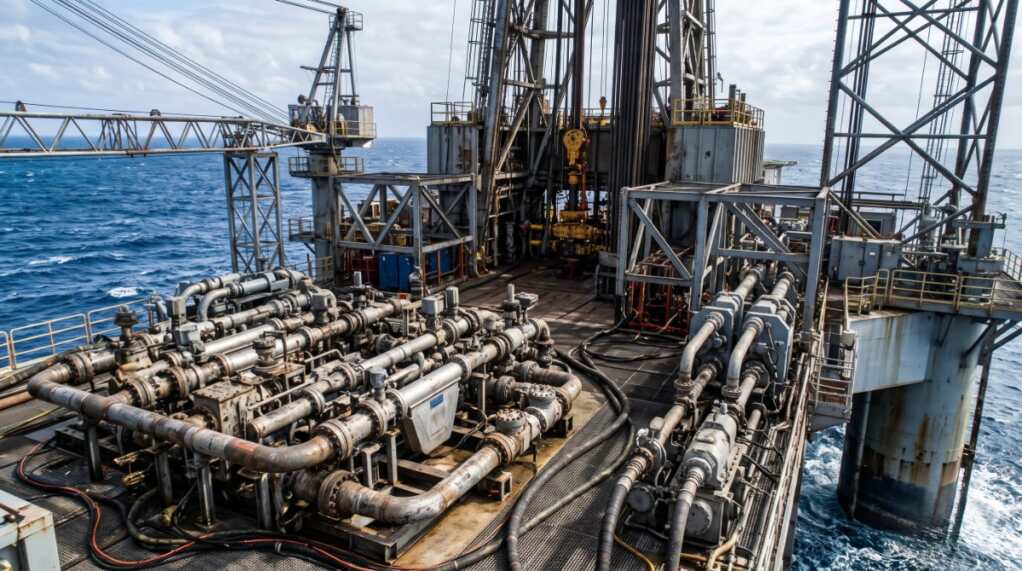
Closed-loop systems overcome this limitation through mechanical containment and automated surface control. A rotating control device installed above the blow-out preventer seals the wellbore annulus while allowing the drillpipe to rotate and move vertically. Returns are diverted away from the atmospheric shale shaker trough into an automated manifold equipped with fast-acting choke valves, continuous mass flow meters, and dedicated backpressure pumps.
When rig pumps slow during a connection, the automated control system instantly throttles the surface chokes or engages the backpressure pump to apply compensating surface backpressure. This rapid response keeps the downhole pressure profile flat, ensuring that:
- Annular pressure remains constantly above pore pressure during circulation shutdowns.
- Peak equivalent circulating density during pump startup stays strictly below the rock fracture limit.
- Micro-fractures in fragile formations are protected from cyclic pressure surges.
- Pipe connection times proceed without ballooning or kick-loss cycles.
By neutralizing pressure fluctuations between dynamic and static states, closed-loop pressure control eliminates the major mechanical driver of downhole instability.
Automated Backpressure Management and Detection of Micro-Fluxes
The integration of high-frequency Coriolis mass flow meters into the return stream transforms early kick and loss detection from a visual rig floor observation into an automated analytical discipline. Coriolis meters measure the mass flow rate and fluid density of returns down to single-gallon increments per minute, detecting influxes or losses long before conventional pit volume totalizers show measurable variation.
Advanced algorithms continuously compare the measured return flow against the real-time inlet flow pumped downhole. If the return mass flow rate exceeds the pumped rate, the control system detects a kick within seconds. Conversely, if return flow drops below inlet flow, the system recognizes an active fluid loss event.
Modern automated choke manifolds respond to these micro-fluxes within fractions of a second by adjusting choke opening percentages:
- Surface backpressure increases automatically to stop formation influxes before gas reaches the riser.
- Surface backpressure decreases immediately upon detecting fluid losses, reducing bottomhole pressure to preserve formation integrity.
- Dynamic pore pressure testing can be performed without stopping drilling by systematically stepping down backpressure until a minor influx is observed and immediately contained.
- Formation fracture pressure limits can be calibrated downhole in real time without inducing destructive hydraulic fractures.
These automated capabilities turn reactive well control into a proactive pressure management process that protects both the drilling rig and the subsurface reservoir.
Commercial Rig Deployments and Operational Milestones
Global offshore operators and major drilling contractors are accelerating the integration of advanced closed-loop systems into deepwater drillships and semi-submersibles. The deployment of managed pressure drilling technology has become a baseline requirement for high-risk offshore campaigns in South America, West Africa, and the Gulf of Mexico. Rig contracts increasingly specify factory-installed MPD packages to eliminate third-party mobilization delays and ensure seamless rig control integration.
Tier-one service providers and drilling contractors have announced significant commercial agreements reflecting this market shift:
- Weatherford secured major multi-year managed pressure drilling contracts and aftermarket service agreements with Noble Corporation in May 2026, deploying automated MPD systems across multiple deepwater drilling rigs to enhance operational safety and drilling speed.
- Weatherford was simultaneously awarded dedicated managed pressure drilling and subsea intervention contracts by Constellation Oil Services in offshore Brazil during May 2026, targeting complex pre-salt drilling horizons characterized by narrow hydraulic windows.
- SLB expanded commercial operations with its integrated automated MPD systems, pairing closed-loop surface pressure control with downhole measurements to optimize equivalent circulating density in deepwater plays.
- Baker Hughes deployed automated surface choke systems and downhole pressure-while-drilling packages across high-pressure horizontal wells in the Middle East, reducing connection gas influxes and eliminating differential sticking.
These commercial achievements confirm that automated pressure control is moving into standard offshore rig configurations, delivering measurable time savings and mitigating substantial drilling hazards.
Bridging Drilling Success into Efficient Well Completions
Drilling a complex well to total depth through a narrow hydraulic window represents only the first phase of asset delivery. Once the production section is reached, the borehole must be secured, isolated, and prepared for long-term hydrocarbon extraction. A borehole drilled with tight pressure control preserves rock stability, producing a smooth, gauge hole with minimal washouts and superior mechanical integrity.
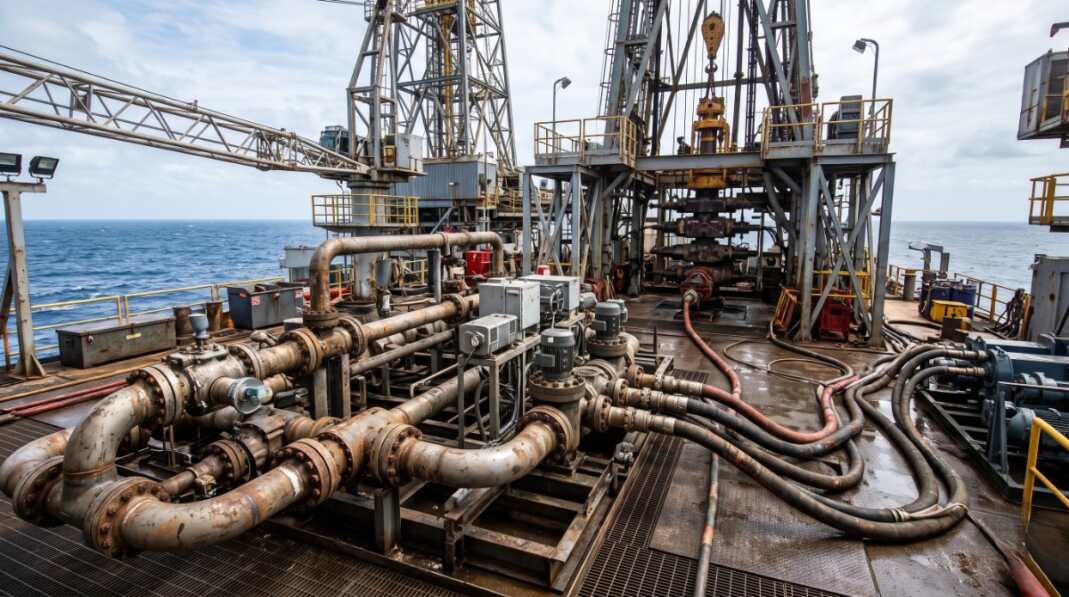
However, transitioning a well drilled under narrow pressure margins into a producing asset requires completion technologies capable of maintaining reliable zonal barriers without subjecting the delicate formation to excessive hydrostatic or mechanical shock. To achieve rapid and reliable zonal isolation in these sensitive intervals, operators rely on [Expandable Packers Speeding Up Oil and Gas Well Completions] to establish robust mechanical seals without requiring multiple casing strings or complex cementing operations.
Combining automated pressure control during the drilling phase with advanced expandable completion systems ensures that the wellbore remains stable from initial spudding through to final hydrocarbon flow. This integrated approach reduces wellbore stress, prevents fluid losses during gravel packing or screen running, and protects productive reservoir layers from formation damage.
Casing Design Optimization and Capital Savings
Deploying managed pressure drilling technology delivers substantial capital benefits beyond preventing downhole incidents. In conventional deepwater wells, narrow margins between pore pressure and fracture gradients force engineers to design conservative well architectures with numerous casing strings. Each casing string steps down the internal borehole diameter, often resulting in a small production liner that restricts hydrocarbon flow rates and limits future workover access.
By actively managing equivalent circulating density and applying dynamic surface backpressure, operators can drill deeper intervals on a single hole size, effectively walking the pressure profile through multiple geological formations that would otherwise require separate casing strings.
The financial and operational impacts of this well architecture optimization are substantial:
- Eliminating one or two intermediate casing strings saves millions of dollars in tubular costs, cementing services, and rig handling time.
- Maintaining a larger borehole diameter down to the reservoir target permits larger completion tubing, maximizing initial production flow rates.
- Consuming fewer casing strings reduces the total weight hung from subsea wellheads, decreasing structural fatigue on subsea infrastructure.
- Mitigating non-productive time associated with differential sticking and lost circulation cuts weeks off offshore drilling schedules.
Through automated pressure control, operators achieve greater operational certainty in challenging offshore basins, transforming geologically complex reservoirs into commercially viable producing assets. Oil & Gas Advancement notes that integrating managed pressure drilling technology across global drilling campaigns ensures high capital efficiency while meeting demanding offshore safety standards.
References
- “Managed Pressure Drilling Services Market Valuation and Growth Trends” – FactMR
- “Weatherford Awarded Multi-Region Managed Pressure Drilling and Global Aftermarket
- Agreement with Noble” – Weatherford
- “Weatherford Wins Managed Pressure Drilling and Subsea Intervention Contracts with Constellation Oil Services in Offshore Brazil” – Weatherford
- “Managed Pressure Drilling Technology and Deepwater Wellbore Systems” – SLB
