

















Pipeline integrity programs have traditionally operated on periodic inspection intervals. In-line inspection tools, aerial right-of-way flyovers, and manual foot patrols provide high-value snapshots of pipeline health, but they leave operational blind spots that can span months or years between surveys. When an unauthorized backhoe digs into a pipeline right-of-way or an unmapped slope failure exerts sudden bending stresses on a river crossing, waiting for the next scheduled inspection run exposes operators to severe environmental and financial liabilities.
To achieve persistent, 24-hour situational awareness across critical transportation corridors, energy companies are turning to fibre optic structural integrity monitoring architectures. By transforming standard telecommunication optical fibers laid alongside or strapped directly to the pipe into continuous linear sensor arrays, optoelectronic interrogator units detect acoustic disturbances, thermal variations, and structural strain in real time. This continuous sensory envelope allows operators to respond to active physical threats long before loss of containment occurs.
Optical Scattering Physics and Distributed Sensing Modalities
The fundamental physics of distributed fibre optic sensing relies on optical time-domain reflectometry. An optoelectronic interrogator unit located in a block valve station or compressor facility fires narrow laser pulses down the optical fiber core. As the laser pulse propagates through the silica glass, microscopic density fluctuations inherent to the manufacturing of the fiber cause a tiny fraction of the light to scatter backward toward the receiver.
By measuring the exact arrival time and spectral properties of this backscattered light, the interrogator unit calculates the precise location and magnitude of physical disturbances along tens of kilometers of fiber.
Industrial monitoring systems employ three distinct light scattering mechanisms:
- Rayleigh backscattering, utilized in Distributed Acoustic Sensing, which tracks coherent phase shifts caused by dynamic acoustic waves and mechanical vibrations surrounding the fiber.
- Brillouin backscattering, deployed in Distributed Strain Sensing, where the frequency shift of scattered photons correlates directly with static and dynamic mechanical elongation of the pipe wall.
- Raman backscattering, applied in Distributed Temperature Sensing, where temperature-dependent anti-Stokes intensity shifts provide precise thermal profiles along the pipeline right-of-way.
Combining these three modalities gives operators a multi-parameter diagnostic platform. Distributed acoustic sensing listens for unauthorized digging equipment and pinhole leak noise, distributed strain sensing measures axial bending forces from slope movements, and distributed temperature sensing flags local thermal drops caused by high-pressure gas expansion.
Deployment Topologies and Optical Infrastructure Engineering
Implementing an effective optical sensing network requires careful consideration of physical cable placement during pipeline construction or retrofit phases. The coupling between the optical cable, the pipeline, and the surrounding soil matrix dictates the measurement fidelity of each sensing channel.
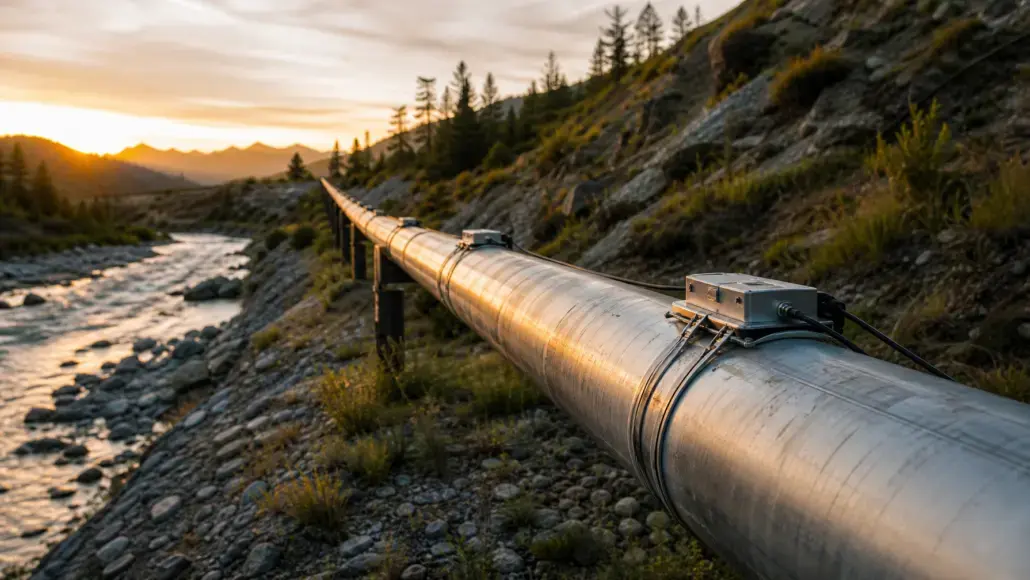
During new construction, operators achieve optimal results by strapping strain sensing cables directly to the pipe steel or factory coating prior to backfilling. Placing cables at the crown or flanks of the pipe ensures direct mechanical strain transfer from the steel cylinder to the optical fibers. For existing lines where excavating long distances is cost-prohibitive, operators repurpose telecommunication fiber in parallel conduits for distributed acoustic intrusion sensing.
Engineers design optical monitoring networks around specific optical loss budgets and physical interrogator placement:
- Deploying high-end Distributed Acoustic Sensing interrogators capable of monitoring 50 to 70 kilometers of fiber bidirectionally from a single equipment shelter.
- Configuring Distributed Strain Sensing interrogators in closed-loop configurations to achieve continuous measurement across spans exceeding 80 kilometers.
- Installing armoured, rodent-resistant cable jackets with steel wire braiding to prevent subterranean wildlife damage and mechanical crushing during backfill compaction.
- Integrating optical amplification repeaters at automated block valve stations to maintain signal-to-noise ratios across vast cross-country pipeline networks.
These engineering provisions ensure that optical pulses maintain high signal integrity across decades of continuous subterranean exposure.
Pipeline Leak Detection and Third-Party Interference Prevention
Third-party mechanical damage remains a leading cause of pipeline ruptures worldwide. Standard supervisory control and data acquisition systems typically detect leaks only after significant mass imbalances register across regional metering stations. In contrast, distributed acoustic systems identify mechanical intrusion before the pipe wall is breached.
When an excavator bucket scratches the ground surface or heavy tracked machinery enters the protected pipeline right-of-way, the soil transmits characteristic seismic vibrations to the optical fiber. Interrogator algorithms analyze the frequency spectra, identifying specific mechanical signatures such as drilling, digging, or heavy vehicle movement up to several meters away. The monitoring platform alerts pipeline dispatchers instantly, transmitting GPS coordinates to local patrol teams to halt unauthorized excavation before contact occurs.
If a pressurized pipeline suffers a pinhole leak or crack, the escaping fluid generates distinct acoustic and thermal phenomena:
- High-pressure gas discharge produces high-frequency orifice hiss and soil turbulence that acoustic interrogators register within seconds.
- Expanding gas causes rapid localized chilling through the Joule-Thomson effect, creating a sharp cold spot that temperature monitoring channels detect immediately.
- Pressurized liquid releases saturate the surrounding backfill, damping ambient acoustic noise and creating localized thermal anomalies that highlight leak boundaries.
Because distributed optical sensing monitors the entire pipeline span simultaneously, it pinpoints small product releases that fall well below the detection limits of conventional mass-balance computational leak detection systems.
Monitoring Geohazards and Dynamic Ground Movement
Climate-induced geohazards, including flash floods causing riverbed scouring, permafrost thaw degradation, and heavy rainfall triggering mountain landslides, represent escalating threats to midstream infrastructure. When shifting soils displace a buried pipe, the asset experiences dangerous tensile and compressive bending forces.
Deploying distributed strain sensing cables provides engineering teams with an early warning system against geohazard failures. Specialized strain cables are tightly bonded to the external pipe coating at the three, nine, or twelve o’clock positions using structural adhesives or strapping bands. As soil movement displaces the pipe, the strain is transferred directly from the steel wall through the coating into the glass fiber core.
Interrogator units calculate continuous micro-strain profiles along kilometers of pipeline traversing unstable slopes. When cumulative ground shifts push pipeline longitudinal bending strain toward critical design thresholds defined by engineering standards, the system triggers automated maintenance alerts. Field crews can excavate the unstable slope, relieve trapped mechanical stresses, and reinforce the right-of-way long before excessive deformation causes pipeline buckling or weld tearing.
Executing continuous fibre optic structural integrity monitoring across vulnerable mountain crossings protects capital investments from unpredictable geotechnical earth shifts.
Managing Signal Data and Minimizing False Alarms
Operating distributed fibre optic systems across hundreds of kilometers of remote transmission lines generates petabytes of raw optical data. Early commercial installations often overwhelmed pipeline control rooms with nuisance alarms triggered by ambient highway traffic, agricultural tractors, low-flying aircraft, or torrential rainstorms.
Modern systems resolve these operational challenges by deploying advanced edge-computing processors paired with deep learning classification models. Interrogator units execute initial signal filtering at the local equipment cabinet, using spatial-temporal algorithms to distinguish benign ambient noise from genuine structural threats:
- Convolutional neural networks trained on extensive field sound libraries classify machinery noise, ignoring agricultural plowing while flagging stationary digging.
- Multi-zone classification thresholds adjust sensitivity dynamically, permitting higher vibration tolerances near highway crossings while maintaining maximum sensitivity across secluded river banks.
- Pattern-matching routines correlate acoustic transient signals with localized temperature deviations, verifying leak events before escalating critical alarms.
These artificial intelligence filters ensure that pipeline operators receive high-confidence, actionable incident alerts that prevent alarm fatigue in control centers.
Continuous external strain measurements validate pipeline stability in geohazard zones, yet structural resilience ultimately depends on initial construction joint quality verified by Automated Ultrasonic Testing for Pipeline Girth Weld Inspection before pipes enter service.
Integrating continuous optical monitoring into pipeline integrity programs bridges the operational divide between construction quality assurance and long-term asset operation. By delivering instantaneous detection of third-party threats, geohazard strain, and product releases, fibre optic structural integrity monitoring empowers operators to safeguard public safety, reduce operational liabilities, and guarantee reliable energy transmission across critical infrastructure corridors.
