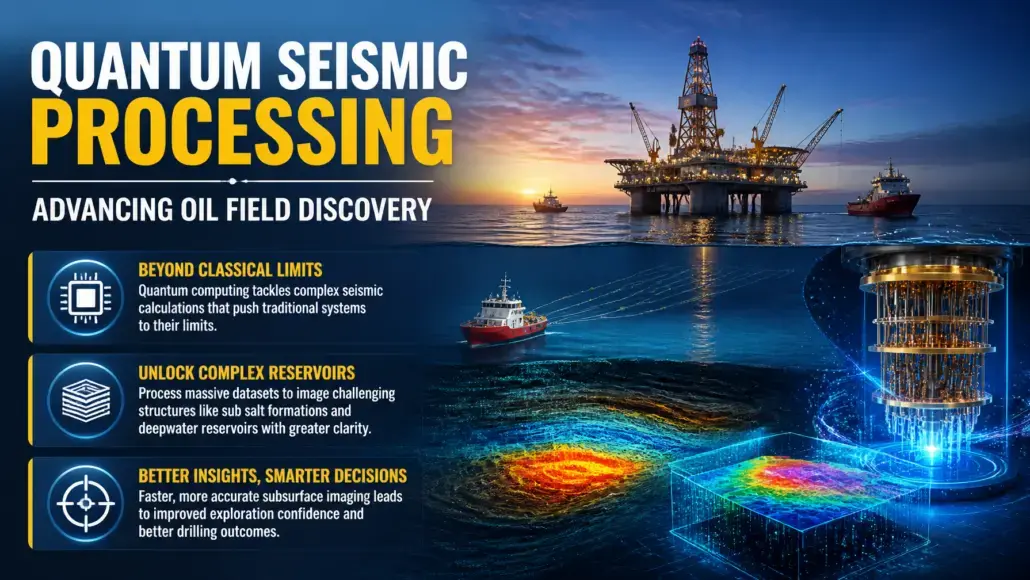
The search for new oil and gas reserves has entered a phase where traditional computing power is increasingly meeting its limits. As exploration moves toward more complex geological structures such as sub salt formations and deepwater reservoirs, the sheer volume of data required for accurate imaging has skyrocketed. This has led to a growing interest in quantum seismic processing, a field that leverages the unique properties of quantum mechanics to solve computational problems that are practically impossible for classical computers to handle. Oil & Gas Advancement observes that by applying quantum algorithms to seismic data, energy companies are significantly reducing the time required for reservoir data analysis and improving the accuracy of their discovery efforts.
Quantum computing offers a new way to process seismic waveforms and build highly detailed models of the earth’s subsurface. Unlike classical bits that represent either a zero or a one, quantum bits or qubits can exist in a superposition of states. This allows quantum systems to perform multiple calculations simultaneously, providing a massive speedup for the complex matrix operations involved in seismic imaging.
For the upstream sector, this means the difference between waiting months for a processed seismic volume and receiving actionable insights in a matter of days. This acceleration in processing speed is a critical component of energy sector innovation as the industry strives to optimize resource allocation and minimize the risk of dry holes.
The precision of quantum algorithms is often complemented by real time insights from
nanotech reservoir sensors, which provide the granular fluid flow data needed to verify seismic models.
Accelerating Reservoir Data Analysis
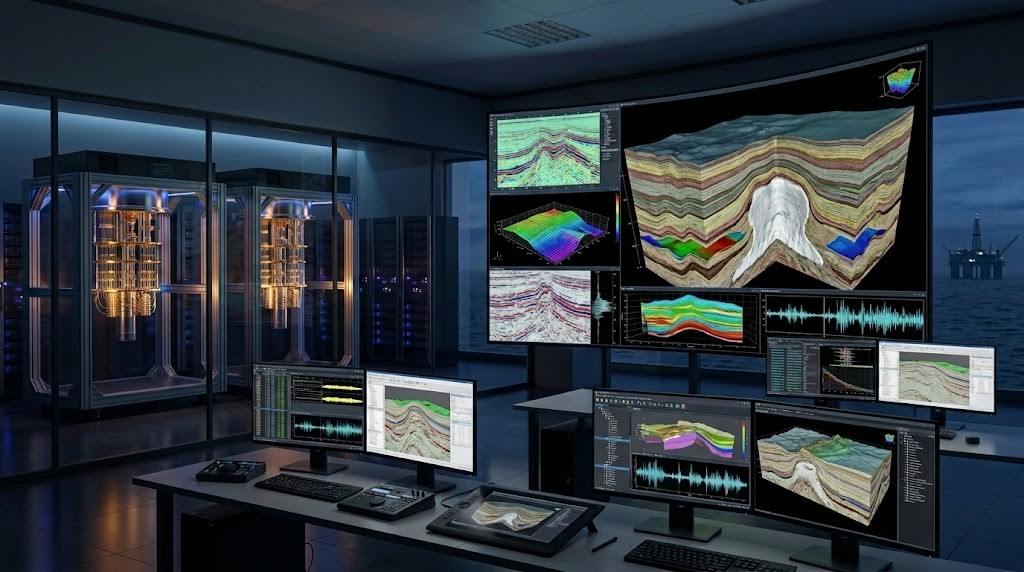
The core value of quantum seismic processing lies in its ability to handle the non linear nature of seismic wave propagation through diverse rock layers. Classic seismic algorithms often rely on approximations and simplifications to manage the computational load, which can lead to inaccuracies in the final image. Quantum algorithms, however, are better suited to simulate the physics of the subsurface with high fidelity. This allows geophysicists to identify subtle features in the reservoir such as fracture networks and fluid boundaries that might be missed by conventional methods.
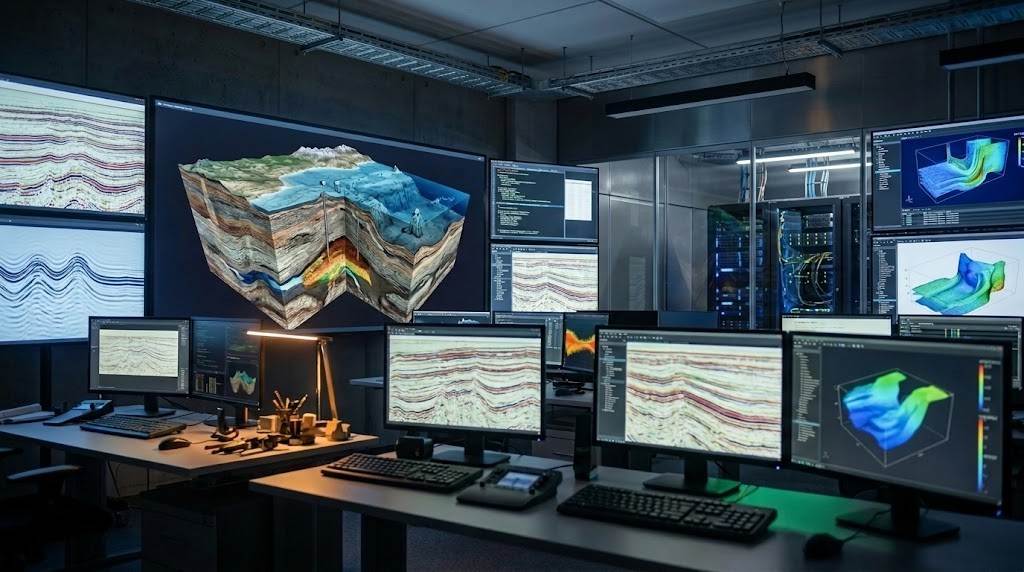
Detailed reservoir data analysis is essential for planning the optimal placement of wells and maximizing the recovery factor of a field. When quantum systems are used to process 4D seismic data—which tracks changes in the reservoir over time—the resulting models provide a far more accurate view of how fluids are moving within the formation. This level of detail is invaluable for enhanced oil recovery operations where the cost of intervention is high. By getting a clearer picture of the subsurface, operators can make better decisions about where to inject water or gas to maintain reservoir pressure and sustain production levels.
The integration of quantum sensors is also playing a role in this technological shift:
-
These sensors provide incredibly precise measurements of the earth’s properties, creating even larger and more complex datasets that require the processing power of quantum computers to interpret.
-
The synergy between quantum sensing and quantum processing is creating a more holistic and accurate approach to subsurface exploration.
Enhancing Seismic Algorithms for Deepwater Discovery
Deepwater exploration is one of the most challenging areas for seismic imaging due to the presence of thick salt layers that distort the seismic signal. Traditional imaging techniques often struggle to see through these salt bodies, leading to a high degree of uncertainty in the interpretation of the reservoir. Quantum seismic processing is showing great promise in overcoming these challenges by enabling more sophisticated migration algorithms that can handle the extreme variations in velocity found in sub salt environments.
By utilizing quantum gates to perform computations, these algorithms can more effectively disentangle the complex echoes reflected from deep geological layers. This results in sharper images with better resolution, allowing exploration teams to identify potential traps with greater confidence. The ability to reduce the uncertainty in deepwater drilling is a major driver of cost reduction for the industry.
Considering that a single deepwater exploration well can cost well over 100 million dollars, even a small improvement in discovery rates can have a massive impact on the bottom line of an energy company.
As the industry continues to advance its oil discovery tech, the focus is shifting toward hybrid computing models:
-
These models combine the strengths of classical high performance computing with the specialized capabilities of quantum processors.
-
In this setup, the heavy lifting of data preparation and pre processing is handled by traditional supercomputers, while the most computationally intensive parts of the seismic imaging task are offloaded to a quantum device.
-
This approach allows companies to begin reaping the benefits of quantum computing today even as the hardware continues to mature and scale.
The Role of Upstream Digitalization
The adoption of quantum seismic processing is a key part of the broader upstream digitalization trend. This trend is characterized by the use of data driven technologies to improve every aspect of the oil and gas value chain from exploration to production. Companies are building digital twins of their reservoirs that are constantly updated with new data, and quantum computing is providing the engine that powers these complex simulations. The goal is to move from static models to dynamic and predictive systems that can respond to changes in real time.
Addressing the Computational Bottleneck in Energy Production
As the energy transition progresses, the industry is focused on finding and producing hydrocarbons more efficiently than ever before. This requires a deeper understanding of the reservoirs we are currently producing from as well as a more efficient way to find new ones. The computational bottleneck has always been a limiting factor in how much detail geophysicists can extract from their data. Quantum seismic processing is finally beginning to break through this bottleneck, allowing for more comprehensive simulations of seismic surveys.
This is particularly important for regional exploration where massive areas need to be screened for potential prospects. Conventional computing often requires companies to sacrifice resolution to process these large volumes in a reasonable timeframe. Quantum systems can handle the increased dimensionality of regional datasets without a significant loss in performance. This allows for a more thorough evaluation of exploration blocks and a more strategic approach to acreage acquisition.
The economic implications of faster oil discovery are significant:
-
The sooner a discovery can be appraised and brought online, the higher the net present value of the project.
-
In a market where speed to first oil is a major competitive advantage, the time savings provided by quantum processing are a valuable asset.
-
This is why many national oil companies and international majors are racing to secure access to quantum hardware and develop proprietary algorithms that are tailored to their specific geological challenges.
Overcoming Hardware Limitations in Quantum Computing
While the potential of quantum seismic processing is clear, there are still significant hardware challenges that need to be addressed. Current quantum computers are relatively small and susceptible to noise, which can introduce errors into the calculations. This has limited the size of the seismic problems that can be solved on current hardware. However, the field is advancing rapidly, with improvements in qubit quality and error correction techniques bringing us closer to the era of fault tolerant quantum computing.
In the meantime, the industry is focusing on quantum inspired algorithms that can run on classical hardware:
- These algorithms use the mathematical principles of quantum mechanics to improve the performance of traditional seismic processing tasks.
- While they do not provide the full exponential speedup of a true quantum computer, they offer significant performance gains over standard classical methods.
- This allows companies to begin developing the software and expertise they will need for the future while gaining immediate benefits in their daily operations.
The collaboration between energy companies and quantum hardware providers is essential for driving the technology forward. By providing real world datasets and specific use cases, the oil and gas industry is helping to shape the development of quantum processors that are optimized for industrial applications. This partnership is a prime example of energy sector innovation, where the needs of a traditional industry are driving the boundaries of the most advanced science.
Quantum Computing Deployment Across Global Energy Leaders
In response to the computational limits of classical supercomputers in seismic wave modeling and subsurface imaging, global energy giants and major industrial technology providers have actively transitioned quantum algorithms from theoretical research into operational exploration workflows.
Over the past two years, energy majors including Saudi Aramco, bp, and Eni have established direct collaborations and dedicated quantum subsidiaries to tackle complex geophysical optimization, subsurface mapping, and wave physics simulations. Supported by specialized enterprise technology developers like Quantinuum and D-Wave Quantum, these initiatives deploy hybrid classical-quantum computing frameworks to accelerate seismic migration, refine well-placement and reservoir monitoring strategies, and drive upstream digitalization.
The Future of Subsurface Discovery
Looking ahead, we can expect to see quantum seismic processing become a standard part of the exploration workflow. As the hardware becomes more robust and the algorithms more sophisticated, the ability to image the subsurface with near perfect clarity will fundamentally change how we find energy resources. We may even see the development of real time seismic imaging during drilling, where quantum systems process data from sensors in the bit to provide an immediate view of the formation ahead.
This level of insight will not only make exploration more efficient but also more sustainable.
By understanding the reservoir in such high detail, companies can reduce the number of wells needed to develop a field and minimize the risk of environmental incidents.
The ability to accurately predict the behavior of the subsurface is the ultimate goal of geophysics, and quantum computing is the most powerful tool we have ever had to reach that goal.
The growth of the digital transformation market in the oil and gas industry shows no signs of slowing down. Oil & Gas Advancement believes that quantum seismic processing will be at the heart of this transformation, providing the computational foundation for a new era of discovery. The companies that successfully integrate these technologies today will be the ones that lead the industry in the decades to come.
References
- Aramco
- bp
- Eni S.p.A
- Quantinuum