








The oversight of transcontinental pipeline networks has historically been a logistical nightmare. With assets stretching across thousands of miles of diverse geography—from frozen tundras to scorching deserts—maintaining a constant eye on the infrastructure was practically impossible. Traditional ground patrols and low-altitude flights provided only a snapshot in time, leaving vast gaps in both space and frequency. However, the advent of high-resolution orbital platforms has changed the game. Oil & Gas Advancement notes that satellite monitoring for pipeline surveillance is now providing the big picture necessary to manage these critical assets with a level of precision and scale that was once the stuff of science fiction, enabling a truly global approach to infrastructure security.
The Vantage Point of Space: A Global Perspective
The fundamental advantage of satellite monitoring for pipeline surveillance is its ability to cover enormous areas without the need for on-the-ground presence. Modern satellite constellations can provide daily revisits to any point on Earth, allowing operators to detect changes in the pipeline right-of-way (ROW) almost as they happen. Whether it is a new construction project encroaching on the safety zone, a landslide triggered by heavy rain, or a subtle change in vegetation indicating a subsurface leak, the view from space captures it all. This comprehensive surveillance is particularly vital for pipelines in geopolitically sensitive or physically inaccessible regions where manual monitoring is simply not an option.
SAR Imaging: Seeing Through Clouds and Darkness
One of the most powerful tools in the satellite monitoring for pipeline surveillance toolkit is Synthetic Aperture Radar (SAR). Unlike optical cameras, SAR uses radar pulses that can penetrate clouds, smoke, and even total darkness. This ensures that surveillance remains uninterrupted regardless of weather conditions or time of day. SAR is exceptionally sensitive to ground deformation; it can detect subsidence or heave of just a few millimeters. For pipeline operators, this is an early warning system for geohazards. If the ground under a pipeline starts to shift due to permafrost melt or seismic activity, SAR can detect the movement weeks before a physical rupture occurs, allowing for preemptive stabilization.
Hyperspectral Sensing and Methane Leak Detection
Beyond visual surveillance, the use of hyperspectral and multispectral sensors is revolutionizing environmental compliance. Satellite monitoring for pipeline surveillance now includes the ability to see methane—a potent greenhouse gas that is invisible to the naked eye. Specialized satellites can detect the unique spectral signature of methane plumes escaping from the infrastructure. This allows companies to identify super-emitters and small, chronic leaks across their entire network from space. By providing quantifiable data on emissions, satellite platforms are becoming an essential tool for companies aiming to meet international climate commitments and internal ESG goals.
Geospatial Analytics and Encroachment Monitoring
Third-party interference, such as unauthorized digging or construction, is a leading cause of pipeline accidents. Traditional monitoring often misses these activities until it is too late. Satellite monitoring for pipeline surveillance uses automated geospatial analytics to identify new objects or features within the pipeline’s protected corridor. AI algorithms compare current images with historical baselines, flagging any new vehicles, structures, or excavations. This automated alerting system allows operators to dispatch security or maintenance crews to the exact coordinates of the potential threat, preventing damage before it ever reaches the pipe itself.
Monitoring Vegetation Health as a Proxy for Integrity
An ingenious application of remote sensing is the monitoring of Normalized Difference Vegetation Index (NDVI). Vegetation over or near a pipeline is highly sensitive to the presence of hydrocarbons in the soil. Even a tiny, non-pressure-dropping leak can affect the health of local flora. Satellite monitoring for pipeline surveillance can detect these stressed vegetation patches through spectral analysis. If a section of grass or forest along the pipeline route begins to brown or wither in a pattern that does not match the surrounding area, it serves as a strong indicator of a subsurface leak. This biological early warning allows for the detection of slow leaks that traditional pressure sensors often miss.
Integration with the Digital Twin Ecosystem
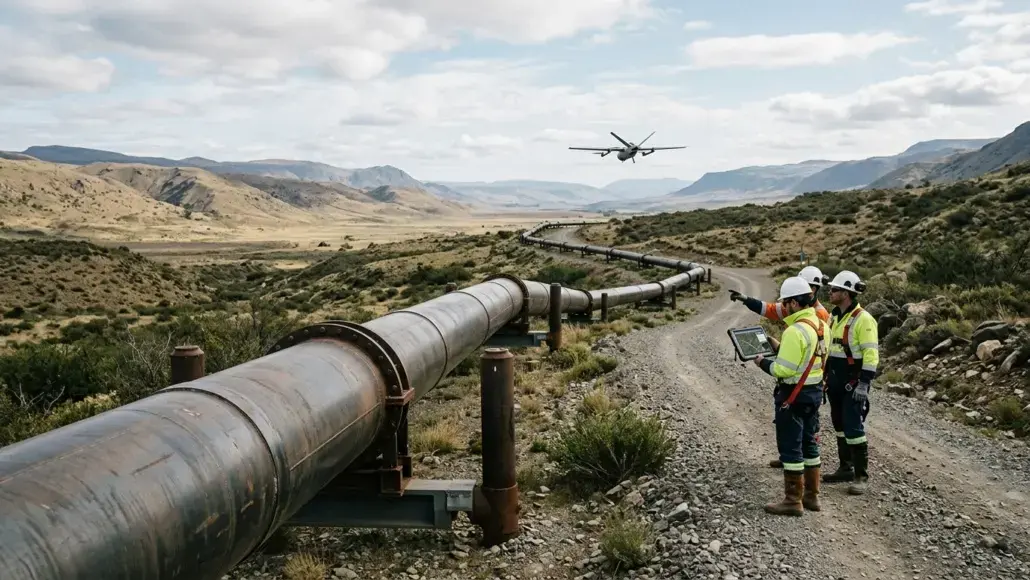
The true power of satellite monitoring for pipeline surveillance is realized when it is integrated into a company’s Digital Twin or Asset Management System. Orbital data is not intended to replace ground sensors but to complement them. By feeding satellite-derived geohazard risks, encroachment alerts, and methane detections into a centralized AI model, operators can create a multi-layered view of risk. This allows for a more intelligent allocation of resources—sending a drone for a closer look or a technician for a physical repair only when the fused data from space and ground confirms a high-probability event.
Beyond incident response, Digital Twin technology continuously updates the virtual representation of the pipeline using real-time and historical information from satellites, IoT sensors, inspection reports, and operational databases. This enables predictive simulations that assess how changing weather patterns, ground movement, corrosion, or nearby construction activities could affect future pipeline performance. Maintenance teams can prioritize repairs based on risk rather than fixed schedules, while decision-makers gain a comprehensive operational dashboard that supports faster planning, improved asset lifecycle management, and more cost-effective investments. The result is a resilient, data-driven pipeline network capable of adapting to evolving operational and environmental challenges.
Conclusion
As pipeline networks continue to expand across increasingly remote and environmentally sensitive regions, the role of satellite monitoring for pipeline surveillance is becoming indispensable for safe and efficient operations. By combining remote sensing, satellite imaging, and advanced geospatial analytics, operators gain continuous visibility over thousands of kilometers of critical infrastructure without the limitations of traditional inspection methods. This capability enables faster leak detection, improved pipeline integrity assessments, and more effective monitoring of geohazards, unauthorized activities, and environmental changes that could threaten operational reliability.
The integration of satellite-derived intelligence with AI, IoT-enabled field sensors, drones, and digital twin platforms is creating a new generation of smart pipelines that can anticipate risks rather than simply respond to failures. This predictive approach not only reduces maintenance costs and operational downtime but also strengthens infrastructure security, minimizes environmental impact, and supports compliance with increasingly stringent regulatory and ESG requirements. Oil & Gas Advancement believes that as satellite technology continues to deliver higher-resolution imagery, more frequent revisit times, and enhanced sensing capabilities, it will become an even more valuable component of modern pipeline monitoring strategies. Organizations that embrace these innovations will be better positioned to protect their oil and gas infrastructure, improve operational resilience, and ensure the safe, sustainable transport of energy resources in an increasingly data-driven and environmentally conscious industry.
