












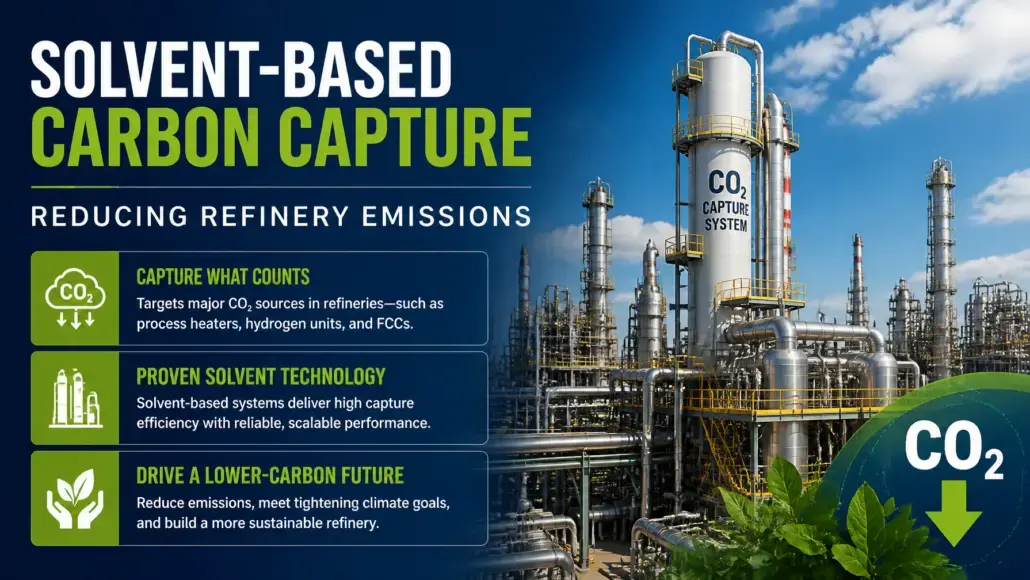
The refining industry is one of the largest industrial emitters of carbon dioxide, with emissions originating from a diverse array of point sources including fluid catalytic crackers, hydrogen production units, and process heaters. As global climate targets become more stringent, the adoption of refinery carbon capture integration has become a strategic necessity for operators looking to mitigate their environmental impact. Among the various technologies available, solvent-based carbon capture remains the most mature and widely deployed solution, offering the ability to capture 90 percent or more of the CO2 from flue gas streams without requiring major modifications to the underlying refinery processes.
In 2026, the focus has shifted from small-scale pilot projects to the integration of gigawatt-scale capture systems. These projects are essential for refineries to comply with emerging carbon tax regimes and to maintain their social license to operate. Oil & Gas Advancement observes that the global market for carbon capture, utilization, and storage (CCUS) is seeing unprecedented growth, with dozens of large-scale projects reaching final investment decisions in the last two years. This acceleration is driven by improvements in solvent chemistry that have significantly reduced the energy penalty associated with capturing and compressing CO2.
Advanced Solvent Chemistry and Energy Efficiency
The core of a solvent-based capture system is the chemical solvent used to absorb CO2 from the flue gas. Traditional amine-based solvents, such as monoethanolamine (MEA), have been used for decades but suffer from high energy requirements for regeneration and issues with chemical degradation. Modern refinery carbon capture integration strategies now utilize advanced, proprietary solvents that are more stable and require up to 30 percent less energy. These newer solvents operate at higher concentrations and have a higher CO2 loading capacity, which allows for the use of smaller and more cost-effective absorption columns.
In late 2025, researchers at major global chemical firms announced the development of water-lean solvents that further reduce the heat required for CO2 stripping. By minimizing the amount of water in the solvent mixture, the energy spent on heating and cooling water is significantly lowered. This technical breakthrough is critical for refineries, where the availability of low-cost steam is often a limiting factor for CCUS integration. Furthermore, these advanced solvents are designed to be less corrosive, which extends the life of the capture equipment and reduces long-term maintenance costs.
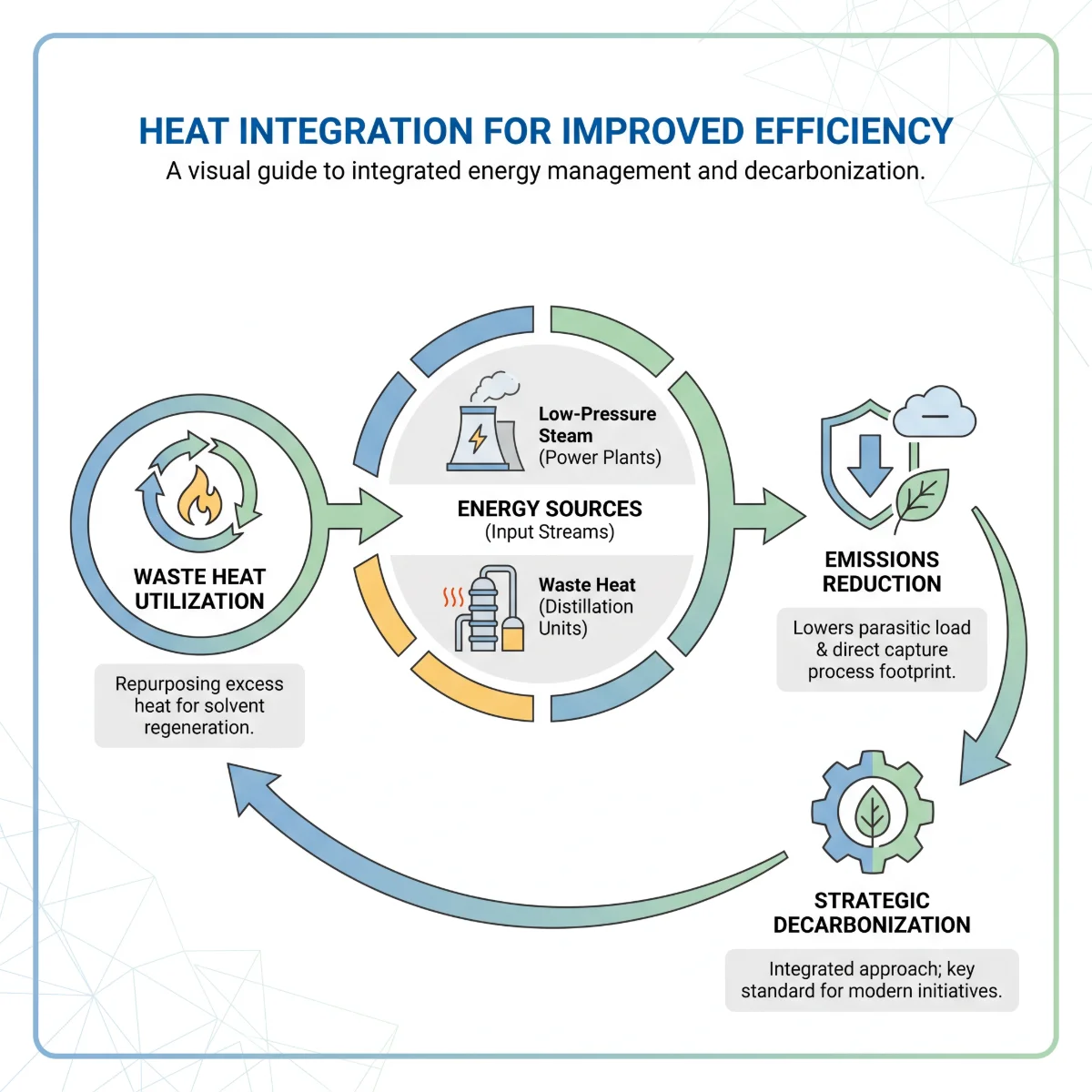
The integration of heat integration techniques also plays a vital role in improving overall efficiency:
- Waste heat utilization: Refiners are repurposing excess heat across plant operations to supply the energy required for solvent regeneration.
- Energy sources: Common thermal streams routed to the carbon capture system include low-pressure steam from power plants and waste heat from distillation units.
- Emissions reduction: Sourcing internal energy lowers the parasitic load and direct carbon footprint of the capture process itself.
- Strategic decarbonization: This integrated approach to energy management is a key standard in modern downstream decarbonization initiatives.
Strategic Deployment Across Multiple Point Sources
Refineries are complex facilities with dozens of individual stacks, making a single one-size-fits-all capture solution impractical. Leading refinery carbon capture integration strategies involve a prioritized approach, starting with the largest and most concentrated emission sources. The fluid catalytic cracking (FCC) unit and the hydrogen production unit are typically the first candidates for capture because they produce high volumes of CO2 at relatively high concentrations, which improves the economics of the capture process.
However, capturing emissions from smaller, distributed sources like process heaters and boilers remains a challenge. To address this, some refiners are exploring the use of modular, skid-mounted capture units that can be deployed at multiple locations across the plant. These modular systems can be manufactured in a controlled factory environment and then shipped to the refinery for rapid installation. This approach reduces onsite construction time and allows for a more flexible scaling of the capture capacity as the refinery’s needs evolve.
The integration of these capture systems is also a foundational requirement for successful advanced blue hydrogen refinery integration for goals in the downstream sector. By capturing the CO2 from the steam methane reforming process, refiners can produce the low-carbon hydrogen needed for hydrotreating while simultaneously reducing their total facility emissions. This synergy between hydrogen production and carbon capture is a key driver for investment in integrated low-carbon energy hubs.
Global Company Developments in Solvent-Based Capture
Major global energy and technology companies are at the forefront of the CCUS revolution, developing new technologies and partnering with refiners to deploy them at scale.
- Shell: The company’s CANSOLV technology is one of the most widely used solvent-based carbon capture systems in the world. In 2025, Shell announced a series of new contracts to deploy CANSOLV at refineries in North America and Asia, citing the technology’s ability to handle the complex flue gas compositions found in downstream environments.
- Aker Carbon Capture: In early 2026, Aker Carbon Capture reported significant progress on its “Just Catch” modular units, which are designed for mid-sized industrial emitters. Several European refineries have selected Aker’s technology for its low environmental footprint and ease of integration.
- Mitsubishi Heavy Industries (MHI): MHI continues to dominate the high-capacity capture market with its KS-1 and KS-21 solvents. Throughout 2025, the company has been working with major oil firms to design capture systems for some of the world’s largest refining complexes, aiming for capture capacities exceeding 1 million tons of CO2 per year.
- TotalEnergies: The company is integrating solvent-based carbon capture into several of its flagship decarbonization projects. In late 2025, TotalEnergies confirmed that it is evaluating the integration of MHI’s capture technology at its Antwerp refinery as part of the broader Antwerp@C initiative.
- Equinor: As a leader in carbon storage, Equinor is a key partner for refiners looking to sequester their captured CO2. In 2026, the company’s Northern Lights project is providing the critical infrastructure needed for several European refineries to begin their carbon capture journeys.
These developments highlight a robust ecosystem of technology providers and operators working together to make refinery carbon capture integration a commercial reality.
Overcoming Infrastructure and Logistical Barriers
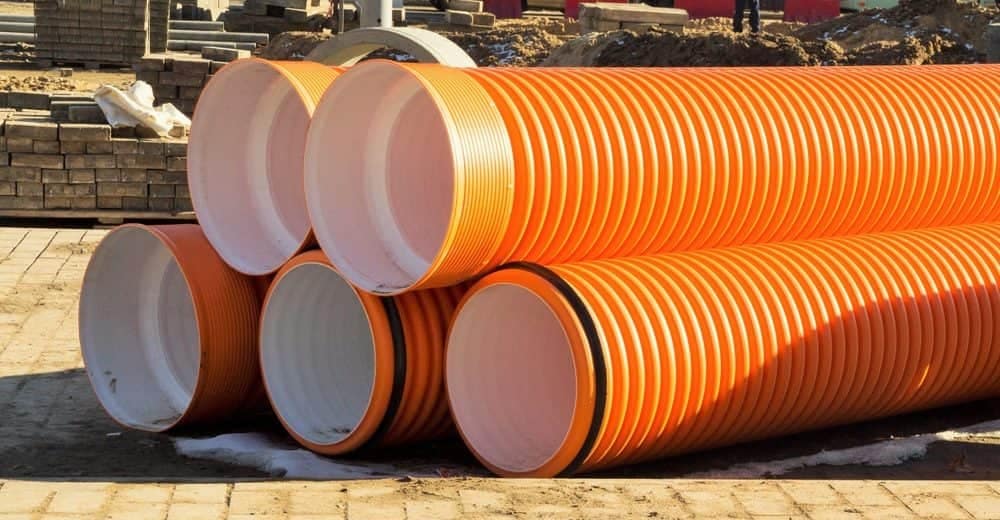
Capturing the CO2 is only half the battle. Once the carbon is captured and compressed, it must be transported to a suitable storage site. The lack of a comprehensive CO2 pipeline network is currently the biggest bottleneck for CCUS in many regions. To overcome this, many refiners are advocating for the creation of regional carbon hubs where multiple industrial emitters share the cost of pipeline infrastructure. This model is already being successful in the United States Gulf Coast and the North Sea region.
Shipping is also emerging as a viable alternative to pipelines for transporting CO2 over long distances. In 2025, the first specialized CO2 carriers began operations, providing refiners in coastal areas with access to remote offshore storage sites. This flexibility is particularly important for refineries in regions where onshore storage is socially or geologically difficult. The development of a global CO2 shipping market will be essential for the widespread adoption of CCUS in the downstream sector.
Refiners also face logistical challenges related to the supply of chemical solvents:
- High solvent volume requirements: Large-scale systems can require thousands of tons of solvent, requiring safe transport, storage, and handling protocols.
- Degradation waste management: Byproducts from solvent degradation must be disposed of in an environmentally sound manner.
- Integrated solvent planning: Modern refinery carbon capture strategies incorporate comprehensive solvent management plans.
- Chemical recovery and recycling: Systems prioritize recovering and recycling chemicals to reduce the overall environmental impact of the capture process.
The Economic Case for Carbon Capture
The economics of carbon capture have improved dramatically over the last two years. While the capital cost remains high, the operational cost is being offset by a combination of government incentives and rising carbon prices. In the European Union, the price of carbon under the Emissions Trading System (ETS) has remained consistently high throughout 2025 and 2026, making the cost of inaction greater than the cost of capture for many refiners.
In the United States, the 45Q tax credit provides a significant financial incentive for every ton of CO2 captured and sequestered. This credit has been a game changer for the industry, allowing for the financing of multi-billion dollar projects that would have been unthinkable a decade ago. Similar incentives are being introduced in Canada, Australia, and parts of Asia, creating a truly global market for carbon capture technology.
Beyond direct financial incentives, CCUS integration provides refiners with a competitive advantage in a world where customers are increasingly demanding low-carbon products. By reducing the carbon intensity of their refining process, operators can sell blue or low-carbon fuels at a premium. This market-driven demand is expected to be a major force in the continued growth of refinery carbon capture integration throughout the late 2020s.
Future Innovations and the Path to Net-Zero
Looking ahead, the next generation of carbon capture technology will likely focus on non-solvent based methods such as solid adsorbents and membrane separation. While these technologies are currently less mature than solvent-based carbon capture systems, they offer the potential for even lower energy requirements and simpler integration. In 2026, several pilot projects are testing these second-generation capture methods in refinery settings, with the goal of commercial deployment by 2030.
The ultimate goal for the downstream industry is to achieve net-zero emissions, and CCUS is the most important tool for reaching that target. By integrating solvent-based carbon capture with other technologies such as industrial electrification and green hydrogen, refiners can eliminate the vast majority of their carbon footprint while continuing to provide the essential energy and chemical products that the world requires.
Oil & Gas Advancement believes that the transition is well underway, and the progress made in last few years has set the stage for a decade of rapid decarbonization. Refinery carbon capture integration is no longer a luxury for the most profitable facilities but a standard requirement for any refinery that plans to operate in the post-transition energy economy.
References
-
“State of the Art CCS Technologies 2026” – Global CCS Institute
-
“Shell CANSOLV Technology Deployment Report 2025” – Shell
-
“Aker Carbon Capture Just Catch Project Milestones” – Aker Carbon Capture
-
“2026 Global CCUS Market Outlook” – International Energy Agency
-
“Antwerp@C Project Update and Solvent Evaluation” – TotalEnergies
