




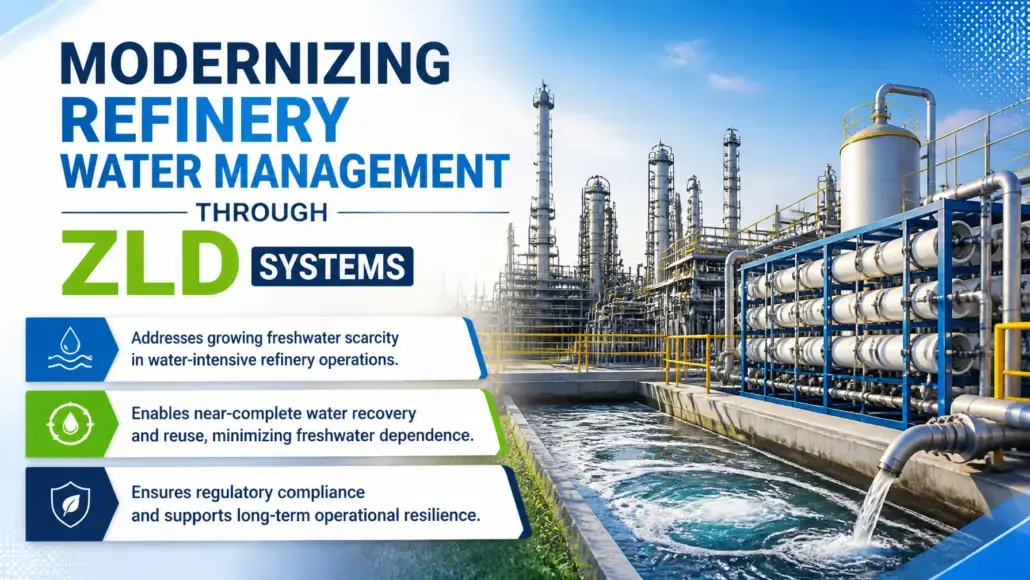
Refineries are among the most water-intensive industrial facilities, requiring vast quantities of high-purity water for cooling, steam generation, and chemical processing. In many regions, the availability of fresh water is becoming increasingly constrained due to climate change, population growth, and stricter environmental regulations. To ensure long-term operational resilience, the downstream industry is prioritizing the task of modernizing refinery water management through the implementation of zero-liquid discharge (ZLD) systems. These advanced treatment processes aim to eliminate the discharge of liquid waste into the environment by recycling and reusing every drop of water within the plant.
Oil & Gas Advancement observes that the transition to ZLD is not only an environmental imperative but also a strategic business decision. In 2026, the global market for zero-liquid discharge systems is estimated to be valued at $8.4 billion, reflecting the rapid adoption of these technologies in water-stressed areas such as the Middle East, North Africa, and parts of Asia. By 2033, the market is expected to grow to nearly $13.8 billion. For refinery operators, ZLD provides a secure and predictable water supply that is independent of local municipal sources or surface water availability, effectively de-risking the facility against future water shortages.
The Technical Evolution of ZLD in Downstream Facilities
Traditional wastewater treatment in refineries often involves primary and secondary processes designed to remove oils, solids, and biological contaminants before discharging the treated effluent into nearby water bodies. While effective for regulatory compliance, this approach represents a significant loss of potential water resources. Modernizing refinery water management involves the addition of tertiary and advanced treatment stages such as reverse osmosis (RO), ultrafiltration, and thermal evaporation. These processes can remove dissolved salts and other trace contaminants, producing a high-purity water stream that can be returned to the refinery’s cooling towers or boilers.
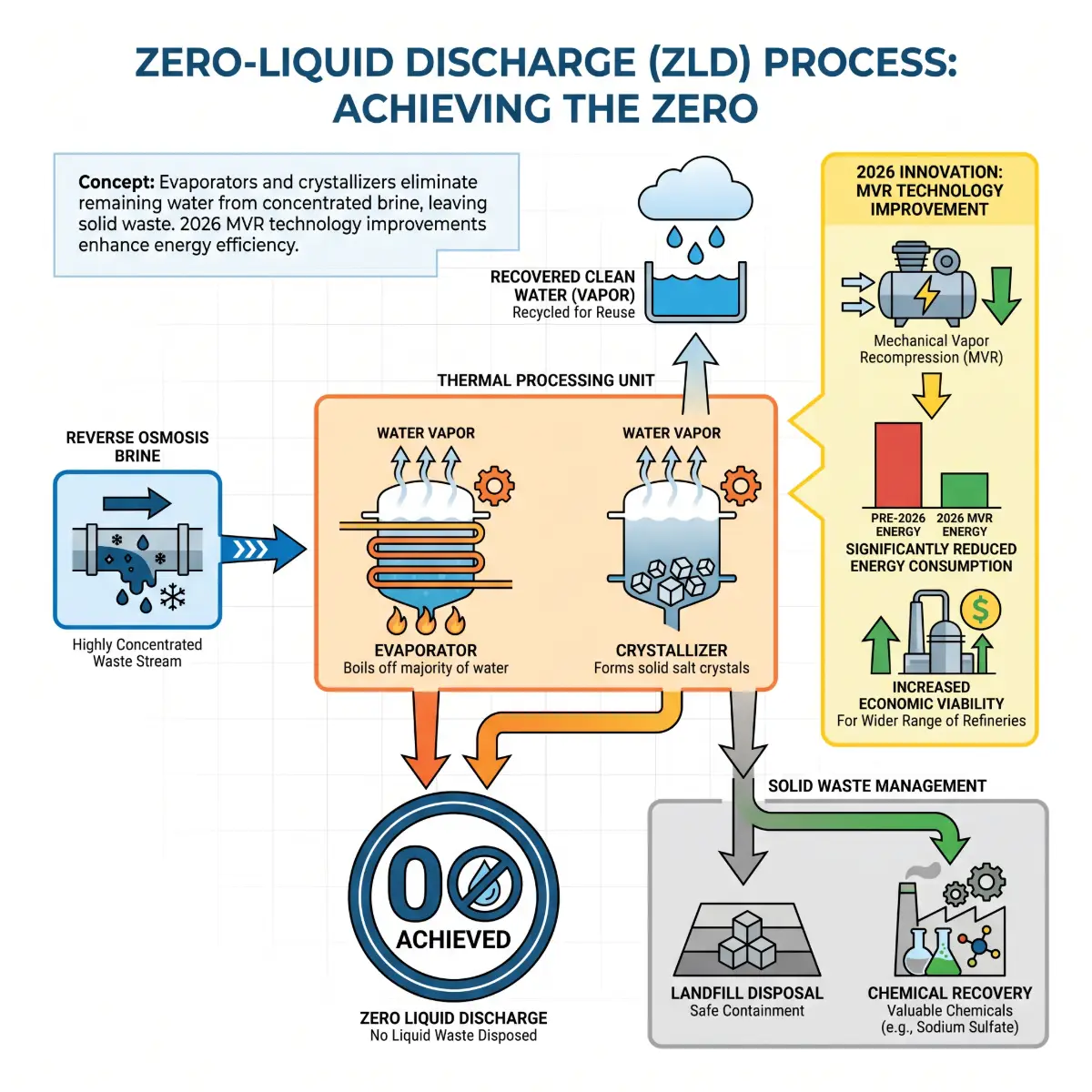
The zero in zero-liquid discharge is achieved through the use of evaporators and crystallizers. These units take the highly concentrated brine from the reverse osmosis process and evaporate the remaining water, leaving behind only solid crystals of salt and other minerals. This solid waste can then be safely disposed of in a landfill or, in some cases, processed further to recover valuable chemicals such as sodium sulfate. In 2026, improvements in mechanical vapor recompression (MVR) technology have significantly reduced the energy consumption of these thermal processes, making ZLD more economically viable for a wider range of refineries.
Furthermore, the integration of advanced sensors and AI-driven control systems is allowing for more precise management of the refinery water balance. These systems can monitor the quality and quantity of various water streams in real time, automatically adjusting the treatment processes to ensure optimal performance. This digital layer is essential for modernizing refinery water management because it allows for the dynamic reuse of water across different units, maximizing the total volume of recycled water while minimizing the need for fresh makeup water.
Strategic Drivers for Water Circularity
-
Regulatory Compliance & Risk Reduction: Eliminating liquid discharge bypasses tightening effluent standards (e.g., limits on heavy metals, persistent pollutants, and microplastics), simplifying compliance and future-proofing against stricter rules.
-
Social License to Operate: Minimizing freshwater intake eases competition with local communities and agriculture, strengthens stakeholder trust, and fulfills permit requirements for expansions in water-stressed regions.
-
Resource Recovery & Cost Offsets: Reclaimed water cuts the need for costly freshwater or desalination, while recovered byproducts (such as industrial-grade salt) create new revenue streams to offset system capital and operational expenses.
Global Company Developments in Water Management
The world’s leading water technology and energy companies are collaborating to develop and deploy the next generation of ZLD solutions for the refining industry.
- Veolia Water Technologies: In 2025, Veolia announced several new contracts for the installation of its HPD evaporation and crystallization systems at major refineries in the Middle East. The company is a global leader in ZLD and is focused on improving the energy efficiency of its thermal treatment processes.
- Suez: Now part of the Veolia group, Suez has a long history of providing advanced water treatment solutions to the oil and gas industry. Throughout 2025 and 2026, the company has been expanding its portfolio of membrane-based ZLD technologies, focusing on reducing the total cost of ownership for refinery operators.
- Saudi Aramco: As part of its broader sustainability goals, Aramco is investing heavily in water reuse and ZLD across its domestic refining network. In 2025, the company reported that it had achieved water reuse rates of over 70 percent at several of its key facilities, with a target of reaching even higher levels through the adoption of advanced ZLD systems.
- Reliance Industries: The Jamnagar refinery complex, one of the largest in the world, utilizes extensive water treatment and desalination facilities. In 2026, Reliance continues to upgrade its water management systems to improve circularity and reduce its reliance on external water sources.
- DuPont Water Solutions: The company is a leading provider of the membranes used in reverse osmosis and ultrafiltration. In late 2025, DuPont launched a new series of fouling-resistant membranes specifically designed for the challenging wastewater found in downstream operations, which is a key component for modernizing refinery water management.
These examples highlight the diverse range of technologies and strategies being used to address the water challenges facing the downstream industry.
Overcoming Energy and Cost Constraints
Despite the clear benefits, ZLD systems remain expensive and energy-intensive. The capital cost of a full-scale ZLD plant can be tens of millions of dollars, and the energy required to evaporate water can be a significant addition to the refinery’s utility bill. To mitigate these costs, refiners are exploring ways to integrate ZLD with renewable energy sources. For example, some facilities in sunny regions are using solar thermal power to provide the heat needed for evaporation, while others are using surplus wind or solar electricity to power their reverse osmosis units.
Innovation in membrane technology is also helping to reduce the cost of ZLD. High-recovery reverse osmosis systems can now achieve water recovery rates of 90 percent or more, which reduces the volume of brine that must be processed by the expensive thermal evaporators. This shift toward membrane-based concentration is significantly lowering the total energy consumption of modernizing refinery water management. In 2026, several pilot projects are testing the use of forward osmosis and electrodialysis reversal as even more efficient alternatives for brine concentration.
Refiners are also adopting more modular and phased approaches to ZLD. Rather than building a massive centralized plant, some operators are installing smaller treatment units at specific point sources within the refinery. This allows them to target the most difficult waste streams first and gradually expand the ZLD capacity as the economics improve. This modularity also makes it easier to upgrade the system as new and more efficient technologies become available.
The Role of Digital Transformation in Water Reuse
The success of any ZLD system depends on the accurate monitoring and control of the plant’s entire water network. Digital transformation is providing the tools needed to manage this complexity. Cloud-based platforms can aggregate data from thousands of water sensors across the refinery, providing a comprehensive view of the water balance. Machine learning algorithms can then analyze this data to identify leaks, predict equipment failure, and optimize the treatment processes in real time.
In 2026, several major refiners have begun using digital twins of their water systems to simulate the impact of different operating scenarios. For example, if the refinery needs to process a heavier crude slate that requires more water for desulfurization, the digital twin can predict how this will affect the ZLD system’s performance and identify any necessary adjustments. This level of foresight is essential for maintaining the stability of the water network and ensuring that the ZLD targets are met consistently.
The integration of water management with other digital initiatives is also creating new opportunities for optimization. For instance, modernizing lpg recovery units for enhanced 2026 profit can benefit from high-quality water for cooling and process requirements, further highlighting the interconnected nature of refinery utilities. By managing water, energy, and production as a single integrated system, refiners can achieve much higher levels of overall efficiency and sustainability.
Future Outlook for Refinery Water Circularity
Looking toward 2030, the vision of the water-neutral refinery is moving closer to reality. In this model, the refinery acts as a closed-loop system, with no liquid discharge and a minimal requirement for fresh water. The widespread adoption of ZLD will be a critical step in this journey, providing the technology needed to recover every drop of water from even the most challenging waste streams.
As water scarcity becomes an even more pressing global issue, Oil & Gas Advancement believes that the ability to manage water efficiently will be a key differentiator for the downstream industry. Refiners that have invested in modernizing refinery water management will be better positioned to navigate the challenges of the energy transition and to maintain their operations in an increasingly resource-constrained world. The progress made in 2025 and 2026 is just the beginning of a long-term shift toward true water circularity in the downstream sector.
References
- “2026 Global ZLD Market Valuation” – Coherent Market Insights
- “Veolia HPD Evaporation and Crystallization Contracts” – Veolia Water Technologies
- “Suez Advanced Membrane Solutions for Oil and Gas” – Suez
- “Aramco Sustainability Report: Water Reuse Targets 2025” – Saudi Aramco
- “DuPont Fouling-Resistant Membrane Launch” – DuPont Water Solutions
