

























Penetrating dense crystalline basements, abrasive volcanic sills, and ultra-hard metamorphic formations represents one of the most punishing tasks in subsurface engineering. In sectors ranging from deep geothermal energy development and deep oilfield drilling to large-scale mineral extraction, conventional rotary shearing mechanisms frequently fail when encountering compressive rock strengths exceeding thirty thousand pounds per square inch. Standard polycrystalline diamond compact and roller-cone bits experience rapid thermal degradation, impact spalling, and catastrophic cutter loss in these environments. Drilling rates of penetration collapse to just a few feet per hour, multiplying bit trips and driving daily spread costs to unsustainable levels.
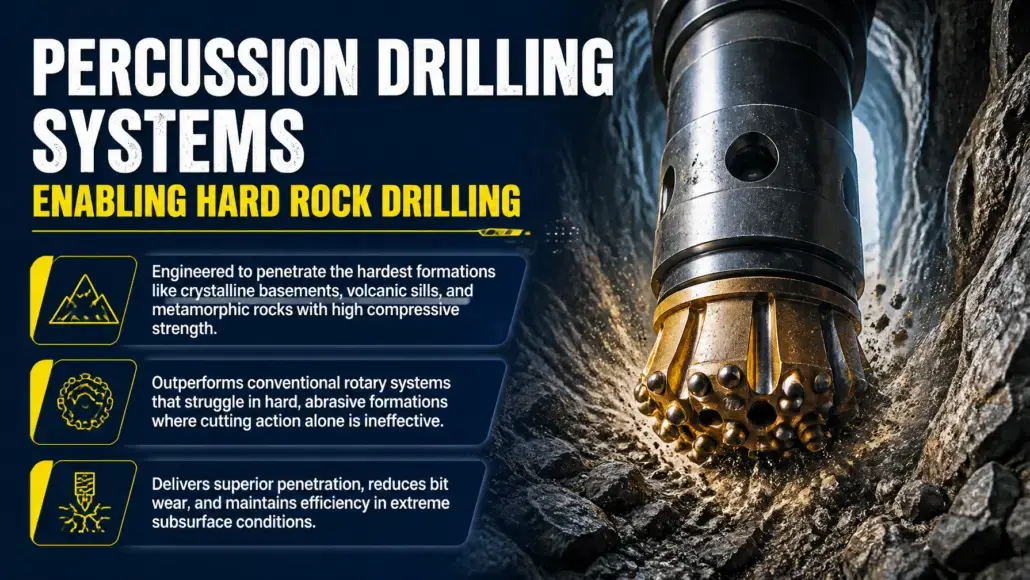
To overcome these physical limitations, operators rely on advanced percussion drilling technologies that fundamentally alter the physics of rock destruction. Rather than attempting to scrape, shear, or grind hard rock formations, percussive systems deliver rapid, high-energy axial impacts directly to the rock face. Oil & Gas Advancement observes that by subjecting the rock matrix to compressive impact loads that exceed its dynamic compressive strength, percussion systems induce crushing and micro-fracturing beneath tungsten carbide inserts. Low rotational torque is simultaneously applied to index the bit buttons to fresh rock, generating coarse cuttings with minimal energy waste and dramatically accelerating drilling velocity.
Fundamentals of Percussive Rock Destruction
The mechanical efficiency of percussive drilling rests on dynamic stress wave propagation. An internal reciprocating piston strikes an anvil or the bit shank at frequencies typically ranging from twenty to fifty Hertz in large-diameter downhole tools, and exceeding sixty Hertz in top-hammer mining systems:
- The kinetic energy of the moving piston transfers into the drill bit as a compressive stress wave, which travels through the tool body and discharges into the rock face.
- High-intensity contact stresses beneath the spherical or ballistic carbide buttons exceed the tensile and compressive thresholds of the formation, generating localized pulverized zones and radiating brittle micro-cracks.
- The subsequent reflection of the stress wave creates tensile stress fields that detach large rock chips from the crater boundary, creating clean fracture profiles.
- Fluid or compressed gas flowing through the bit face instantly flushes liberated chips up the annulus, preventing the regrinding of debris and keeping the impact zone clear.
Because percussive fracture mechanics exploit the brittle nature of hard rock, the axial bit weight required to initiate failure is substantially lower than in pure rotary drilling. Lower surface bit weight mitigates drill string deflection, improves borehole straightness, reduces cyclic fatigue on tubular connections, and preserves rig mechanical integrity.
Downhole Dynamics and Fluidic Valve Engineering
A primary technical hurdle in deep fluid-driven percussive drilling has been developing valving mechanisms capable of enduring abrasive, solids-laden drilling muds without eroding or seizing. Early mud-hammer designs utilized mechanical spring-assisted poppet valves that suffered premature fatigue failure when exposed to high circulating fluid velocities and entrained drill cuttings.
Contemporary percussion drilling technologies have largely eliminated mechanical springs, replacing them with bistable fluidic switches that exploit the Coanda effect to oscillate fluid pressure automatically:
- Coanda-effect fluidic switches divert pressurized mud streams between opposing piston channels using hydraulic pressure differentials, eliminating moving valve parts that wear out in abrasive environments.
- Symmetrical chamber geometry ensures that pressure pulses remain uniform throughout thousands of operating hours, preventing uneven piston wear and mechanical galling.
- Specialized tungsten carbide erosion sleeves line internal fluid conduits, resisting cavitation damage caused by high-velocity drilling mud containing abrasive barite and drill solids.
- Pressure-balanced seals isolate internal lubricating oils from external wellbore fluids, preventing mud contamination and extending bearing lifespans in high-temperature environments.
These hydrodynamic innovations allow downhole mud hammers to operate continuously for hundreds of circulating hours without surface maintenance, providing the reliability required for offshore deepwater and deep geothermal applications where tripping pipe costs tens of thousands of dollars per hour.
Down-The-Hole Hammers and Fluid-Driven Systems
Percussion systems are traditionally divided into pneumatic down-the-hole hammers, hydraulic top-hammers, and fluid-driven mud hammers. In shallow mining, quarrying, and geothermal top-hole operations, pneumatic down-the-hole hammers powered by high-pressure compressed air deliver outstanding penetration rates. However, as well depths extend thousands of feet into hydrocarbon reservoirs or deep geothermal formations, pneumatic systems become impractical due to hydrostatic water influxes, high backpressures, and well control limitations.
In response, deep drilling engineering has pivoted toward fluid-driven percussion drilling technologies, commonly known as mud hammers. These specialized downhole tools are powered directly by the circulating stream of drilling mud or water pumped from surface mud pumps:
- Internal fluidic valves or oscillating sleeve mechanisms alternate high-pressure fluid flow between the upper and lower piston chambers, driving the reciprocating piston against the drill bit without requiring downhole electronics.
- Operating on conventional drilling fluids allows full compatibility with standard oilfield wellhead equipment, blowout preventers, and closed-loop mud recycling systems.
- Water-hammer and mud-hammer configurations operate effectively under high hydrostatic pressures, maintaining robust impact energy even at depths exceeding ten thousand feet.
- Specialized internal flow diverters bypass excess fluid volume around the hammer mechanism, allowing drillers to optimize annular hole cleaning velocity independently of hammer operating frequency.
Mitigating Destructive Vibration for Downhole Electronics
While high-frequency impact energy shatters hard rock efficiently, the resulting axial, torsional, and lateral vibrations pose extreme hazards to downhole electronics. Sensitive accelerometers, magnetometers, and logging sensors housed in measurement while drilling assemblies can experience severe mechanical fatigue and component detachment when subjected to unmitigated percussive shock.
To solve this operational dilemma, modern bottomhole assemblies incorporate mechanical isolators, elastomeric shock absorbers, and hydraulic dampening subs placed directly above the percussion hammer:
- Multi-stage spring dampeners attenuate axial shock waves, preventing high-frequency compressive energy from propagating up the drill string into sensitive measurement subs.
- Torsional decoupling joints absorb instantaneous torque spikes caused by bit button indexing, protecting motor drives and directional steering linkages.
- Ruggedized electronic enclosures utilize specialized potting compounds and isolated mounting chassis to cushion downhole circuit boards against continuous high-G accelerations.
References
- Baker Hughes
- SLB
- Sandvik Mining and Rock Solutions
- Halliburton
