

























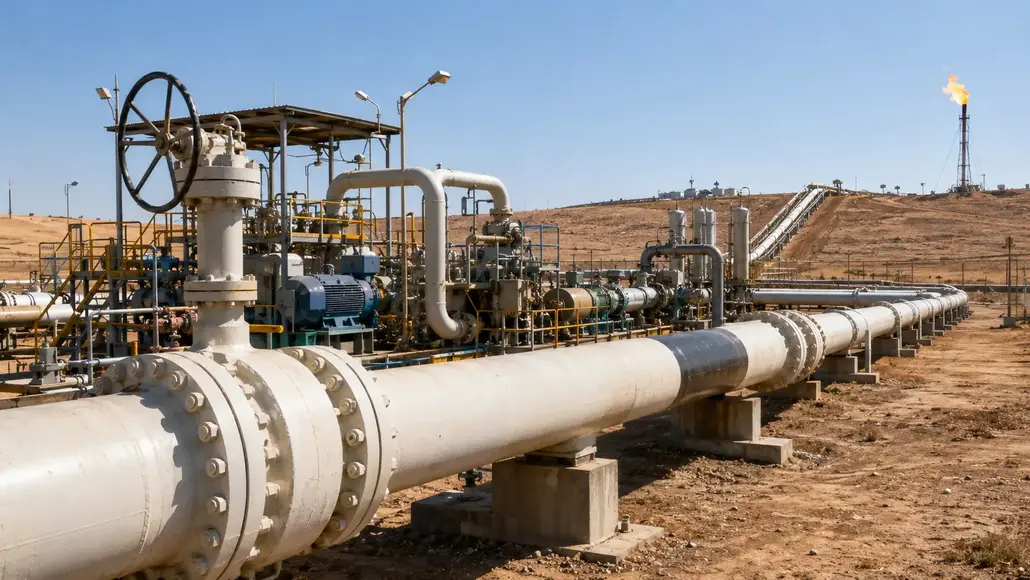
The Iraqi Ministry of Oil has announced that the crude oil pipeline connecting Kirkuk to Nineveh is expected to be fully operational by June 2026. This development is part of the broader Iraq-Turkey crude oil pipeline infrastructure that facilitates transport to the Ceyhan Port on the Mediterranean Sea.
Basim Khudair, the Oil Ministry undersecretary, stated that the Kirkuk-Nineveh pipeline, situated outside the Kurdistan Region, possesses an export capacity of up to 350,000 barrels per day (bpd). However, attaining this maximum volume is currently restricted by the limited capacity of the existing pipeline network between Basra and Kirkuk.
Baghdad is actively working to diversify its Iraq crude oil export routes following closures of the Strait of Hormuz. To address these logistical challenges in oil supplies and export routes, the ministry is prioritizing the future strategic Basra-Haditha pipeline project. Once complete, the Basra-Haditha pipeline is designed to provide significantly larger export capacity. Before ongoing events, the country maintained an export level of 3.4 million bpd, against an actual production figure of 4.2 million bpd.
The North Oil Company has resumed exports to Ceyhan through the Saralo pumping station located in the Kurdistan region. This follows an agreement with the Kurdistan Regional Government (KRG) in March 2026, allowing the federal government to utilize the export line to Fishkhabour on the Turkish border.
Current assessments indicate that the reconstruction of various segments of the Iraq-Turkey pipeline is nearing completion. While initial testing of the peipeline has commenced, technical teams anticipate that final repairs and comprehensive pressure testing on the 48-inch Baiji-Fishkhabour line will require several additional months.
The Kirkuk-Nineveh pipeline remains a critical component of these ongoing efforts to stabilize and improve national energy transport capabilities. Previous reports have confirmed that the broader Iraq-Turkey pipeline network has already undergone hydrostatic testing in preparation for the resumption of full-scale operations.
