














Türkiye’s state energy company BOTAS and Azerbaijan’s state oil company SOCAR have formalized a significant long-term natural gas supply agreement during Baku Energy Week. The deal commits to delivering a total of 33 billion cubic meters of gas from Azerbaijan to Türkiye over a 15-year period beginning in 2029. This natural gas supply agreement represents a major milestone in bilateral energy cooperation, signed alongside French energy multinational TotalEnergies and the UAE’s Abu Dhabi National Oil Company (ADNOC).
According to Türkiye’s Energy and Natural Resources Ministry, the arrangement constitutes a new phase in the established energy partnership between the two nations. The ministry emphasized that this initiative directly supports Ankara’s strategic objective to establish itself as a regional energy hub while simultaneously enhancing the energy security of Türkiye, neighboring countries, and the broader European market.
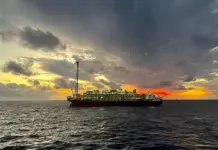
The Absheron gas-condensate field, positioned approximately 100 kilometers southeast of Baku in the Caspian Sea, stands as one of Azerbaijan’s most substantial offshore gas discoveries. The field contains an estimated 350 billion cubic meters of natural gas reserves coupled with 45 million tons of condensate. These reserves position the Absheron field as a cornerstone of Azerbaijan’s comprehensive strategy to expand gas exports to regional markets and throughout Europe.
The field initiated commercial production during 2023 under its inaugural development phase, spearheaded collaboratively by SOCAR and TotalEnergies. Planned expansion projects are anticipated to substantially elevate production volumes during the coming years, directly supporting the objectives outlined in the natural gas supply agreement signed between Türkiye and Azerbaijan.
Speaking at the opening ceremony of Baku Energy Week,Türkiye’s President Recep Tayyip Erdogan underscored the expanding energy partnership between Türkiye and Azerbaijan. He highlighted multiple landmark infrastructure projects that demonstrate the depth of bilateral cooperation, including the Baku-Tbilisi-Ceyhan oil pipeline, the Baku-Tbilisi-Erzurum gas pipeline, and the Trans-Anatolian Natural Gas Pipeline (TANAP). Erdogan also referenced ongoing collaboration in the Azeri-Chirag-Gunashli and Shah Deniz fields, along with the emerging Shafag-Asiman project, as evidence of strengthening bilateral ties. The President directed particular attention toward future opportunities for expanding cooperation on transporting Turkmen gas through Azerbaijan and Türkiye.
“There are significant opportunities ahead of us to further develop our cooperation on the export of Turkmen gas via Azerbaijan and Türkiye,” Erdogan said.
The Trans-Caspian pipeline concept, a proposal under discussion for an extended period, would facilitate the transport of Turkmen gas across the Caspian Sea to Azerbaijan. From there, gas could be directed to Türkiye and European markets through the Southern Gas Corridor framework. Though the project has not yet advanced to implementation stages, it remains a significant prospect for broadening Caspian gas exports and diversifying European energy supply channels.
Türkiye’s Energy and Natural Resources Minister Alparslan Bayraktar characterized Türkiye and Azerbaijan as exemplifying models for sustained, long-term energy cooperation. He emphasized that this partnership meaningfully contributes to the energy security interests of both nations while strengthening European energy resilience.
Bayraktar noted that the Trans-Anatolian Natural Gas Pipeline maintains substantial unused capacity and stressed the importance of optimizing existing infrastructure utilization. The minister signaled increasing momentum regarding the transportation of Turkmen gas to Türkiye and Europe through Azerbaijan.
Bayraktar further announced that Türkiye is actively pursuing additional supply agreements while concurrently expanding natural gas and electricity interconnections with neighboring countries and European partners.
