












Managing the structural integrity of extensive pipeline networks poses persistent logistical challenges for midstream operators and refinery integrity managers. Millions of kilometers of crude oil, natural gas, and refined product pipelines traverse difficult terrain, cross active highways, and run through congested refinery pipe racks. Many of these lines operate under thermal insulation or remain buried beneath reinforced concrete sleeves. Stripping hundreds of meters of insulation or excavating roadways solely to perform spot ultrasonic checks requires massive capital expenditure and prolonged traffic disruptions.
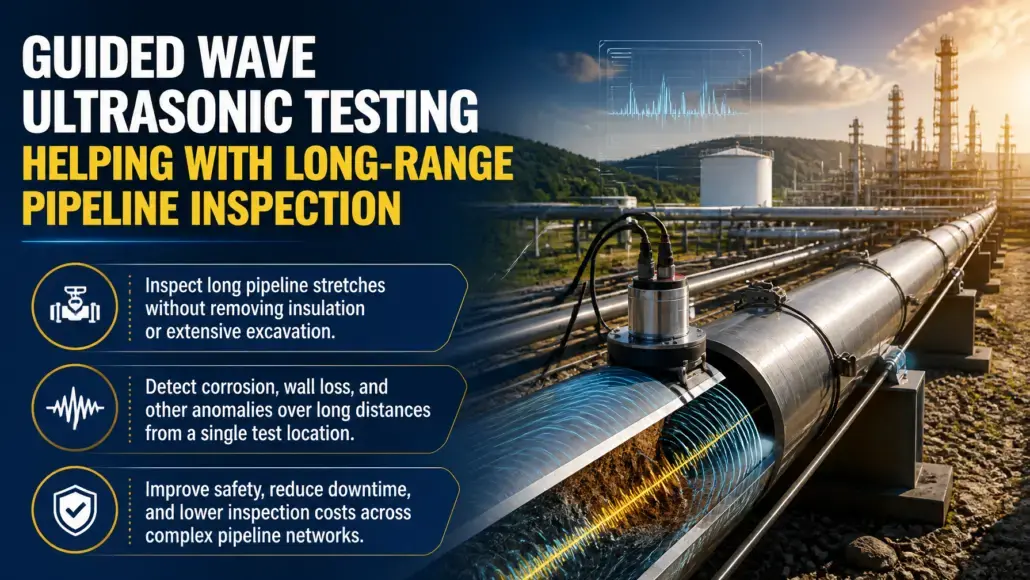
To solve this operational dilemma, the energy sector relies on guided wave ultrasonic testing as a primary screening methodology. Unlike conventional ultrasonic methods that measure wall thickness directly beneath a transducer, guided wave testing uses the physical boundaries of the pipe wall as a waveguide. A single transducer collar mounted at an easily accessible location transmits low-frequency acoustic energy tens of meters in both directions along the pipe axis. According to industry valuation data from Fortune Business Insights, the global pipeline integrity management market reached 10.65 billion dollars in 2025, driven largely by regulatory mandates requiring non-intrusive surveillance of aging energy transmission infrastructure.
Wave Propagation Mechanics and Transducer Architecture
The physics of guided wave inspection relies on low-frequency acoustic waves, typically operating between 20 kHz and 100 kHz. In comparison to the megahertz frequencies used in conventional weld testing, these lower frequencies generate minimal attenuation, allowing the acoustic pulse to travel long distances through cylindrical steel structures.
Engineers primarily utilize axisymmetric torsional wave modes, designated as T(0,1), alongside longitudinal wave modes, designated as L(0,2). Torsional waves offer distinct advantages for pipeline examination because they do not couple into liquid contents such as crude oil or water inside the pipe. This wave isolation prevents acoustic leakage into the transported product, ensuring the signal propagates efficiently along the steel wall even while the line remains in full commercial service.
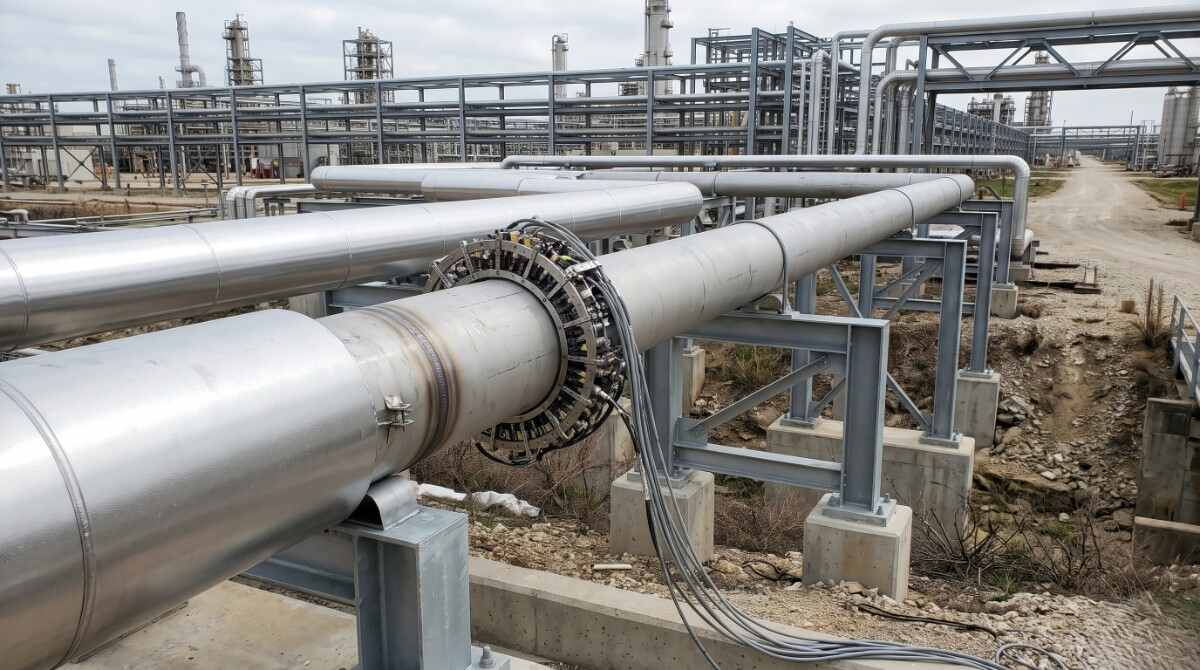
Inspection crews mount a ring of dry-coupled piezoelectric or magnetostrictive transducers around the circumscribed pipe body. The instrument applies precise electronic excitation to pulse the transducers simultaneously. As the torsional sound wave travels down the pipe wall, any change in cross-sectional area causes a portion of the acoustic energy to reflect toward the sensor collar. These reflections occur at geometric features such as girth welds, structural support clamps, flanges, and tees.
When the wave encounters localized wall loss caused by internal erosion or external corrosion under insulation, the sudden reduction in metal area reflects a distinctive signal back to the receiver. The arrival time of the reflected wave indicates the exact axial location of the flaw, while the amplitude of the signal correlates with the percentage of cross-sectional area loss. Modern instruments can detect localized wall loss as low as three to five percent of the total cross-sectional area under favorable pipe conditions.
International Codes and Regulatory Screening Standards
The application of guided wave screening is governed by rigorous engineering practices designed to prevent false calls and ensure reliable flaw classification. Several dominant technical standards establish testing protocols:
- Recommended Practice DNV-RP-G103 provides comprehensive guidance on the qualification, data interpretation, and field application of non-destructive testing using guided wave screening.
- ISO 18211 establishes international performance metrics and testing protocols for long-range guided wave ultrasonic testing on above-ground and buried metallic pipelines.
- NACE SP0108, overseen by the Association for Materials Protection and Performance, defines standard practice for the detection of corrosion under insulation using guided wave ultrasonic examination.
- ASME B31.8S standard on pipeline integrity management incorporates guided wave screening within direct assessment protocols for gas transmission systems.
- API Recommended Practice 570 recognizes guided wave inspection as an effective screening tool for identifying external localized corrosion on refinery piping circuits.
These standards emphasize that guided wave ultrasonic testing serves fundamentally as a rapid screening methodology rather than a final flaw sizing tool. When reflection anomalies exceed predetermined severity thresholds, codes mandate targeted follow-up inspection using localized volumetric methods.
Equipment Advancements and Market Deployments
Instrumentation hardware and data processing capabilities have advanced significantly over the last two years. Leading global inspection technology providers have introduced field-ready systems that extend test range and resolve subtle acoustic reflections:
- Eddyfi Technologies deployed its Sonyks guided wave ultrasonic testing system, featuring broadband magnetostrictive and piezoelectric collar configurations. The platform integrates high-output excitation electronics and advanced focusing algorithms that shorten near-field dead zones and extend screening ranges in heavily coated pipes.
- ROSEN Group expanded its integrity management services by pairing guided wave screening records with high-resolution in-line inspection pigging datasets, delivering comprehensive risk ranking across complex onshore gathering networks.
- Oceaneering International engineered specialized subsea guided wave inspection tooling for offshore platform risers and conductor caissons, enabling splash zone and shallow water inspections without requiring manned diving support.
- Mistras Group introduced upgraded long range ultrasonic testing screening campaigns across North American and European refinery networks, utilizing automated collar systems to survey insulated pipe racks and dead-leg configurations under continuous operation.
- Baker Hughes incorporated advanced ultrasonic guided wave screening into its global asset integrity management portfolio, deploying the technology across major cross-border transmission corridors to prioritize direct physical excavations.
These commercial deployments illustrate how digital signal processing and rugged transducer rings have transformed screening campaigns from qualitative checks into highly quantifiable integrity assessments.
Inspecting Challenging Infrastructure Geometries
The primary operational value of guided wave ultrasonic testing lies in its ability to inspect inaccessible pipe sections from a remote collar placement. Key operational configurations include:
- Buried road and railway crossings where pipelines pass through protective steel or concrete casings, eliminating the need to tear up road surfaces or interrupt rail transport.
- Insulated process piping in chemical plants and refineries, where removing a thirty-centimeter strip of insulation allows inspection of up to fifty meters of pipe on either side of the collar.
- Offshore platform caissons, risers, and conductor tubes passing through turbulent splash zones, where marine growth and tidal currents make direct human inspection extremely hazardous.
- Above-ground river crossings, bridge spans, and elevated pipe racks where erecting scaffolding would introduce substantial maintenance costs and personnel safety hazards.
- Bundled or buried flowlines operating in environmentally sensitive wetlands where excavation is legally restricted or environmentally damaging.
Environmental coatings and soil compaction influence signal attenuation significantly. Uncoated above-ground pipelines carrying gas can allow inspection ranges exceeding one hundred meters in both directions from a single collar position. Conversely, heavy viscoelastic coatings, bitumen wraps, or saturated clay soils absorb acoustic energy more rapidly, shortening effective test ranges to fifteen to thirty meters. Experienced technicians calibrate test frequencies to compensate for these damping effects.
Data Interpretation and Defect Categorization
Modern guided wave instruments generate distance-amplitude correction curves to calibrate signal attenuation over distance. These curves adjust the threshold of detection dynamically as the acoustic wave travels farther from the transducer collar. Reflected signals are classified into symmetric and asymmetric features:
- Symmetric reflections represent uniform, 360 degree cross-sectional changes such as girth welds, flanges, pipe reducers, and mechanical couplings.
- Asymmetric reflections indicate non-uniform cross-sectional loss characteristic of localized external corrosion, pitting clusters, mechanical gouges, or internal erosion channels.
- Signal severity categories rank detected anomalies into minor, moderate, or severe classifications based on the percentage of cross-sectional area loss relative to reference weld reflections.
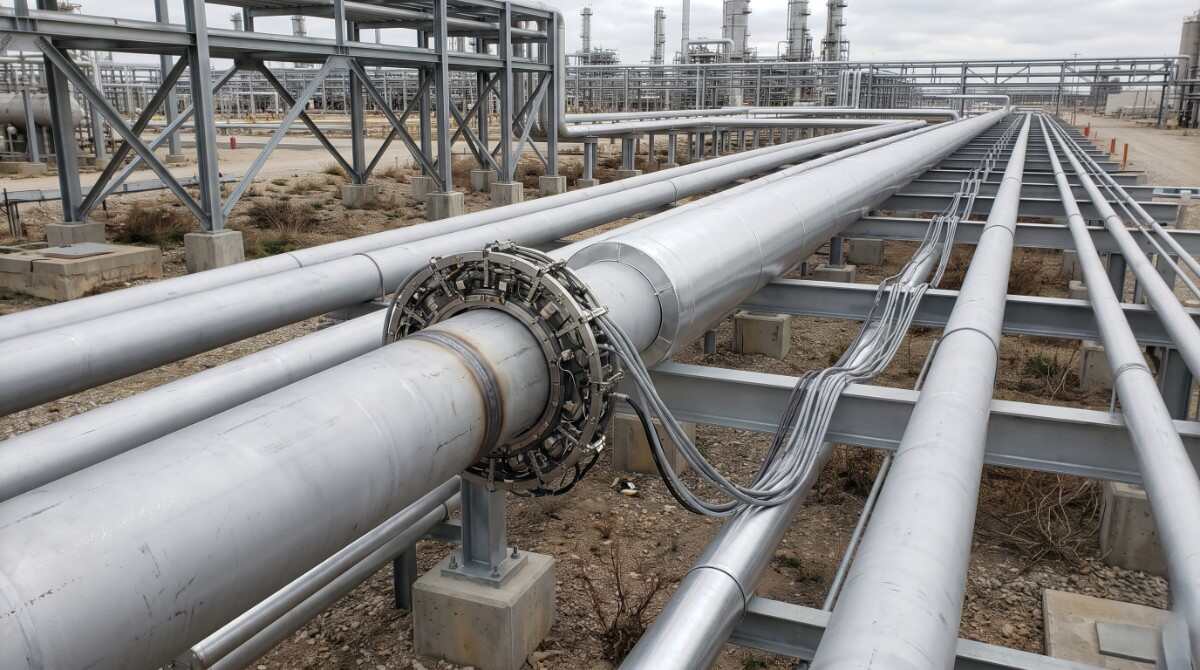
When guided wave screening highlights localized corrosion anomalies near complex fittings or valves, integrity teams deploy Digital Radiography Technologies for Faster Oilfield Equipment Inspection to capture profile wall thickness without removing remaining cladding. This layered inspection strategy ensures that maintenance teams only strip insulation or excavate buried joints where genuine structural damage threatens system containment.
Continuous Structural Health Monitoring Integrations
Oil & Gas Advancement observes that beyond periodic manual screening, guided wave ultrasonic testing is increasingly installed as permanently mounted structural health monitoring rings. High-temperature piezoelectric collars affixed to critical refinery lines transmit automated acoustic sweeps on a scheduled daily or weekly cadence.
These permanent monitoring arrays eliminate the data variability introduced by re-mounting manual collars across successive inspection years. Software algorithms compare baseline acoustic signatures against real-time signals, subtracting stationary weld reflections to highlight subtle new metal loss caused by active corrosion. Early warning alerts transmit directly to control room asset dashboards, allowing plant operators to adjust corrosion inhibitor injection rates long before wall loss reaches minimum design limits.
References
- “Sonyks Guided Wave Testing of Pipelines” – Eddyfi Technologies
- “Pipeline Integrity Management and Screening Services” – ROSEN Group
- “Subsea Pipeline and Riser Non-Destructive Inspection” – Oceaneering International
- “Guided Wave Ultrasonic Inspection Field Services” – Mistras Group
- “Pipeline Asset Integrity Management Solutions” – Baker Hughes
- “Pipeline Integrity Management Market Report 2025” – Fortune Business Insights
- “Recommended Practice DNV-RP-G103 Non-Destructive Testing” – Det Norske Veritas
- “Non-Destructive Testing Long-Range Guided Wave Ultrasonic Testing Standard 18211” – International Organization for Standardization
