






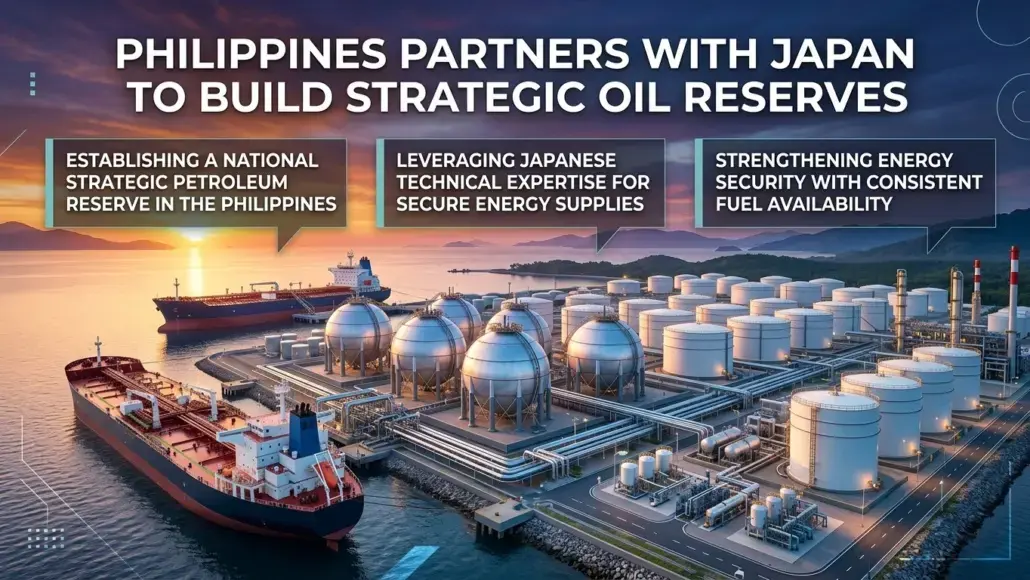
The Philippines is taking a major step toward strengthening its energy security through the creation of its first structured program for strategic oil reserves, an initiative designed to shield the domestic economy from disruptions caused by volatile global supply chains and geopolitical uncertainties. According to the Department of Energy (DOE), the effort will be implemented through a newly established framework known as Partnership On Wide Energy and Resources Resilience Asia (POWERR Asia), which will bring together foreign state institutions and private commercial entities in support of a national oil stockpiling mechanism.
The proposed framework represents a significant policy development for the country as it seeks to establish strategic oil reserves and enhance long-term supply resilience. Through POWERR Asia, the DOE aims to create additional supply buffers while reducing the nation’s dependence on unhedged, spot-market imported fossil fuels. As part of the initial phase, the government intends to build entirely new, state-of-the-art stockpiling facilities. Supporting this process, the Ministry of Economy, Trade and Industry of Japan is expected to send technical experts in the coming days to issue the preliminary terms for comprehensive feasibility studies, formally launching the project’s development phase.
Following the start of the project, developers selected to participate will be required to adhere to a strict, multi-year construction schedule in order to achieve operational readiness. Those involved in the development process will also receive technical capacity building from the Economic Research Institute for ASEAN and East Asia and the Japan Organization for Metals and Energy Security. The DOE believes that the development of strategic oil reserves through these facilities will strengthen the country’s preparedness against future supply disruptions while creating a more resilient energy framework.
To reduce financial and construction-related risks, the DOE is encouraging project proponents to pursue joint ventures with Japanese trading companies and the Japan Bank for International Cooperation. This approach is intended to support execution across engineering, procurement, and construction activities while ensuring reliable project financing. The Philippines and Japan have already completed the foundational alignment of POWERR Asia, establishing a cooperation matrix that includes both government-backed technical assistance and direct private-sector capital participation to support the development of strategic oil reserves.
The infrastructure initiative follows earlier actions taken by the Marcos administration during the recent energy crisis. At the height of that period, the government utilized a ₱20 billion emergency fund to purchase approximately two million barrels of refined petroleum products and liquefied petroleum gas to stabilize domestic inventories. Since then, the DOE has suspended additional emergency procurement activities, stating that the country’s fuel reserves are currently at a comfortable level.
