









In April 1998, the Republika Srpska government (the predominantly Serbian sub-unit of the Republic of Bosnia Herzegovina) held discussions with the Croatian Oil and Gas Company (INA) regarding joint co-operation to reactivate the Srpski Brod refinery in Bosnia Herzegovina.
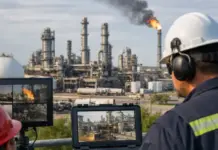
Srpski Brod is the site of the only oil refinery in Bosnia Herzegovina. Originally opened in the late 19th century, the refinery underwent extensive upgrades in the 1970s but, due to the conflict following the break-up of Yugoslavia in the 1990s, the plant was inactive from 1991.
The Republika Srpska government is now interested in pursuing a revitalization programme over the next 2-5 years focusing on production and auxiliary construction. The Republika Srpska government has received numerous enquiries from foreign companies regarding the refinery.
WAR DAMAGE
The facility suffered serious war damage and lack of maintenance during the 1990s. This included breaking off the construction of a new production line, which (as a consequence) was left derelict. The supply of oil to the plant was also cut off as it was passing through an “enemy” state. Economic sanctions against Republika Srpska (the majority Serb part of Bosnia Herzegovina) meant that the country was unable to import the equipment needed to maintain the plant properly and the plant was consequently somewhat degraded.
REFINERY REACTIVATION
The Srpski Brod oil refinery was re-opened on 13 May 2000. The refinery can process between 1,500 and 1,800 tons of crude oil a day. Before the conflict in Bosnia Herzegovina, the refinery processed 9,000 tons of crude oil daily, accounting for 14% of the energy balance of the former Yugoslavia. The main product that the refinery was hoping to produce from its abandoned production line was bitumen, so that is likely to become a major product of the reactivated refinery.
The basic repairs are completed, but the refinery is now eager to go further. There are plans for two more stages. The second stage would involve the reconstruction of the production facilities to give them a capacity of 1.2 million tons. However this would require about $15 million of foreign investment. The refinery states that it could co-finance the project with $3 million. The third stage would involve expansion of the production capacities to 3 to 4.2 million tons. This is a much more ambitious undertaking and would require $50 million in investments (presumably from foreign partners). For this reason, it is felt to be some way further over the horizon.