


















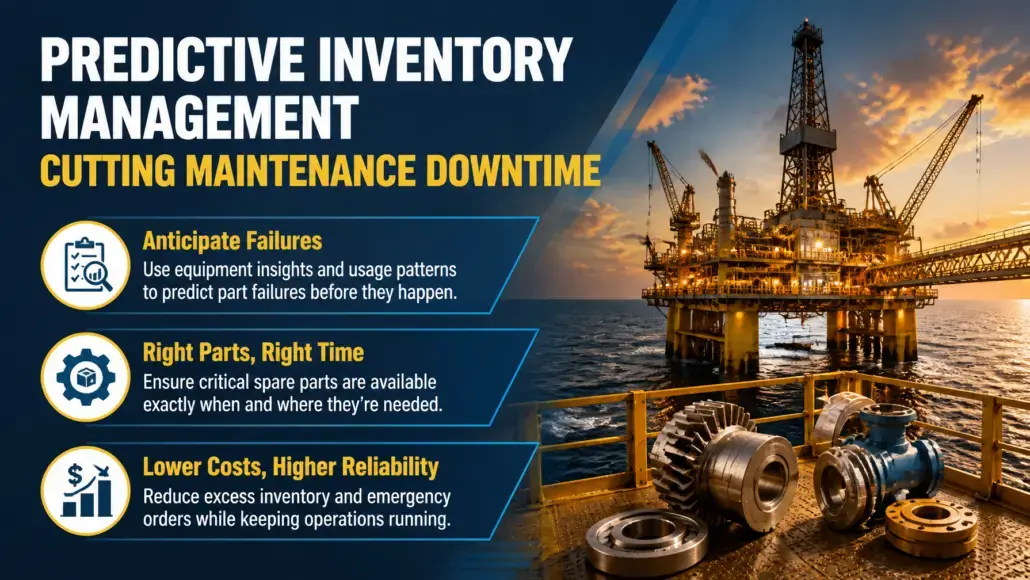
The cost of downtime in the oil and gas industry is measured not just in thousands of dollars per hour, but in lost production cycles that can impact global supply. A single failed component on an offshore platform or in a remote refinery can halt operations for days if the necessary spare part is not immediately available.
Historically, companies managed this risk by maintaining vast warehouses of surplus equipment, a strategy that tied up billions of dollars in capital. Oil & Gas Advancement observes that the emergence of predictive inventory management for oil and gas spare parts is enabling a much more sophisticated and cost-effective approach to asset integrity.
This new model moves beyond traditional stocking levels to a system that anticipates when and where a part will be needed:
- Just-in-time logistics: Aligning maintenance timelines with supply chain systems ensures parts arrive precisely when needed.
- Asset optimization & waste reduction: Synchronized delivery extends the productive lifespan of aging infrastructure while eliminating unnecessary operational overhead.
- Automated replenishment: Predictive failure tracking paired with automated parts ordering is emerging as a critical differentiator in the energy sector.
The shift toward predictive models is driven by the rapid maturation of artificial intelligence and machine learning. Major technology providers like Baker Hughes and SLB have invested billions into digital tools that provide deep insights into equipment health. These systems analyze sensor data in real time to identify the subtle patterns that precede a failure. When an anomaly is detected, the system does not just alert the maintenance team. It also checks the inventory levels and triggers a procurement request if the required spare part is not on hand.
Integrating Maintenance and Supply Chain Data
The true power of predictive inventory management lies in its ability to break down the silos between maintenance and procurement departments. In many traditional organizations, these functions operated in isolation, leading to either excessive stock or critical shortages. Predictive systems create a unified digital thread that connects the health of a physical asset to the logistics network that supports it. This integration ensures that every part in the warehouse has a specific, data-backed reason for being there.
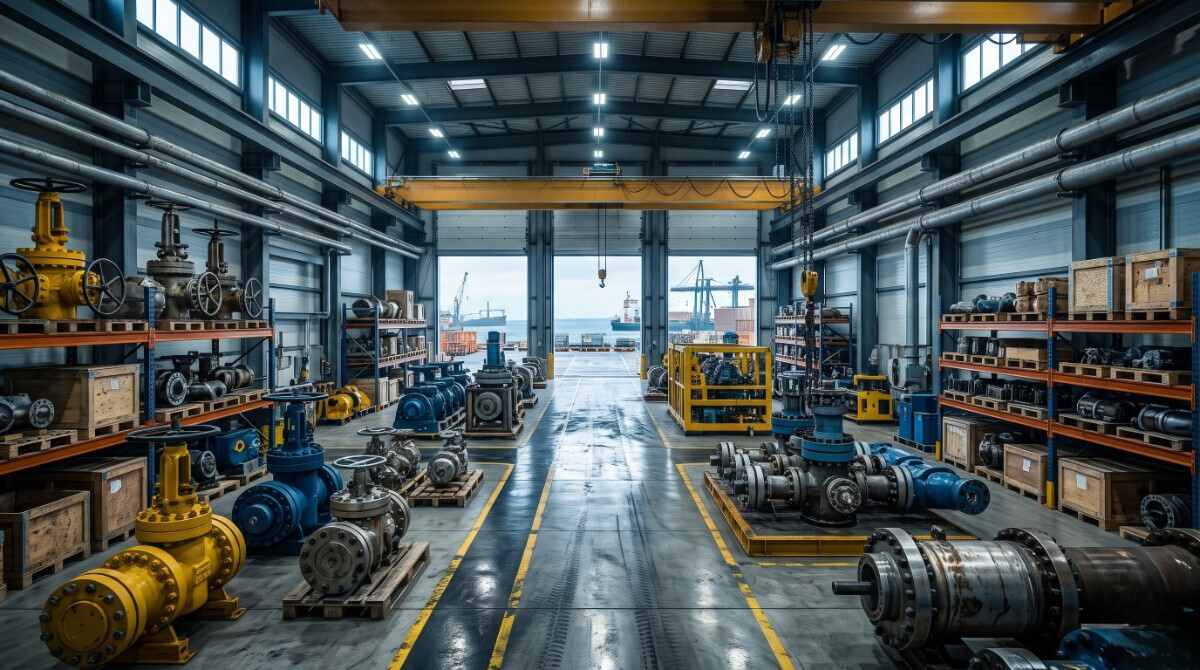
Global energy companies are increasingly adopting uptime intelligence platforms to manage their spare parts ecosystems. These platforms use historical failure data and operational parameters to calculate the optimal stock level for every component across multiple locations. For a company like Shell or BP, which may manage tens of thousands of individual parts, this level of automated optimization is transformative. It allows for a drastic reduction in total inventory value without increasing the risk of stockouts during critical repairs.
Recent project examples highlight the practical application of these strategies. In late 2025, SLB OneSubsea secured a subsea boosting contract for the Tiber Project in the Gulf of Mexico. Developments in deep-water environments are particularly reliant on precise inventory management because the cost of intervention is so high. By using predictive models to manage the specialized subsea components, the project team can minimize the need for emergency logistics and ensure that any required maintenance is performed with the right parts already on site.
The Role of Artificial Intelligence in Forecasting
Artificial intelligence is the engine that drives predictive inventory forecasting. Unlike traditional statistical models, which rely on simple averages, AI can account for a vast array of variables, including environmental conditions, usage intensity, and even supplier performance. This allow for much more accurate predictions of when a component will reach the end of its useful life. In a high-pressure environment like an oilfield, this accuracy is the difference between planned maintenance and a catastrophic failure.
Strategic partnerships are also playing a vital role in the development of these AI tools. Many operators are working closely with technology firms to develop custom algorithms tailored to their specific equipment and operating conditions. This collaborative approach ensures that the predictive models are grounded in real-world operational reality. As these tools become more widespread, the industry is moving toward a future where unplanned downtime becomes a relic of the past.
Reducing Capital Expenditure through Optimization
One of the most immediate benefits of predictive inventory management is the significant reduction in capital expenditure. By eliminating the need for excessive just-in-case stock, companies can free up millions of dollars that can be redirected toward more productive investments, such as new technology or energy transition projects. For many boards, the financial case for predictive inventory management is just as compelling as the operational one.
The optimization process also includes identifying and disposing of obsolete stock. In many old oil and gas facilities, warehouses are filled with parts for equipment that is no longer in use. Predictive systems can identify these dead assets and suggest ways to monetize or recycle them. This not only cleans up the balance sheet but also frees up valuable warehouse space for the critical components that actually keep the facility running.
Standardization across the fleet is another way that companies are optimizing their spare parts. By using the same components in multiple locations, operators can reduce the variety of parts they need to stock. This simplifies the predictive modeling and allows for a more flexible logistics network. If one facility has a sudden need for a part, the system can quickly identify if a nearby site has a surplus and arrange for a transfer, further reducing the need for new procurement.
Challenges and Future Directions in Inventory Management
Despite the clear benefits, the transition to predictive inventory management is not without its challenges:
- Critical role of data quality: Accurate AI predictions depend on consistent, high-grade field data that many organizations currently lack.
- Legacy facility limitations: Older operating sites often do not possess the sensors or connectivity required to feed modern analytics systems.
- Prohibitive retrofit barriers: Upgrading older infrastructure with modern sensing equipment is capital-intensive and time-consuming.
- Multi-supplier fragmentation: Projects rely on dozens of manufacturers, each using disparate data formats and communication protocols.
- Need for technical standardization: Consolidating siloed information into a single inventory view demands deep technical alignment across suppliers.
- Cross-industry collaboration: Industry-wide initiatives are actively working to establish common data-sharing standards and protocols.

As the industry continues to localize its supply chains, the focus is shifting toward how these predictive models can be used to support domestic manufacturing. By knowing exactly what parts will be needed and when, operators can provide more stable demand forecasts to local suppliers. This certainty is a key driver for the growth of local manufacturing of critical oilfield equipment and components, which in turn reduces the reliance on long-distance logistics and further improves overall resilience.
The journey toward a fully predictive supply chain is a fundamental shift in how the energy industry manages its physical assets. It requires a combination of advanced technology, data-driven culture, and strategic collaboration. For those who successfully navigate this transition, the rewards are clear: higher uptime, lower costs, and a more agile and responsive operation. As we move through 2026 and beyond, Oil & Gas Advancement believes that the ability to turn data into inventory intelligence will be one of the most important hallmarks of a successful oil and gas company.
References
- “2026 Oil and Gas Industry Outlook” – Deloitte
- “Four shifts redefining the oil and gas operating model” – McKinsey
- “Digital Oilfield Market Size And Share Report, 2026-2033” – Grand View Research
- “SLB OneSubsea Awarded Subsea Boosting Contract for bp’s Tiber Project” – SLB
- “McKinsey Technology Trends Outlook 2026” – McKinsey
