

























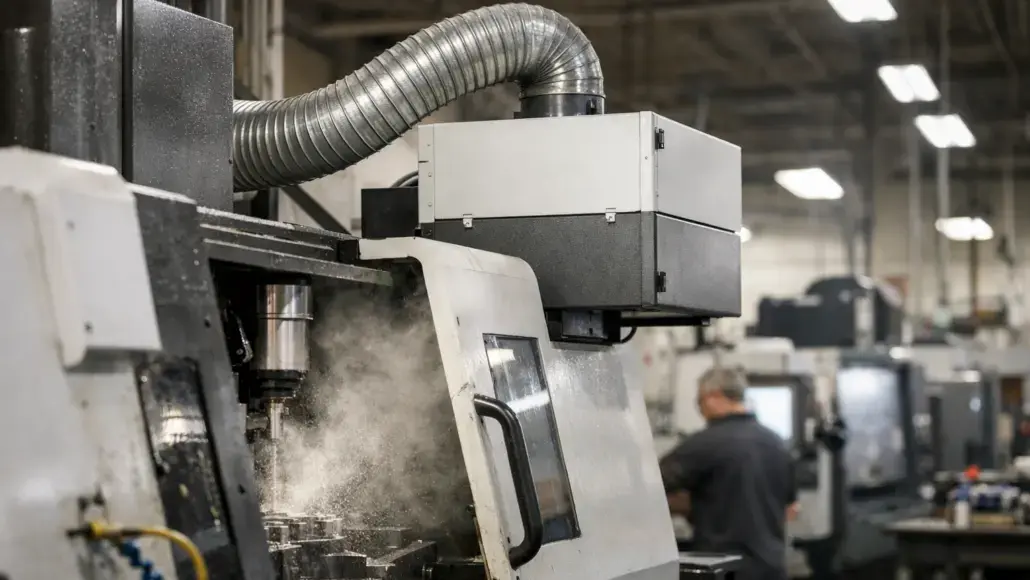
Machining, metalworking, and CNC manufacturing all share a common byproduct: airborne oil mist. Left unmanaged, this fine mist coats machinery, clouds visibility, contaminates products, and puts workers at risk of respiratory irritation. That’s where an oil mist collector becomes essential — capturing oil particles at the source before they spread through the facility.
This article breaks down what oil mist collectors do, why they matter for industrial and manufacturing environments, and what to look for when selecting a system.
What Is an Oil Mist Collector?
An oil mist collector is an air filtration system engineered specifically to capture oil, coolant, and lubricant mist generated during machining processes. Unlike general ventilation, these units are built to handle fine, sticky, oil-based particulates that would otherwise clog standard filters or settle on surfaces throughout a plant.
The core function is straightforward:
- Draw contaminated air away from the machine or process.
- Pass it through multi-stage filtration media.
- Separate oil droplets from the airstream.
- Return clean, breathable air back into the workspace, or exhaust it safely outside.
Why Oil Mist Control Matters in Industrial Settings
- Worker health and safety. Prolonged exposure to oil mist has been linked to respiratory issues and skin irritation. A properly sized collector keeps airborne oil concentrations within safe occupational limits.
- Equipment longevity. Oil mist that settles on electrical panels, control systems, and machine surfaces accelerates wear and increases maintenance frequency. Capturing mist at the source protects surrounding equipment.
- Housekeeping and slip hazards. Oil film on floors and walkways is a common cause of workplace slips. Effective mist collection significantly reduces this buildup.
- Regulatory compliance. Many industrial facilities are required to meet air quality standards, and a reliable collection system supports compliance with workplace exposure limits.
Where Industrial Oil Mist Collectors Are Used
Industrial oil mist collector systems show up across a wide range of manufacturing environments. Whatever the specific process, the goal stays the same: capture mist efficiently without disrupting production flow.
- Oil mist collector for CNC machines. CNC turning, milling, and grinding operations generate continuous mist during high-speed cutting and cooling.
- Stamping and metal forming. Lubricants used in press operations create fine airborne droplets that build up quickly on a busy line.
- Heat treating and quenching. Oil-based quenching processes release significant mist during rapid cooling cycles.
- Gear cutting and hobbing. Precision operations that rely heavily on cutting fluids need tight, targeted capture.
Key Features to Look for in an Oil Mist Collector System
- Filtration stages. Multi-stage designs (pre-filter, mist eliminator, final filter) typically deliver higher capture efficiency and longer filter life.
- Airflow capacity (CFM). Sized correctly for the number and type of machines connected to the system.
- Drainable design. Systems that allow collected oil to drain back into the process reduce waste and filter replacement costs.
- Compact footprint. Many facilities need units that mount directly on or near individual machines rather than a separate mechanical room.
- Low-maintenance filters. Washable or long-life oil mist collector filter media reduces downtime and operating cost over the life of the system.
Choosing the Right Oil Mist Collector Manufacturer
Not all systems are built the same. When selecting an oil mist collector manufacturer, a few things separate a good fit from a costly mismatch:
- Industry experience. Familiarity with your specific process — machining, stamping, heat treating, or another oil-mist-heavy operation.
- System range. Availability of both centralized and machine-mounted oil mist collector systems, so the platform can grow with your floor.
- Filter supply. Reliable access to replacement oil mist collector filter media without long lead times.
- Technical support. Guidance on sizing and installation so the unit actually matches your airflow and duty cycle.
Centralized vs. Individual Oil Mist Collector Systems
Facilities generally choose between two approaches. Individual, machine-mounted units attach directly to a single CNC machine or press, offering targeted capture and simple installation — ideal for smaller shops or isolated processes. Centralized oil mist collector systems connect multiple machines through ductwork to one larger unit, which suits high-volume production floors running many mist-generating stations at once.
The right choice depends on facility layout, number of machines, and future expansion plans.
Final Thoughts
Oil mist may be invisible at first glance, but its impact on air quality, equipment, and worker safety adds up over time. Investing in a properly engineered oil mist collector is one of the most effective steps a manufacturing facility can take to protect its workforce and its machinery.
For facilities exploring dependable, industrial-grade filtration, an oil mist collector built for continuous-duty environments offers a practical, long-term solution to airborne oil contamination.
