













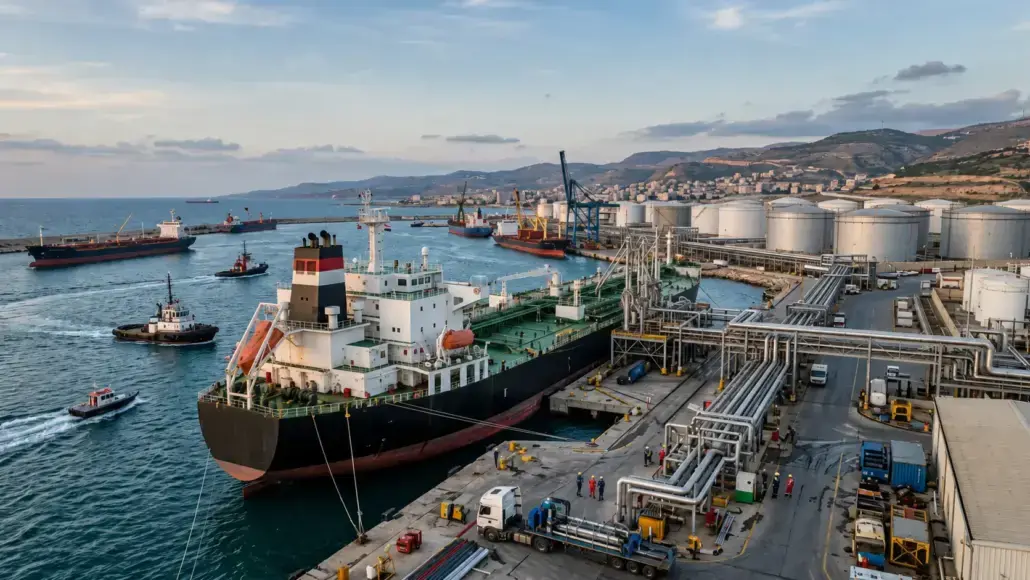
Iraq’s Ministry of Oil has unveiled a significant plan to broaden its fuel oil export capabilities, leveraging Syria’s Baniyas port for shipments. This initiative, announced on Friday, May 8th, aims to streamline the export of what is locally known as “black oil.” According to ministry spokesperson Sahib Bazoun, the plan involves transporting fuel oil via tanker trucks to the Baniyas port, located in Syria’s Tartus governorate. Timetables have reportedly been established to ensure the efficient execution of this export strategy.
The decision to enhance fuel oil exports is underpinned by advances in refinery technology. Bazoun explained that certain refineries are now employing physical cracking processes to process fuel oil, a byproduct of crude oil extraction. This process is crucial for producing high-demand petroleum derivatives, including high-octane gasoline. The successful implementation of this export plan is also intrinsically linked to securing the necessary financial liquidity to establish new avenues for general oil exports.
In parallel with these export plans, a delegation from Iraq’s Ministry of Oil, led by Amer Khalil Ahmed, Director General of the North Oil Company, recently visited the Iraqi Embassy in Damascus. The delegation engaged in discussions with the embassy’s chargé d’affaires concerning potential cooperation with Syrian authorities. A primary focus of these discussions was the prospective restart of the Iraqi-Syrian oil pipeline, as communicated by the Media and Government Communication Office at Iraq’s Ministry of Oil on Thursday, May 7th.
Further strengthening bilateral cooperation, discussions also encompassed the establishment of an Iraqi shipping office at Syria’s Baniyas port. Such an office is anticipated to bolster Iraqi oil export operations and expand marketing channels, contributing to the overall development of the oil transport and export sector’s infrastructure. The Iraqi delegation comprised representatives from the Pipeline Company, the technical department, and the department of studies, planning, and follow-up.
Recent operational adjustments have also been noted, with the Syrian Petroleum Company announcing on May 2nd an increase in the unloading capacity for Iraqi oil tankers at the Baniyas refinery. This enhancement, coupled with the rerouting of oil supplies entering Syrian territory to the Rabiya-al-Yarubiyah border crossing in northeastern Syria, signifies a strategic shift. The capacity at Baniyas refinery now accommodates approximately 500 tankers daily, a notable increase from the previous 300, thanks to activated unloading yards. This boost in operational capacity, equating to roughly 120,000 barrels per day, was achieved through engineering and logistical improvements to unloading routes, enabling direct pumping into storage tanks and reducing turnaround time by approximately 40 working hours.
Safwan Sheikh Ahmad, director of corporate communications at the Syrian Petroleum Company, clarified that the rerouting of these shipments to the al-Yarubiyah crossing and subsequent passage along the M4 road toward Baniyas, instead of the al-Tanf crossing, is a purely logistical measure. The objective is to shorten transit distances and times, ensuring the swift arrival of supplies without altering existing contract terms or material specifications.
These developments follow Iraq’s commencement of crude oil exports through Syrian territory via the al-Waleed border crossing in April. At that time, Syria’s Ministry of Energy indicated that shipments were being directed into refinery tanks before transfer to the Baniyas oil terminal for loading onto maritime tankers. Iraq is actively seeking to expand its crude oil export outlets via the Baniyas port on the Mediterranean, positioning it as a key transit point for European and American markets. This strategic move comes in the context of global energy market disruptions, which have impacted Iraqi oil exports. The government has been implementing an emergency plan to maintain export flows by reactivating pipelines and coordinating regionally for alternative export routes.
