





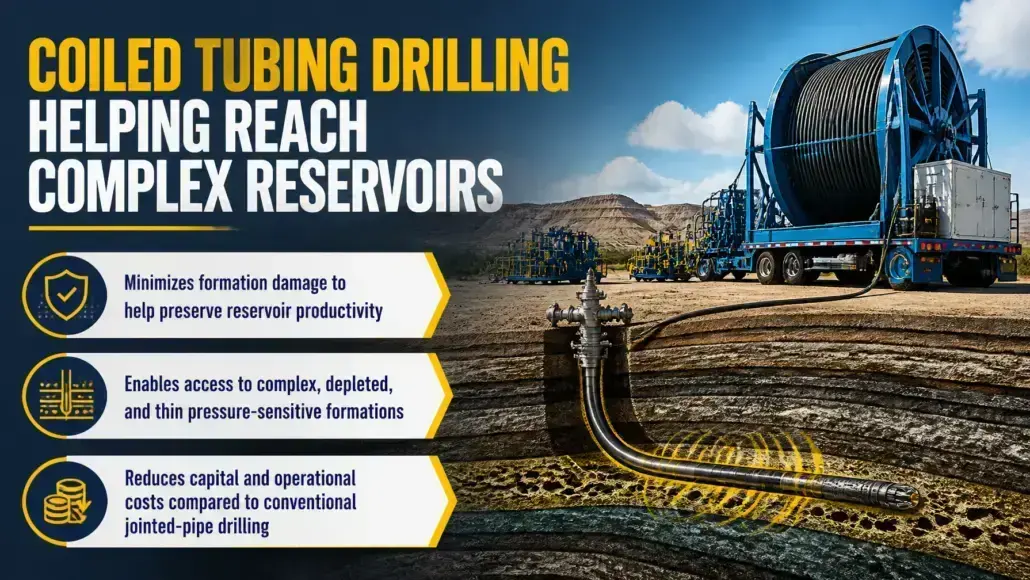
Maximizing hydrocarbon recovery from geologically complex, depleted, and marginal reservoirs requires drilling techniques that minimize formation damage and bypass high capital expenditure requirements. Conventional jointed-pipe drilling rigs face severe economic and physical limitations when attempting to re-enter aging wells or access thin, pressure-depleted formations. Heavy rotary drill strings require frequent pipe connections that interrupt circulation, induce damaging pressure surges against delicate rock faces, and escalate nonproductive time. In response to these operational constraints, coiled tubing drilling has emerged as an indispensable technology for accessing bypassed hydrocarbons, extending brownfield life cycles, and conducting continuous underbalanced operations.
Operating without threaded pipe joints, coiled tubing drilling utilizes a continuous, flexible steel or composite pipe reel coupled with specialized downhole mud motors and directional steering assemblies. This continuous configuration allows uninterrupted fluid circulation while running in and out of the hole, eliminating connection-related pressure fluctuations. Oil & Gas Advancement observes that by maintaining continuous wellhead pressure containment, operators can drill underbalanced, keeping bottomhole pressure deliberately lower than formation pore pressure. Reservoir fluids are allowed to flow safely to the surface during drilling, preventing fluid invasion into productive porosity and preserving natural permeability.
Operational Advantages Over Conventional Rotary Systems
The technical architecture of coiled tubing drilling offers distinct operational advantages across mature assets and sensitive subterranean structures. Conventional rotary operations require killing the well with weighted drilling mud prior to workover or sidetrack operations, exposing sensitive, low-pressure pay zones to invasive solids, chemical filtrates, and permanent skin damage. Coiled tubing drilling bypasses this destructive cycle by operating under live well conditions through specialized high-pressure strippers and blowout preventer stacks:
- Continuous pumping maintains constant equivalent circulating density, preventing the hydraulic swabbing and surging that destabilizes weak rock formations.
- Real-time downhole monitoring through internal electric wirelines or high-frequency mud telemetry provides immediate geosteering control within thin target reservoirs.
- Compact equipment footprints allow deployment on congested offshore platforms, single-well satellite structures, and environmentally sensitive land locations where mobilizing a conventional drilling rig is cost-prohibitive.
- Rapid tripping speeds reduce transition times between intervals, accelerating project delivery schedules and lowering daily operating expenditures.
These operational attributes are especially valuable in depleted gas reservoirs, layered tight oil plays, and mature carbonate waterfloods. In these environments, conventional drilling frequently incurs massive fluid loss, differential pipe sticking, and irreversible formation damage, making continuous coiled tubing intervention an economically compelling alternative.
Directional Steering and Slimhole Bottomhole Assemblies
Directional control has historically represented a significant technical challenge for continuous tubing systems, because the coiled string cannot be rotated continuously from surface rotary tables like conventional drill pipe. To overcome this limitation, contemporary bottomhole assemblies integrate downhole orienting tools, positive displacement motors, and electric steering modules that provide precise three-dimensional trajectory control.
Modern slimhole bottomhole assemblies measure between two and three-eighths inches and three and one-half inches in outer diameter, housing sophisticated measurement while drilling sensors, gamma-ray tools, and resistivity devices. Hydraulic or electromechanical orienting tools rotate the downhole bent-housing motor in controlled angular increments, allowing directional drillers to adjust toolface orientation without surface string rotation:
- Electrically actuated steering tools receive surface commands through internal tubing wirelines, executing toolface adjustments in seconds.
- Downhole hydraulic tractors provide supplementary axial force in high-angle horizontal sections where mechanical pipe friction limits gravity-assisted weight transfer.
- Slimhole bi-directional communication systems transmit continuous inclination, azimuth, and formation evaluation data to surface logging software.
- Specialized window milling packages allow the bottomhole assembly to exit existing production tubing strings and initiate lateral drainholes without pulling the production completion.
In late 2026, Sharjah National Oil Corporation awarded SLB an expanded framework agreement for Underbalanced Coiled Tubing Drilling across the Moveyeid gas storage field and adjacent producing reservoirs in the United Arab Emirates. The multi-well campaign utilizes advanced underbalanced coiled tubing drilling assemblies to re-enter depleted carbonate formations, doubling the scope of earlier development phases to expand underground gas storage deliverability and accelerate field output without inducing skin damage.
Through-Tubing Sidetracking in Mature Brownfields
As offshore platforms and mature land fields approach late-stage economic limits, drilling new wells from surface locations becomes difficult to justify financially. Through-tubing sidetracking via coiled tubing drilling provides a cost-effective method to tap isolated fault blocks, bypassed oil pockets, and undrained attic reserves using existing well infrastructure.
By entering through the existing production tubing, operators avoid the substantial cost and environmental exposure of pulling completion packers, production tubing strings, and artificial lift systems. A specialized whipstock is anchored within the casing or liner, and a casing exit window is milled in a single trip. The coiled tubing drilling assembly then drills a lateral bore ranging from several hundred to several thousand feet into the target formation, creating a high-conductivity drainage channel directly tied back into existing processing facilities. By eliminating the necessity for heavy workover vessels, mobile offshore drilling units, or extensive casing retrieval, through-tubing operations dramatically compress field reinvestment cycles and generate attractive internal rates of return on marginal reservoir assets.
Surface Pressure Control and Underbalanced Separation
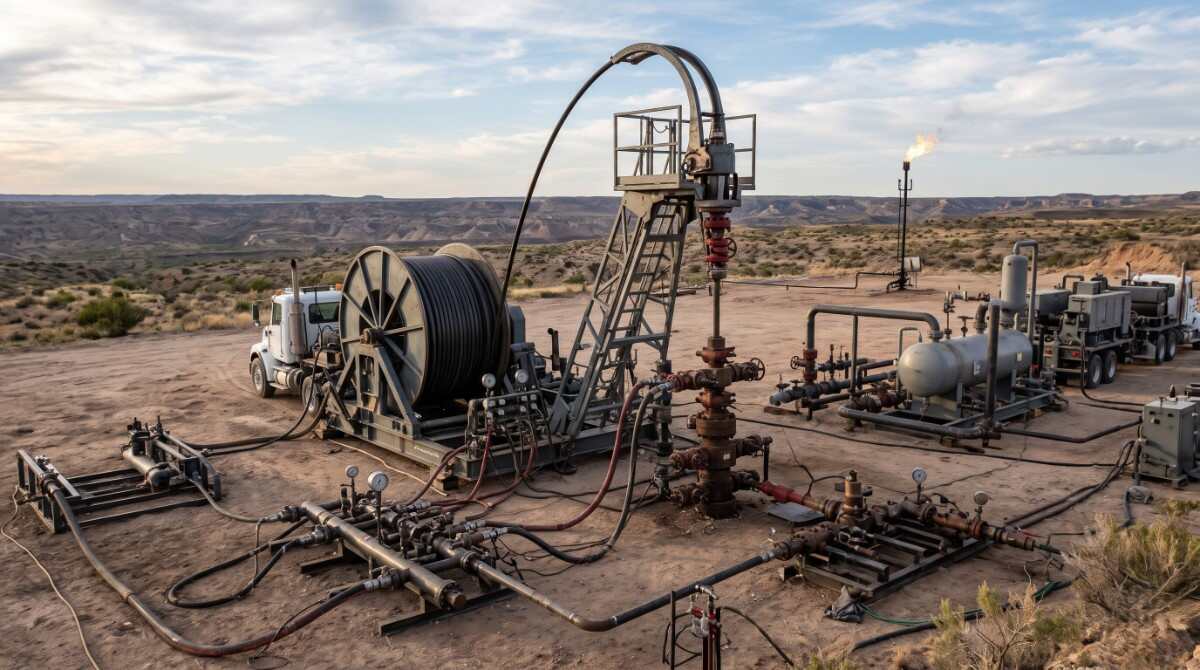
Executing underbalanced coiled tubing drilling demands an integrated surface infrastructure capable of handling continuous hydrocarbon production alongside returning drilling fluids and drill cuttings. Unlike conventional drilling where fluid returns discharge to open shale shakers at atmospheric pressure, coiled tubing drilling routes live returns through a closed four-phase separator system.
The surface package includes dual or triple hydraulic stripper heads that seal around the moving continuous tubing string, high-pressure choke manifolds, solids separation units, and automated gas flare systems. As formation gas and reservoir fluids enter the circulating fluid stream downhole, automated chokes throttle backpressure to keep bottomhole pressure safely within the underbalanced window, preventing wellbore collapse while suppressing uncontrolled influxes:
- Closed-loop degassers extract entrained hydrocarbon gases, directing them to production flowlines or environmental flare systems without atmospheric venting.
- Centrifugal sand separators remove fine abrasive cuttings under pressure, protecting downstream chokes and valves from erosive failure.
- Automated fluid mixing units inject controlled concentrations of cryogenic nitrogen or light hydrocarbon bases into the circulating stream, precisely tuning fluid density to match reservoir pore pressures.
- Surface emergency shut-in valves isolate the wellbore in milliseconds upon detecting anomalous pressure spikes or mechanical seal compromise.
During brownfield optimization campaigns in North America in 2025, Halliburton expanded its through-tubing re-entry drilling operations and Sperry Drilling slimhole evaluation tools across low-pressure tight formation assets. The deployment demonstrated that continuous underbalanced fluid circulation combined with real-time pressure monitoring preserved formation integrity, yielding post-intervention production rates that exceeded offset conventionally drilled wells by more than thirty percent.
Weatherford International introduced automated continuous circulation pressure control packages for offshore platform deployments in late 2025. These modular surface units streamline footprint requirements on congested decks while maintaining redundant barrier envelopes during through-tubing sidetracks in high-pressure gas environments.
NOV Inc. contributed critical mechanical advances in early 2026 through the rollout of high-strength continuous tubing strings engineered from fatigue-resistant micro-alloyed steels.
Mechanical Boundaries and Rotary System Transitions
Despite continuous mechanical advances, coiled tubing drilling faces inherent physical boundaries dictated by string mechanics. Because the tubing string is continuous and cannot be rotated from surface rotary drives, wall contact friction escalates dramatically in high-angle horizontal sections. Helical buckling eventually locks the string against the borehole wall, limiting the maximum achievable lateral reach. When reservoir targets require step-out distances extending several miles across wide drainage areas, operators must transition from coiled tubing systems to heavy rotary drill strings capable of transmitting continuous rotation and high axial torque, leveraging extended-reach drilling technologies to access distant reserves from centralized surface locations.
References
- “Expanded Underbalanced Coiled Tubing Drilling Agreement for Moveyeid Field” – SLB
- “Through-Tubing Lateral Re-Entry and Reservoir Preservation in Depleted Formations” – Halliburton
- “Compact Pressure Containment Architecture for Offshore Coiled Tubing Operations” – Weatherford International
- “Fatigue-Resistant High-Strength Continuous Tubing Alloys for Sour Gas Wells” – NOV Inc.
- “Underbalanced Coiled Tubing Drilling: Principles, Field Experiences, and Economics” – Society of Petroleum Engineers
