




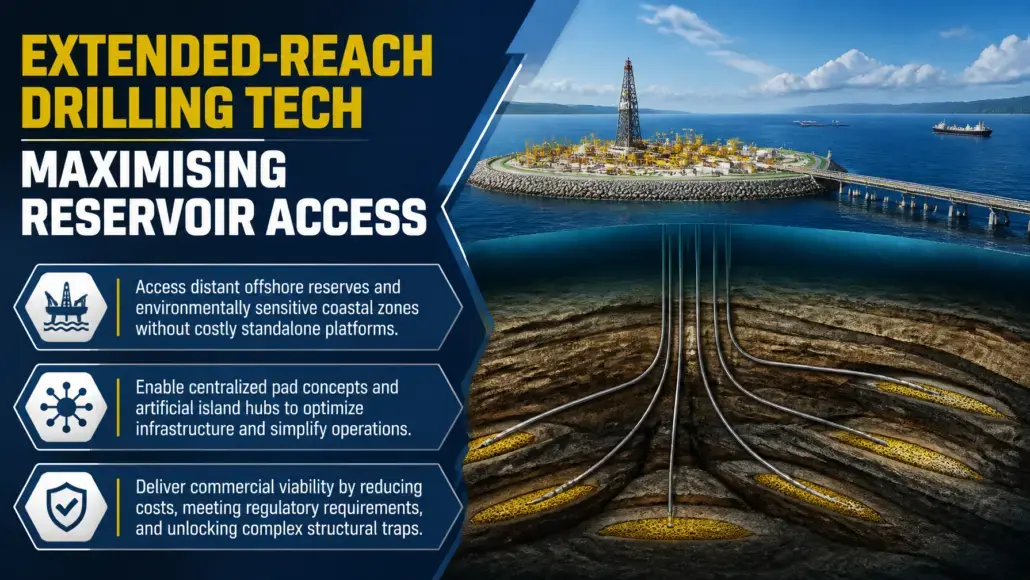
Tapping distant offshore hydrocarbon reserves, environmentally restricted coastal zones, and geologically complex structural traps without installing expensive standalone surface infrastructure represents one of the greatest engineering achievements of modern energy development. As greenfield offshore platforms face escalating fabrication costs and stringent regulatory oversight, operators increasingly prioritize centralized pad concepts and artificial island hubs. Achieving commercial viability under this framework relies heavily on advanced extended-reach drilling technologies that push horizontal step-out boundaries miles beyond the surface wellhead.
Extended-reach drilling involves constructing well profiles characterized by high ratios of measured depth to true vertical depth, frequently exceeding step-out ratios of five to one. Oil & Gas Advancement observes that by directing drill strings along high-angle trajectories across five to ten miles of horizontal displacement, operators can drain multiple peripheral reservoir compartments from a single surface cluster. This operational model consolidates wellheads, streamlines production manifolding, eliminates subsea pipeline tiebacks, and minimizes surface environmental disturbances. Furthermore, by reducing the overall quantity of offshore installations, energy companies decrease decommissioning liabilities and substantially lower their operational greenhouse gas intensity per produced barrel.
Mechanical Impediments in High Step-Out Trajectories
Steering a drill string across several miles of horizontal displacement introduces severe mechanical challenges that do not exist in conventional vertical or moderately inclined wells. As borehole inclination surpasses sixty degrees, gravity causes the rotating drill string to rest heavily against the low side of the borehole wall. The cumulative contact area creates massive rotational torque and axial drag, threatening to stall surface top drives and prevent weight from transferring effectively to the drill bit.
In severe cases, compressive forces induce mechanical sinusoidal and helical buckling along the drill string, locking the tubulars against the casing or open rock face. Hole cleaning introduces an equally formidable operational hurdle. In high-angle sections, drilling fluid velocity decreases along the low side of the borehole, allowing drill cuttings to settle out of suspension and form dense cuttings beds:
- Cuttings bed accumulation increases rotational friction, leads to mechanical pack-offs, and sharply elevates equivalent circulating density.
- Excessive torque causes premature fatigue failures at threaded drill pipe connections, risking expensive fishing operations miles from the surface rig.
- High frictional drag prevents casing strings and production liners from reaching bottom, necessitating complex buoyancy-assist techniques such as casing flotation.
- Mechanical differential sticking risks multiply when drilling through permeable formations with significant overbalance margins along extensive horizontal intervals.
Overcoming these physical limitations requires specialized drill pipe geometries, low-friction synthetic drilling fluid formulations, downhole vibration dampeners, and advanced rotary steerable assemblies that continuously rotate the entire drill string while executing precise trajectory adjustments.
Rotary Steerable Systems and Advanced Geosteering
The commercial evolution of extended-reach drilling technologies is directly linked to the development of rotary steerable systems. Traditional directional drilling with downhole mud motors required sliding the non-rotating drill string to steer along a specific orientation, creating high static friction that severely restricted lateral reach. Rotary steerable systems eliminate sliding mode entirely, steering continuously while rotating the drill string from surface top drives.
Contemporary point-the-bit and push-the-bit rotary steerable architectures utilize internal hydraulic pads or articulating internal drives to orient the bit face dynamically:
- Continuous string rotation keeps cuttings agitated and suspended in the mud stream, dramatically improving hole cleaning efficiency and reducing cuttings bed formation.
- Automated closed-loop trajectory correction algorithms inside the bottomhole assembly maintain designated inclination and azimuth without requiring manual surface commands.
- High-build rate capabilities allow rapid trajectory adjustments, enabling drillers to drop through overburden formations quickly and initiate horizontal sections at precise geological entry points.
- Real-time continuous vibration monitoring tools detect harmful stick-slip and high-frequency torsional oscillations, allowing surface drillers to optimize rotary speeds and bit weight instantaneously.
To stay positioned within optimal reservoir layers across several miles of horizontal displacement, operators integrate ultra-deep directional resistivity mapping tools. In offshore extended-reach campaigns during 2025 and 2026, SLB deployed its PowerDrive rotary steerable systems coupled with GeoSphere 3D reservoir mapping-while-drilling technology. The downhole array maps structural bed boundaries, fluid contacts, and fault boundaries up to one hundred feet away from the wellbore in real time, allowing geosteering engineers to make proactive trajectory corrections that keep the lateral section centered within high-permeability pay zones.
Field Deployments and Record-Setting Developments
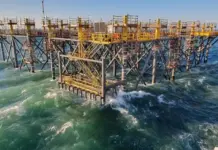
Global operators are leveraging extended-reach drilling technologies to unlock world-class offshore developments with unprecedented capital efficiency. In the Arabian Gulf, Abu Dhabi National Oil Company has systematically advanced its long-reach drilling program across the Upper Zakum field, utilizing artificial offshore islands as centralized development hubs.
Service company technology advancements have played an essential role in supporting these extreme step-out achievements. During long-reach multilateral drilling campaigns in the North Sea in 2025, Baker Hughes deployed its AutoTrak eXpress continuous proportional steering systems integrated with Lucida advanced logging-while-drilling sensors. The package delivered smooth borehole trajectories with minimal tortuosity, lowering drag coefficients and enabling record-length completion liners to be placed without mechanical obstruction.
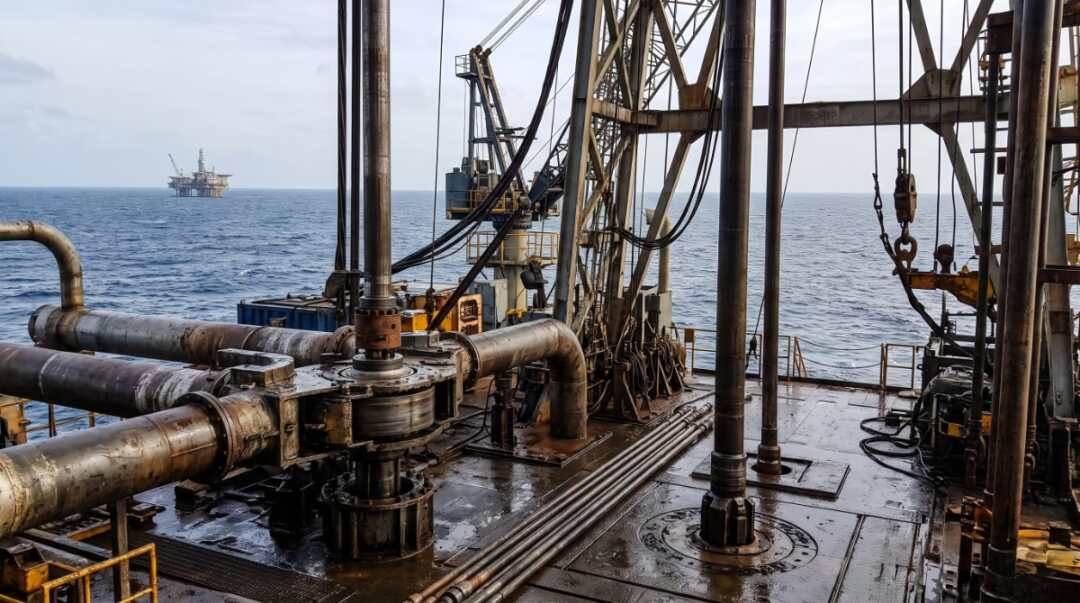
Halliburton advanced torque management across deep horizontal campaigns in South America and the Middle East during 2025 and 2026 by combining its iCruise intelligent rotary steerable systems with BaraLube high-performance mechanical friction reducers. The chemical lubricants form robust boundary films on rock and casing surfaces, slashing rotational torque by thirty-five percent and preserving drill string mechanical integrity across ultra-long lateral intervals.
NOV Inc. engineered high-torque, double-shouldered drill pipe connections capable of withstanding extreme torsional fatigue under continuous high-RPM rotation, providing the structural backbone necessary for five-mile horizontal reach applications.
Casing Flotation and Liner Installation in Extended Wells
Drilling the lateral section represents only half the challenge in extended-reach operations. Successfully running and cementing heavy steel casing strings and sand control screens into place is equally demanding. In wells exceeding four or five miles of measured depth, the accumulated weight of the casing string against the low side of the hole generates frictional drag that exceeds the buoyant weight of the string, preventing gravity-assisted installation.
To overcome this restriction, operators utilize casing flotation techniques. A temporary glass or elastomeric pressure-containing barrier is installed near the lower end of the casing string, allowing the bottom section of the pipe to be filled with atmospheric air or light nitrogen gas while the upper section remains filled with drilling fluid:
- The trapped air pocket provides buoyancy along the horizontal section, dramatically reducing low-side contact force and cutting axial friction by more than fifty percent.
- Once the casing string reaches total depth, internal hydraulic pressure is elevated from the surface to rupture the flotation barrier, restoring full fluid circulation for subsequent cementing operations.
- Premium centralizers placed at computer-modeled standoff intervals ensure uniform annular cement coverage around the casing, preventing gas migration and long-term casing collapse.
Operational Transitions in Abrasive Formations
While rotary steerable systems and high-torque strings excel in navigating sedimentary reservoirs, extended well paths occasionally encounter structural surprises. When long-reach trajectories intersect abrasive crystalline basement rock, dense chert horizons, or volcanic sills, conventional shearing drill bits experience extreme mechanical wear, impact shock, and severe penetration rate collapse. Under these demanding conditions, operators transition from conventional rotary shearing methods to high-frequency downhole impact tools, implementing percussion drilling technologies to pulverize compressive rock matrices and maintain operational drilling efficiency.
References
- “PowerDrive Rotary Steerable Systems and Ultra-Deep Reservoir Mapping Integration” – SLB
- “iCruise Intelligent Steering Systems Combined with Advanced Lubricant Formulations” – Halliburton
- “Multilateral Extended-Reach Well Architecture on Mature North Sea Assets” – Equinor
- “High-Torque Double-Shouldered Drill Pipe Connections for Ultra-Long Lateral Intervals” – NOV Inc.
- “Extended-Reach Drilling: Engineering Boundaries, Friction Management, and Hole Cleaning” – Society of Petroleum Engineers
