













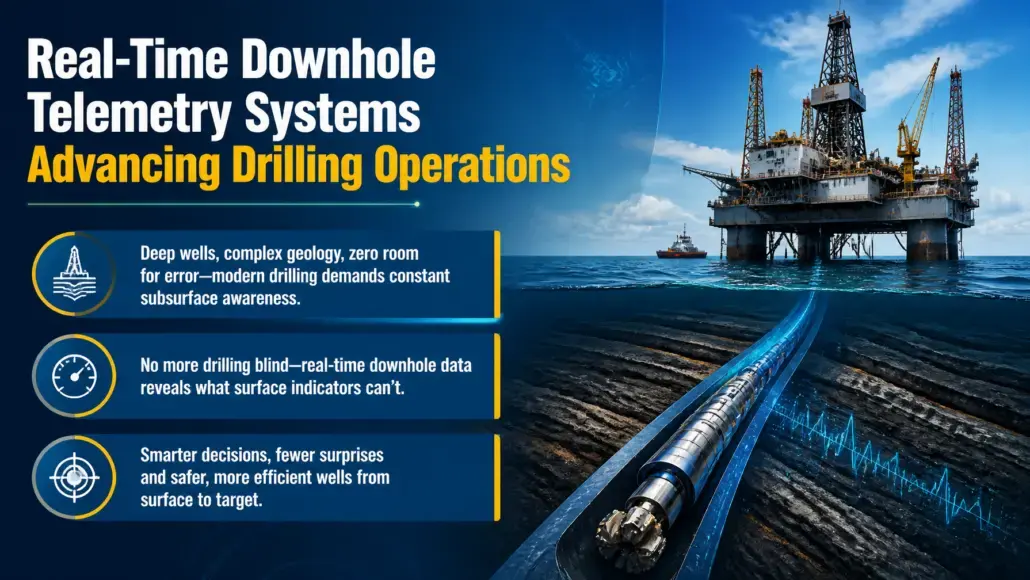
Drilling modern hydrocarbon, geothermal, and carbon sequestration wells requires an unprecedented level of subsurface situational awareness. Today well construction routinely extends miles beneath the seabed, navigates complex multi-layered structural traps, and threads narrow geological corridors with minimal tolerance for error. Historically, drillers operated blind between intermittent directional surveys, relying on surface indicators like standpipe pressure, torque, and hook load to infer downhole conditions. When downhole complications emerged, surface crews often recognized the problem hours after damage occurred. The commercialization of high-speed real time downhole telemetry systems has eliminated this informational lag, transforming drilling from a reactive craft into an automated, data-driven industrial science.
Oil & Gas Advancement observes that downhole telemetry serves as the nervous system of the drill string, bridging the communication divide between subterranean measurement sensors and surface control consoles. As bottomhole assemblies drill through diverse lithologies, embedded sensors capture millions of data points, including triaxial vibration, annular pressure, equivalent circulating density, continuous inclination, azimuth, gamma radiation, resistivity, and sonic velocity. Transmitting these data streams instantaneously to surface drilling automation systems allows operators to optimize drilling parameters, mitigate catastrophic downhole tool failures, geosteer within thin pay zones, and prevent hazardous well control incidents.
Telemetry Methodologies Across Modern Drilling Environments
Subsurface environments present formidable communication obstacles. Radio waves attenuate rapidly in dense, conductive rock formations, and metallic drill strings act as acoustic filters that distort vibrational signals. To overcome these natural barriers, the industry has engineered several distinct telemetry methodologies, each tailored to specific operational and geological conditions:
- Mud pulse telemetry transmits data by generating controlled pressure pulses within the circulating drilling mud column. Positive-pulse, negative-pulse, and continuous-wave sirens modulate pressure waves that travel up to the surface at the speed of sound in mud, where sensitive transducers decode the acoustic signals.
- Electromagnetic telemetry transmits low-frequency electromagnetic waves directly through the geological strata. Dipole antennas in the bottomhole assembly transmit signals through surrounding rock formations to surface antennae arrays, providing a reliable telemetry pathway in underbalanced drilling, foam circulation, and severe fluid loss zones where no continuous liquid mud column exists.
- Acoustic telemetry propagates acoustic stress waves directly through the metallic body of the drill pipe. Transducers generate high-frequency elastic waves that travel along the steel tubulars, bypassing fluid-related transmission barriers.
- Wired drill pipe networks incorporate armored coaxial or high-frequency cables embedded within specialized drill pipe sections, utilizing inductive coils at tool joints to form a continuous broadband data transmission circuit from the bit to the surface rig floor.
While mud pulse telemetry remains a standard workhorse across many conventional drilling campaigns, its physical bandwidth is severely constrained. Signal attenuation, mud compressibility, and hydraulic noise generated by surface pumps restrict mud pulse data rates to between one-half and twenty bits per second. In ultra-deep, high-angle, and multi-lateral wells, this narrow bandwidth forces drillers to compress, batch, or discard high-resolution sensor readings.
Wired Drill Pipe and the Broadband Data Revolution
The transition toward automated and autonomous drilling has made broadband telemetry essential. Wired drill pipe has broken through the physical data ceiling of mud pulsing, elevating transmission speeds from single-digit bits per second to broadband rates of fifty-seven thousand six hundred bits per second. This thousands-fold expansion in transmission bandwidth enables true bi-directional, sub-second communication between surface automation algorithms and downhole bottomhole assemblies.
With broadband wired telemetry, surface control systems receive raw, uncompressed measurements from downhole sensors along the entire length of the drill string:
- Distributed along-string pressure and temperature sensors provide continuous hydraulic profiles, mapping thermal expansion and pressure waves in real time.
- High-definition azimuthal imaging and sonic logs are transmitted continuously while drilling, eliminating the need to halt operations for time-consuming stationary logging sweeps.
- Bi-directional communication enables surface geosteering software to send instantaneous commands to downhole rotary steerable systems, modifying bit trajectories automatically within seconds.
- Continuous high-frequency vibration diagnostics detect the earliest onset of destructive stick-slip and whirl oscillations, triggering automated surface top-drive speed adjustments before bit cutters are damaged.
- Downhole sensor telemetry integrates directly into surface rig control systems, enabling automated drawworks braking and rotational speed modulation that maintain optimal mechanical specific energy across varying rock strata.
NOV Inc. has driven significant milestones in wired drill pipe commercialization through its IntelliServ broadband telemetry platform. In field campaigns across ultra-deep offshore assets in 2025 and early 2026, the IntelliServ network maintained sustained transmission speeds of fifty-seven point six kilobits per second with ninety-nine point eight percent continuous communication uptime. The continuous broadband connection allowed operators to execute automated downhole closed-loop steering and dynamic pressure management, reducing overall drilling time by twenty-five percent.
Downhole Formation Evaluation and Autonomous Geosteering
High-speed telemetry systems are redefining the capabilities of logging while drilling and geosteering. Instead of relying on delayed post-run memory dumps, multidisciplinary asset teams can analyze reservoir architecture in real time from remote operating centers thousands of miles away from the drill site.
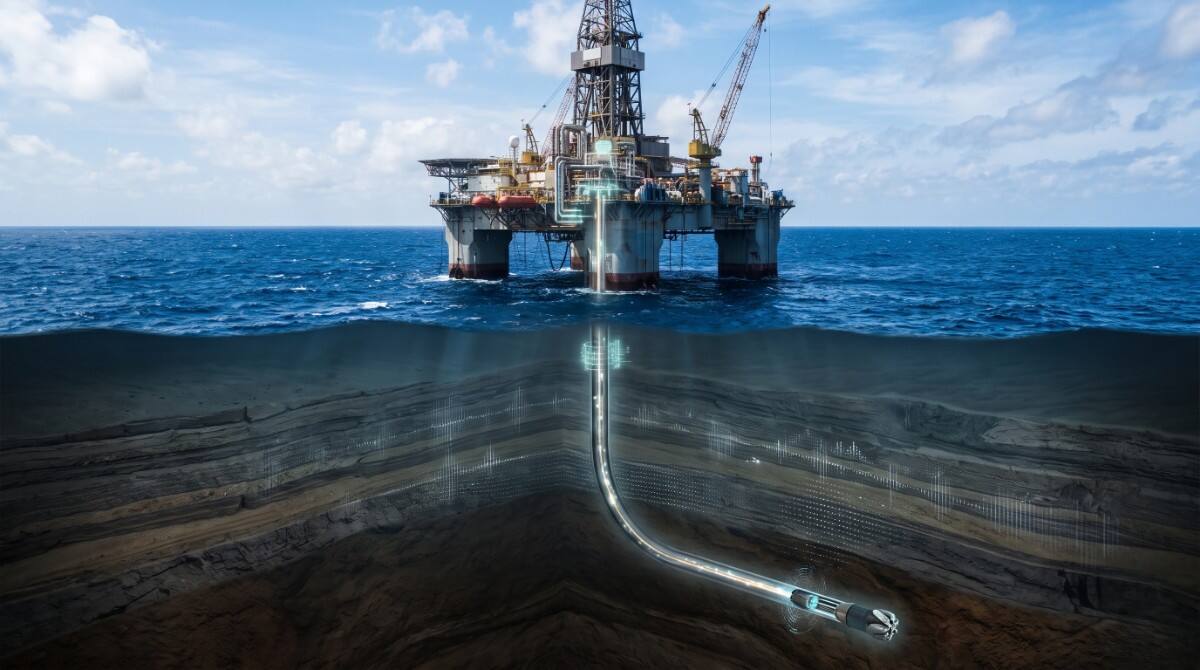
In complex offshore carbonate and deepwater turbidite campaigns during 2025 and 2026, Baker Hughes deployed its high-speed telemetry platforms integrated with NaviTrak steering and advanced modular logging suites. The system transmitted real-time acoustic compressional and shear wave data alongside high-resolution resistivity images through challenging high-pressure, high-temperature formations, enabling operators to identify reservoir fluid contacts and structural fault planes hundreds of feet ahead of the drill bit.
Edge Computing and Downhole Data Pre-Processing
To further maximize telemetry efficiency, modern downhole sensor subs incorporate ruggedized microprocessors capable of executing edge computing algorithms directly behind the drill bit. Rather than transmitting raw voltage signals across transmission channels, downhole tools perform onboard filtering, fast Fourier transform vibration analysis, and statistical feature extraction downhole.
By transmitting compressed high-value feature vectors and anomaly flags rather than unprocessed noise, edge computing enables drillers to extract maximum situational awareness from available telemetry bandwidth. When anomalous conditions such as sudden fluid influxes or catastrophic stick-slip are detected, downhole microprocessors automatically prioritize emergency diagnostic packets, temporarily overriding routine formation evaluation telemetry to alert surface crews instantly.
Hybrid Telemetry Solutions in Multi-Phase Drilling
In underbalanced drilling, managed pressure operations, and high-temperature geothermal wells, no single telemetry medium functions optimally across every hole section. For example, aerated or foam drilling fluids severely attenuate acoustic mud pulses, while deep high-resistivity formations and salt sheets can degrade electromagnetic signal propagation.
To ensure uninterrupted communication across changing drilling conditions, operators increasingly implement hybrid telemetry networks. Weatherford International expanded its multi-channel electromagnetic and acoustic hybrid downhole telemetry network across North American and Middle Eastern operations throughout 2025. The modular downhole subassembly automatically detects signal-to-noise degradation in the primary communication channel, switching seamlessly between electromagnetic and acoustic transmission modes without interrupting drilling operations. This dual-path architecture guarantees unbroken telemetry during aerated underbalanced drilling and through complex geological unconformities where single-medium telemetry systems routinely fail.
Downhole Telemetry as the Foundational Enabler of Pressure Control
The operational value of high-speed downhole telemetry extends far beyond directional steering. By continuously transmitting equivalent circulating density, annular pressure differentials, and downhole flow parameters at sub-second intervals, telemetry systems serve as the critical early warning mechanism for severe wellbore instability. When equivalent circulating density begins to spike or annular pressure anomalies indicate micro-fracturing and hydraulic breakdown, the continuous data stream instantly informs surface control systems, providing the foundational measurements required for deploying lost circulation technologies to dynamically adjust surface chokes and deploy engineered sealing treatments before catastrophic fluid loss destabilizes the wellbore.
References
- “IntelliServ Broadband Wired Drill Pipe Network Sets Reliability Benchmarks” – NOV Inc.
- “NaviTrak High-Speed Telemetry and Real-Time Acoustic Imaging in Deep HPHT Formations” – Baker Hughes
- “Multi-Channel Electromagnetic and Acoustic Hybrid Telemetry Systems” – Weatherford International
- “Broadband Downhole Telemetry: Network Architecture, Bandwidth Evolution, and Automated Well Construction” – Society of Petroleum Engineers
