












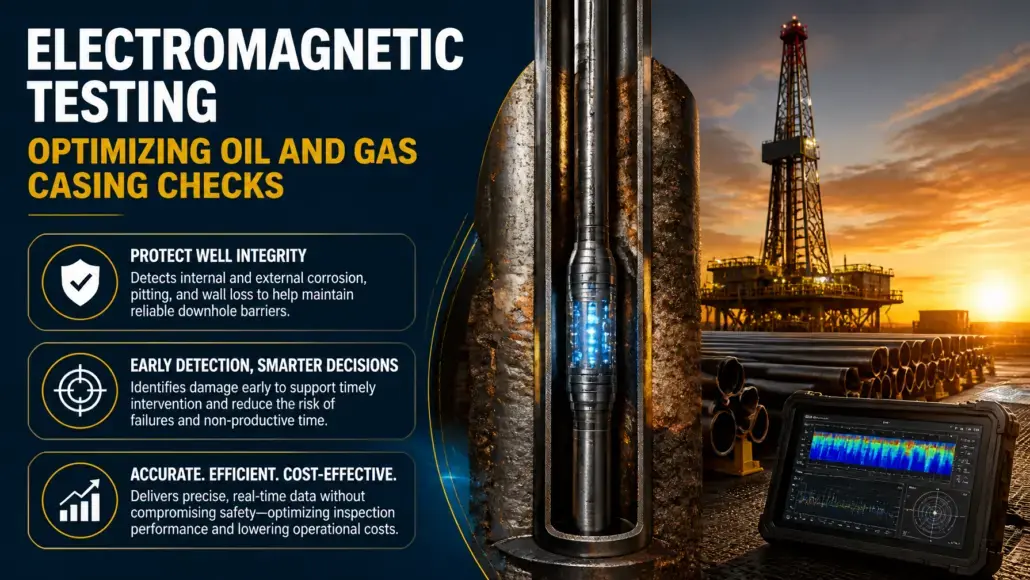
Maintaining downhole well integrity is among the most demanding technical challenges facing upstream oil and gas operators. Hydrocarbon wells penetrate thousands of meters into the subsurface, protected by concentric carbon steel casing strings cemented into place to isolate freshwater aquifers, withstand tectonic shifting, and contain reservoir pressures. Downhole environments subject these steel barriers to aggressive degradation mechanisms, including sour gas corrosion from hydrogen sulfide, carbonic acid erosion from carbon dioxide, corrosive formation brines, and mechanical wear from drill strings. A breach in a single casing string risks catastrophic blowouts, subsurface fluid migration, and costly environmental remediation.
Oil & Gas Advancement observes that evaluating the condition of downhole tubulars presents formidable physical obstacles. Wellbores are narrow, deep, and often filled with opaque drilling mud, crude oil, or dense completion brines. While mechanical multi-finger calipers can map the internal profile of the innermost pipe, they cannot detect metal loss on the external surface of the pipe or evaluate outer casing strings. To overcome these limitations, operators deploy advanced electromagnetic testing technologies via wireline logging cables. These electromagnetic methods penetrate through fluid and metal barriers, providing quantitative wall thickness measurements across multiple nested casing strings without requiring workover rigs to pull production tubing out of the well.
Fundamental Physics of Downhole Electromagnetic Inspection
Downhole electromagnetic evaluation relies on the interaction between controlled electromagnetic fields and the conductive, ferromagnetic properties of carbon steel casing. Depending on the specific tool design and inspection objectives, wireline instruments employ three primary electromagnetic modalities:
- Magnetic Flux Leakage utilizes powerful permanent magnets or low-frequency electromagnets to drive a section of the casing wall into magnetic saturation. When the magnetic field encounters an area of metal loss, such as an internal corrosion pit or external gouge, the magnetic lines of force cannot be contained within the thinned steel. The magnetic flux leaks into the adjacent borehole space, where sensitive Hall effect sensors or induction coil arrays measure the leakage flux amplitude and shape to determine flaw volume.
- Remote Field Eddy Current Testing uses an internal transmitter coil driven by low-frequency alternating current. The electromagnetic field travels radially outward through the pipe wall, propagates axially along the exterior of the pipe, and re-enters the pipe interior where receiver coils are placed several pipe diameters away. The phase shift and attenuation of the received signal provide a direct, highly linear measurement of total circumferential wall thickness.
- Pulsed Eddy Current instruments apply a step-function direct current to an excitation coil, generating a transient magnetic field that induces decaying eddy currents through the casing wall. By analyzing the time-dependent diffusion and decay rates of the electromagnetic field, digital processors calculate the individual wall thicknesses of up to four concentric casing strings simultaneously.
High-frequency eddy current coils are often integrated into the same tool mandrel to inspect the innermost pipe surface. Because high-frequency currents remain confined to the skin depth of the inner metal face, they respond exclusively to internal defects. By comparing high-frequency surface responses with low-frequency through-wall signals, data analysts can definitively distinguish between internal erosion grooves and external formation corrosion.
Industry Standards and Well Integrity Frameworks
The deployment of electromagnetic casing inspection tools operates under strict international regulatory frameworks and well barrier standards:
- API Specification 5CT establishes manufacturing tolerances, minimum wall thicknesses, and material properties for oil and gas well casing and tubing.
- API Recommended Practice 90-2 outlines comprehensive policies for managing annular casing pressure in onshore and offshore wells, mandating periodic diagnostic logging when sustained casing pressure is detected.
- ISO 16530-1 provides international standard guidelines for well integrity management during the operational phase, requiring documented verification of physical well barriers throughout field life.
- NORSOK Standard D-010 defines well integrity requirements in drilling and well operations, establishing criteria for two-barrier envelopes and diagnostic evaluation of compromised casing strings.
- API Recommended Practice 14B mandates subsurface safety valve and casing integrity verification across offshore production platforms.
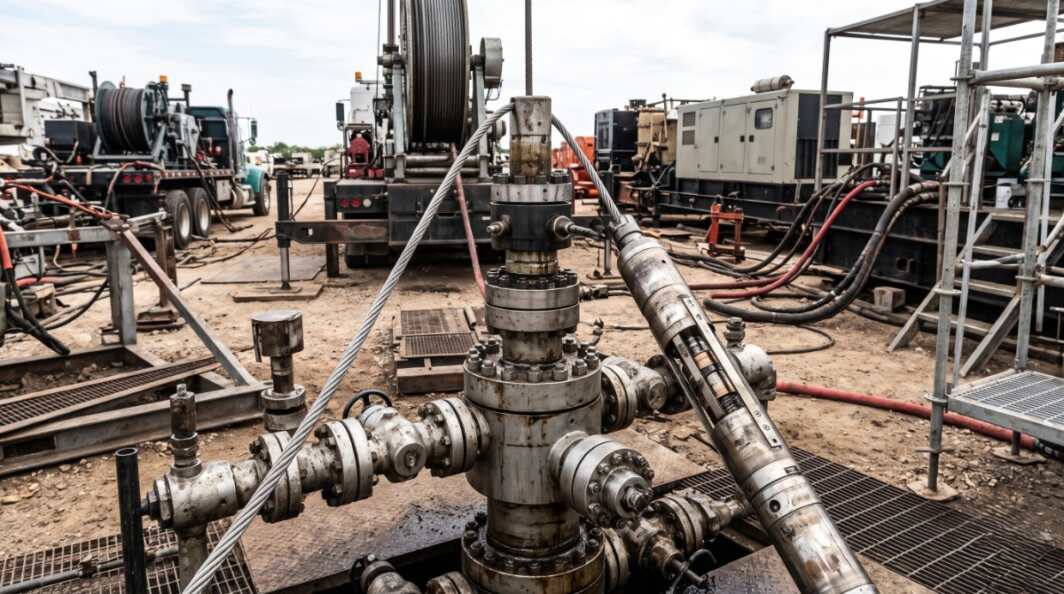
These standards dictate that when sustained annular pressure or unexplained pressure communication occurs between concentric casing strings, operators must conduct diagnostic logging. Electromagnetic testing tools provide the quantitative wall thickness logs necessary to calculate remaining burst and collapse ratings under revised API 5C3 formulas.
Commercial Innovations Across Leading Oilfield Service Companies
The global wireline logging sector has introduced sophisticated electromagnetic casing inspection platforms designed for complex completions and deep HPHT wells:
- SLB deployed its EM Pipe Scanner electromagnetic casing inspection tool across major offshore and onshore fields. The instrument features high-speed screening capabilities up to 3,600 feet per hour during low-frequency passes, identifying multi-barrier casing corrosion and localized wall thinning without requiring rig-assisted tubing pulls.
- Baker Hughes expanded its downhole integrity portfolio with the Digital Magnelog service paired with high-resolution Multi-Finger Imaging Tools. The integrated logging string provides simultaneous 360 degree inner surface caliper profiling and electromagnetic wall thickness measurements across multiple nested tubular strings.
- Halliburton engineered the Electromagnetic Imaging Tool, known as EMIT, which utilizes multi-frequency electromagnetic coils and high-speed telemetry to map metal loss, casing collar damage, and external casing corrosion across outer structural barriers.
- Weatherford commercialized its UltraSlim electromagnetic casing evaluation system, enabling wellbore access through narrow restrictions and micro-tubing to inspect deep production casing strings in aging brownfield assets.
- Eddyfi Technologies expanded the deployment of its Lyft pulsed eddy current system on surface wellheads, conductor casings, and offshore caissons, providing non-intrusive wall thickness evaluation through thick corrosion protection coatings and thermal cladding.
These commercial developments highlight how high-speed downhole telemetry and digital signal processing have transformed casing inspection from time-consuming workover procedures into rapid wireline operations.
Multi-Barrier Evaluation in Complex Well Completions
Modern deepwater and mature onshore wells often feature complex tubular architectures consisting of a central production tubing string surrounded by production casing, intermediate casing, and surface conductor pipes. Traditional acoustic logging tools cannot evaluate outer casings because acoustic waves reflect almost entirely from the first fluid-to-steel interface.
In contrast, electromagnetic testing technologies utilize low-frequency magnetic diffusion to penetrate multiple metallic boundaries. By analyzing the diffusion arrival times, downhole processors separate the electromagnetic response of the first pipe from the delayed responses of the second and third casing strings.
This multi-barrier capability delivers vital operational insights:
- Identification of casing corrosion behind production tubing allows operators to verify well integrity without spending millions of dollars pulling the completion assembly.
- Detection of outer casing wear caused by drill string rotation during deep drilling operations prevents unexpected collapse during subsequent fracture stimulation stages.
- Assessment of surface conductor and intermediate casing integrity in aging offshore platforms ensures structural load-bearing capacity remains sufficient to support platform deck weights.
- Evaluation of casing integrity across carbon capture, utilization, and storage conversion candidates, ensuring legacy oilfield wells can safely contain supercritical carbon dioxide without leakage.
Quantitative Data Interpretation and Asset Life Extension
Electromagnetic casing logs produce continuous, high-resolution profiles displaying individual and total wall thicknesses, internal and external defect indicators, and magnetic permeability variations. Automated processing software converts raw phase shifts and signal amplitudes into intuitive colour-coded 2D maps and 3D cylindrical projections of the wellbore.
Casing collars, centralizers, and perforation clusters create distinct electromagnetic signatures that provide precise depth correlation across historical well logs. Machine learning algorithms compare modern logging runs against original baseline logs recorded during initial well completion, tracking annualized corrosion rates and identifying accelerating wall loss before failure thresholds are breached.
When logs reveal severe localized thinning or mechanical perforation damage, production engineers use the quantitative spatial data to design targeted workover interventions. Instead of executing full string replacements, operating companies install expandable casing patches or set straddle packers directly across the compromised depth interval. Accurate downhole defect sizing ensures that cement squeeze remediation procedures isolate depleted zones effectively, preventing gas channeling toward surface wellheads.
Once fluids safely reach surface processing facilities, structural assurance shifts from downhole barriers to heavy containment equipment, where operators rely on Acoustic Emission Testing for Detecting Defects in Pressure Vessels during hydrotesting and operating cycles. Linking subsurface casing evaluation with surface vessel testing establishes an integrated integrity barrier safeguarding the complete hydrocarbon production chain.
References
- “EM Pipe Scanner Electromagnetic Casing Inspection Tool” – SLB
- “Digital Magnelog Casing Inspection Service Technical Overview” – Baker Hughes
- “Electromagnetic Imaging Tool Downhole Integrity Services” – Halliburton
- “UltraSlim Casing Evaluation and Well Integrity Systems” – Weatherford
- “Lyft Pulsed Eddy Current Casing and Conductor Inspection” – Eddyfi Technologies
- “Well Integrity for the Operational Phase Standard 16530-1” – International Organization
- for Standardization
- “Specification for Casing and Tubing Specification 5CT” – American Petroleum Institute
- “Cased Hole Wireline Logging Market Dynamics 2025” – Mordor Intelligence
