





















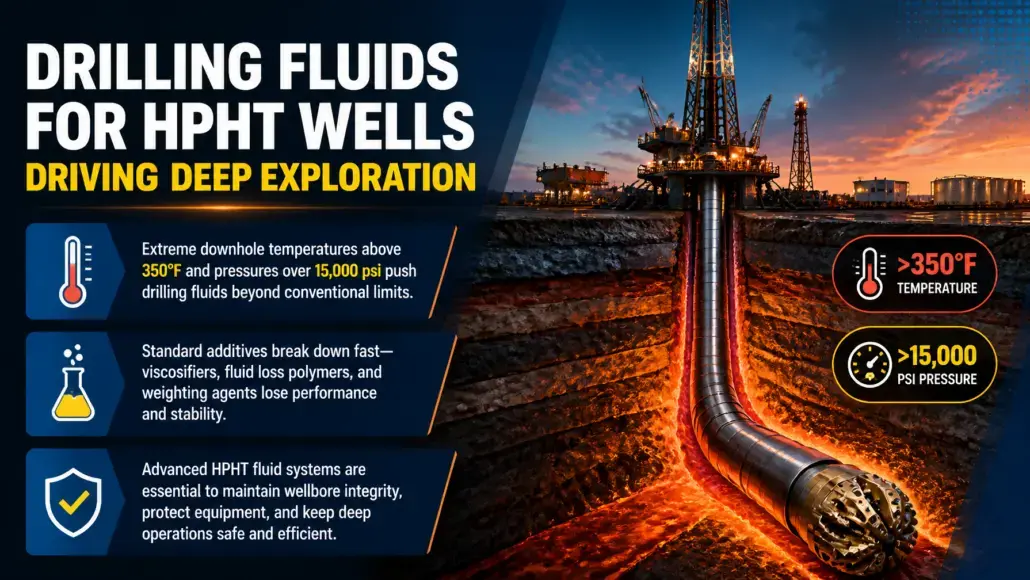
Drilling into ultra-deep horizons exposes downhole circulating systems to thermodynamic forces that test the outer physical limits of chemical engineering. When bottomhole static temperatures surge past 350 degrees Fahrenheit and pore pressures exceed 15,000 pounds per square inch, standard fluid additives break down rapidly. Under these extreme conditions, viscosifiers decompose, fluid loss polymers degrade into short chains, and weighting agents drop out of suspension, leaving drillstrings exposed to differential sticking and severe well control incidents.
The economic and operational significance of these extreme environments has expanded substantially. Global exploration strategies in the Gulf of Mexico, the North Sea, the Middle East, and offshore Brazil increasingly depend on drilling fluids for HPHT wells to unlock hydrocarbons locked beneath deep salt sheets and hard carbonate formations. Commercial research published in late 2025 by FactMR projects that specialized deep exploration and pressure management services continue to expand at a compound annual rate exceeding 4.3 percent through the coming decade, driven directly by deepwater and unconventional plays.
Safeguarding wellbore integrity under severe conditions requires a fundamental shift from conventional mud blending toward scientifically engineered, thermally stable chemical fluid architectures that resist molecular breakdown under continuous stress.
Thermal Degradation Mechanisms in Extreme Environments
Downhole fluids in high-pressure and high-temperature environments undergo extreme mechanical and thermal shear simultaneously. In conventional water-based or lower-tier synthetic systems, elevated thermal energy accelerates chemical oxidation and hydrolysis. Long-chain polymers such as xanthan gum, carboxymethyl cellulose, and polyanionic cellulose, which provide essential cutting carrying capacity and filtration control, experience rapid thermal chain scission.
Once molecular chains snap, fluid viscosity drops precipitously. The fluid loses its yield point, reducing its ability to suspend dense weighting minerals during circulating pauses or connection breaks. Simultaneously, the filter cake across permeable formations thickens into an irregular, permeable sludge, triggering massive fluid filtrate loss into the productive reservoir rock. This fluid loss destabilizes the borehole wall and complicates subsequent logging evaluations.
In non-aqueous inverted emulsion systems, high temperatures challenge surfactant packages. Fatty acid emulsifiers and wetting agents maintain brine droplet dispersion within the continuous hydrocarbon phase. When thermal degradation weakens these surfactants:
- Internal brine droplets coalesce into free water pockets.
- Electrical stability measurements drop sharply, signaling emulsion failure.
- Weighting solids turn water-wet, causing severe agglomeration.
- Rheological properties spike into uncontrolled gelation upon cooling in the riser.
Overcoming these structural failure modes demands innovative synthetic additives engineered specifically for elevated thermal endurance across extended exposure periods.
Advanced Polymer Architectures and Synthetic Base Oils
To combat molecular scission, chemical formulators have turned to synthetic copolymers and thermally stable cross-linking chemistries. Modern high-temperature water-based systems replace vulnerable polysaccharides with synthetic terpolymers containing 2-acrylamido-2-methylpropane sulfonic acid, vinylamide, and acrylic acid monomers. These synthetic chains maintain structural integrity at temperatures exceeding 425 degrees Fahrenheit, providing consistent shear-thinning rheology and low fluid loss even when exposed to severe shear in deep drilling profiles.
Synthetic-based non-aqueous formulations utilize isomerized olefins, linear alpha olefins, and refined synthetic paraffin bases. These synthetic matrices exhibit high flash points, minimal volatility, and resistance to thermal oxidation. Specialized polymeric emulsifiers synthesized from modified polyisobutylene succinic anhydride replace traditional fatty acid soaps, preserving emulsion integrity across broad temperature swings between surface chillers and scorching bottomhole intervals.
Service companies have made substantial commercial advancements in high-temperature fluid design:
- Halliburton engineered its BaraXcel non-aqueous fluid system, incorporating high-temperature organophilic clays and polymeric rheology modifiers to maintain stable suspension and flat rheological properties under severe thermal cycles.
- SLB expanded its EcoShield and high-temperature reservoir fluid technologies, using specialized synthetic polymers to deliver ultra-low filtration rates and thermal endurance up to 450 degrees Fahrenheit.
- Baker Hughes deployed synthetic HPHT fluid systems featuring customized manganese tetroxide and micro-milled barite formulations that preserve fluid stability while reducing dynamic pressure drops through deep drillstrings.
These advanced formulations demonstrate that custom-designed chemical architectures can maintain reliable fluid boundaries where conventional drilling muds experience complete breakdown.
Barite Sag Mitigation and Suspension Engineering
Barite sag represents one of the most perilous operational hazards encountered when managing drilling fluids for HPHT wells. Sag describes the dynamic or static settling of dense weighting solids such as barium sulfate out of the drilling fluid column. This settling creates large hydrostatic density variations between different depths of the wellbore, creating severe drilling hazards.
When the lower fluid column loses density, downhole pressure can drop below the formation pore pressure, allowing formation gas or brine to enter the wellbore in a sudden kick. Conversely, when settled barite accumulates downhole or travels to surface in a dense slug, hydrostatic pressure can exceed the formation fracture gradient, fracturing the formation and causing catastrophic lost circulation. These density variations complicate well control decisions and place excessive load on surface mud pumps.
Controlling sag under HPHT conditions requires precise rheological tuning at ultra-low shear rates. Engineers focus on the yield stress and low-shear viscosity measured at 3 to 6 revolutions per minute on a rotational viscometer. Modern fluid designs introduce cross-linked polymeric rheology modifiers and micronized weighting minerals:
- Micro-milled weighting agents possess smaller average particle sizes, significantly reducing mechanical settling velocities according to Stokes’ Law.
- Surface-treated barite and alternative weight materials such as ilmenite or manganese oxide maintain neutral wetting characteristics, preventing clump formation.
- Specialized rheology modifiers build a delicate, reversible three-dimensional gel network under static conditions that immediately suspends solids without generating excessive circulating pressure when pumps restart.
Maintaining stable suspension without inflating equivalent circulating density is essential for preventing formation fractures in tight drilling windows.
Pressure Management and Hydraulic Integration
Operating in high-pressure and high-temperature environments inevitably tightens the operational margin between reservoir pore pressure and formation breakdown limits. As wells go deeper, the drilling window can narrow to less than 0.5 pounds per gallon equivalent fluid weight. In these narrow operating margins, managing fluid hydraulics becomes as crucial as fluid chemistry. Small changes in pump rate, pipe movement, or mud temperature can push downhole pressures outside safe operating limits.
To successfully manage these razor-thin hydraulic boundaries, drilling operations frequently pair advanced fluid systems with [Managed Pressure Drilling Tech Helping in Narrow Drilling Windows] to dynamically control bottomhole annular pressure during drilling, connections, and tripping. Combining closed-loop pressure management with thermally stable fluids prevents both fluid loss and influxes, protecting reservoir rock from severe skin damage.
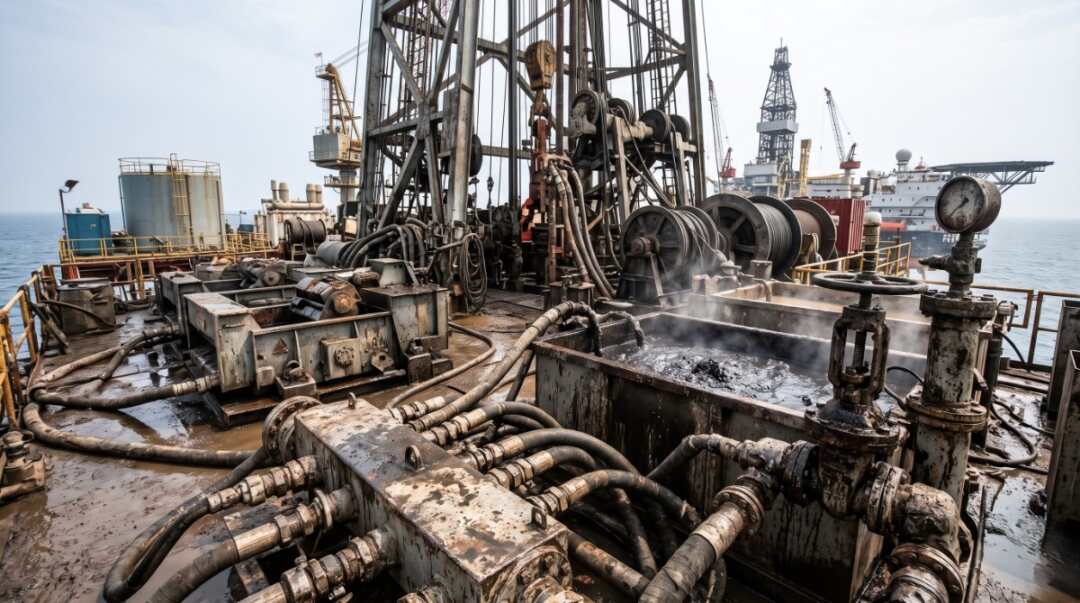
The density of drilling fluids for HPHT wells must be monitored continuously at surface because drilling mud expands under high temperature and compresses under high pressure. Standard surface mud balances only measure atmospheric density, which can deviate significantly from true downhole density. Service companies now rely on downhole pressure-while-drilling sensors combined with sophisticated hydraulic simulation software that models fluid compressibility and thermal expansion across every foot of the hole, allowing real-time hydraulic adjustments.
Formation Protection and Long-Term Well Productivity
The final measure of success for any high-temperature drilling fluid lies in the long-term productivity of the completed well. In deep gas reservoirs and tight oil formations, exposure to incompatible mud filtrate or excessive solids invasion can permanently impair rock permeability. Reservoir rocks that took millions of years to form can suffer irreversible damage in a matter of hours if unconditioned mud components invade productive pore spaces.
Traditional weighting solids and low-quality clays often penetrate micro-fractures in high-temperature formations, forming an internal filter cake that resists conventional cleanup flushes. When exposed to production temperatures, trapped mud filtrate can form stubborn emulsions, water blocks, or mineral scales within the pore throat network.
Advanced drilling fluids for HPHT wells solve this challenge by using acid-soluble or degradable components exclusively within the reservoir interval:
- High-purity calcium carbonate particles are precisely sized according to reservoir pore throat distributions, establishing an impermeable external shield without invading deep rock pore networks.
- Thermally stable polymeric starch derivatives seal microscopic pores and subsequently degrade over time or break down cleanly upon contact with mild organic acid solutions.
- Chelating agents and specialized micro-emulsion cleanup spacers are pumped immediately prior to casing and tubing installation to invert rock wettability and dissolve residual cake components.
Oil & Gas Advancement notes that by prioritizing reservoir protection alongside drilling performance, modern drilling fluids for HPHT wells allow operating companies to extract valuable hydrocarbon reserves from extreme geological settings that were historically deemed unworkable or uneconomic. Careful chemical design preserves reservoir flow capacity, ensuring sustained delivery across decades of field production.
References
- “Managed Pressure Drilling Services Market and Deepwater Outlook” – FactMR
- “BaraXcel Non-Aqueous Fluid System Technical Specification” – Halliburton
- “High-Temperature Well Construction and Drilling Fluid Engineering” – SLB
- “Drilling and Completion Fluids Technology for Harsh Environments” – Baker Hughes
