










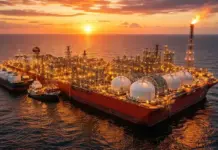






More countries are investing in a new energy supply infrastructure that will rely on LNG from gas-rich locations. As a developed Western European country, Spain needs to develop a gas supply infrastructure that can take advantage of lower prices in the world gas price – whether from Saudi Arabia, Nigeria, the Gulf of Mexico or a host of others – and to do this requires big storage capacity.
Enagás
“The new Enagás LNG facility is the seventh new terminal in Spain.â€
Enagás is one of Spain’s principal gas transport companies and has recently been awarded a government contract to construct and operate a new regasification plant in the port of El Musel in Gijon, Northern Spain. The Spanish Ministry of Industry, Trade and Tourism Directorate General of Energy Policy awarded the contract to increase the gas storage capacity of the region.
The facility is expected to take three years to construct following the granting of official permits, and operations have been slated to begin in 2010-11. Enagás already runs three similar Liquid natural gas (LNG) storage and distribution plants in Barcelona, Cartagena and Huelva.
David Seaton, president of Fluor’s energy and chemicals group, commented: “The new Enagás LNG facility is the seventh new terminal in Spain in recent years and it will help to achieve the country’s goal of having reserves of at least 35 days of gas consumption. Fluor is honored that we have been chosen to participate in this important project.”
PROJECT
The capacity of the initial installation will be 300,000 cubic metres between two storage tanks and a docking terminal will handle LNG tankers with capacities of 250,000 cubic metres. The regasified send-out capacity of the first-phase terminal will be 800,000 cubic metres an hour.
“The regasified send-out capacity of the first-phase terminal will be 800,000 cubic metres an hour.â€
The second phase of the terminal will see an additional two storage tanks constructed so that the final capacity will be about 1,200,000 cubic metres. The second phase will be completed by 2012.
The initial investment for the plant will be about €375 million (part of Enagás’ €4.3 billion investment plan for the next four years and it will be constructed on an 18-hectare site at one of Spain’s largest ports, in Gijón in the province of Asturia. The terminal will supply the domestic gas grid and two combined cycle power stations in the Asturia province.
CONTRACTOR
The detailed engineering, procurement, construction management (EPCM) contract for the new plant was awarded to Fluor in April 2008. The EPCM contract for the project is worth about €320 million ($230 million) and the construction is scheduled to begin in late 2008-early 2009.
The engineering for the plant will be carried out from the Fluor Asturia office and the project will employ about 400–500 workers from the local area.