














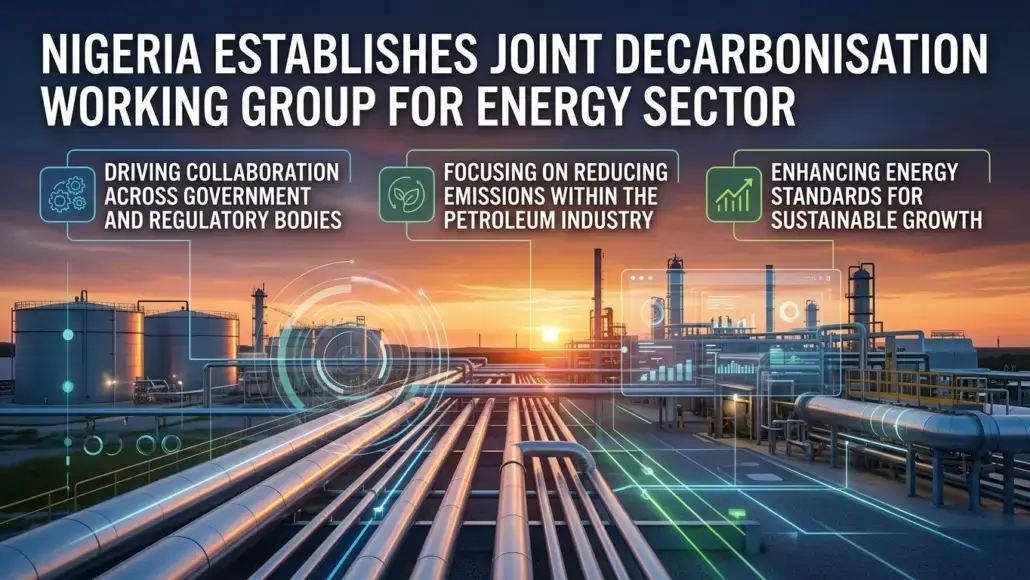
The Federal Government of Nigeria has officially inaugurated the Joint Decarbonisation Working Group (JDWG). This initiative involves a collaborative effort between the Ministry of Petroleum Resources, the National Council on Climate Change (NCCC), and various regulatory bodies to reduce emissions within the nation’s petroleum industry.
Driving Sustainable Growth in the Energy Sector
During the inauguration ceremony held in Abuja, the Minister of State for Petroleum Resources (Gas), Ekperikpe Ekpo, emphasized that decarbonisation has evolved into an economic and investment necessity. According to the Minister, the primary objective is to maintain Nigeria as a preferred destination for energy investment by establishing regulatory frameworks that foster investor confidence.
The decarbonization team is tasked with coordinating a national effort to advance cleaner practices across the oil and gas industry. The government intends to leverage abundant natural gas resources to fuel industrialization, improve domestic gas utilization, and expand energy access while addressing global climate change targets.
Strategic Mandate and Climate Commitments
The mandate for the committee includes several core responsibilities:
- Coordinating initiatives focused on methane reduction.
- Strengthening Measurement, Monitoring, Reporting and Verification (MMRV) systems.
- Facilitating access to international carbon markets and climate finance.
- Supporting the deployment of emissions-reduction technologies.
“Nigeria has also continued to engage constructively within the international community on methane reduction,” said Ekpo.
“Recently, our country expressed support for the United Kingdom-led Global Statement on Reducing Methane Emissions from Fossil Fuel Operations, recognising methane abatement as one of the fastest and most cost-effective opportunities to reduce emissions while preserving energy production,” he added.
Legislative Support for Industrial Improvement
The Minister reiterated that economic development and climate action must progress in tandem, asserting that developing nations should balance environmental protection with poverty reduction. Supporting this initiative, the Chairman of the House Committee on Climate Change, Kama Nkemkanma, confirmed that lawmakers are prepared to enact necessary legislation to support these efforts to clean up the energy sector. The work of the JDWG is intended to ensure that the oil and gas industry remains competitive, resilient, and aligned with sustainable development goals.
