













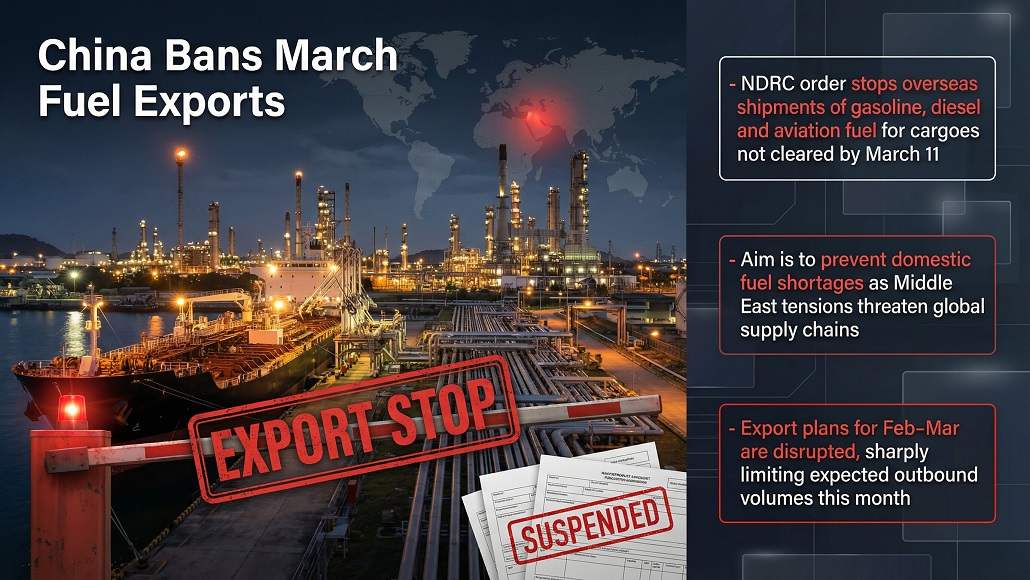
China has introduced a ban on March fuel exports as authorities move to prevent a potential domestic fuel shortage linked to the U.S.-Israeli war on Iran. The decision, issued by the National Development and Reform Commission (NDRC), immediately halts overseas shipments of refined products including gasoline, diesel and aviation fuel. The order applies to cargoes that had not yet cleared customs as of March 11, effectively suspending outbound shipments that were still awaiting final export processing.
The measure marks a stronger intervention compared with steps taken the previous week, when Beijing urged refiners not to agree to new exports and to try to cancel shipments they had already committed to. By enforcing the ban on March fuel exports, authorities are attempting to safeguard domestic fuel availability as recent tensions in the Middle East threaten global energy supply chains.
Under the directive, the suspension affects shipments of gasoline, diesel and aviation fuel, although sources said jet fuel used for aviation bunkering is not included under the ban. The ban on March fuel exports comes at a time when Chinese refiners had initially prepared to increase overseas sales during the early months of the year. Traders indicated that Chinese oil majors had planned to ramp up exports during February and March, aiming to capitalize on stronger profit margins while domestic consumption softened during the Lunar New Year holiday period. That seasonal slowdown in domestic demand had historically created opportunities for refiners to boost overseas shipments.
Market participants had earlier projected that China’s March fuel exports could reach 2.2 million to 2.3 million tons for gasoline, diesel and jet fuel, excluding volumes intended for aviation bunkering. Those forecasts suggested an increase of 300,000 to 400,000 tons compared with expectations for February. However, the introduction of the ban on March fuel exports has significantly curtailed those flows. Data from ship trackers and trade sources show that export volumes so far this month remain limited. As of the latest figures, China has shipped up to 50,000 metric tons of gasoline (422,500 barrels), 300,000 tons of diesel (2.24 million barrels) and 300,000 tons of seaborne jet fuel (2.36 million barrels).
The move underscores China’s role as both the world’s biggest oil importer and a major exporter of refined fuels. By implementing the ban on March fuel exports, authorities are prioritizing domestic supply stability as international energy markets react to disruptions caused by the conflict in Iran.
