









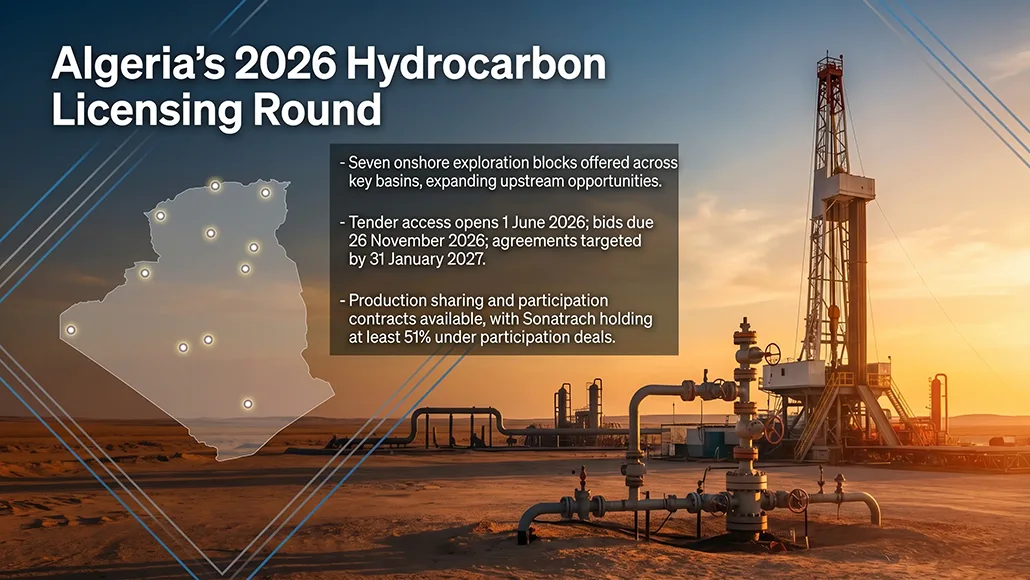
Algeria has initiated a fresh international licensing round featuring seven hydrocarbon exploration blocks, marking a renewed effort to draw investment into its upstream sector while building on progress achieved during the 2024 bid round. The 2026 offering includes seven onshore assets: Illizi Centre 1 in the Illizi basin, El M’Zaid North in the Oued Mya basin, El Borma II in the Berkine basin, East Bordj Omar Driss 1 also in the Illizi basin, El Hadjira III in the Oued Mya basin, El Benoud East in the Benoud trough basin, and Touggourt South in the Amguid Berkin region. This licensing initiative centered on hydrocarbon exploration blocks reflects Algeria’s continued strategy to expand exploration activity and strengthen upstream participation.
According to Algeria Press Service, the process timeline begins with the release of tender documentation, access to Virtual Data Rooms (VDR), and online technical briefings starting from 1st June 2026, concluding on 31st October 2026. Oversight of data licensing for the hydrocarbon exploration blocks has been assigned to EXALT, a joint initiative between ALNAFT and SLB, operating under the supervision of the Bid Round (BR) Committee. Bid submissions are scheduled for 26th November 2026 between 8:00 a.m. and 10:30 a.m. (Algeria time), with contract awards to be announced the same day at 11:00 a.m. Successful participants are expected to finalize agreements with Sonatrach by 31st January 2027.
Evaluation criteria vary across the offered assets. Proposals for the Est Bordj Omar Driss I perimeter will be assessed solely on technical merit, whereas bids for Illizi Centre I, El M’Zaid Nord, El Borma II, El Hadjira III, El Benoud Est, and Touggourt Sud will undergo both technical and financial evaluation. The contractual structures available for the hydrocarbon exploration blocks include production sharing and participation agreements. Under Participation Contracts, Sonatrach retains a minimum 51 percent stake, with remaining shares allocated to private partners. These agreements define financing responsibilities, contractual obligations, tax and royalty frameworks, and the proportional ownership of produced hydrocarbons at the measurement point.
The regulatory environment also ensures that private investors gain access to transportation infrastructure through transparent tariffs and equal access provisions, with proximity to existing pipelines and processing facilities expected to reduce development costs and shorten timelines to production. Within Production Sharing Contracts, private contractors recover costs and earn remuneration through allocated shares of output, while Sonatrach retains ownership of hydrocarbons at the measurement point. Although the Hydrocarbon Law No. 19-13 provides for Risk Services Contracts, this model is not included in the current round. Exploration periods are set at seven years with a possible two-year extension, followed by a production phase of 30 years, extendable by 10 years, before site abandonment and restoration conclude the lifecycle.
