















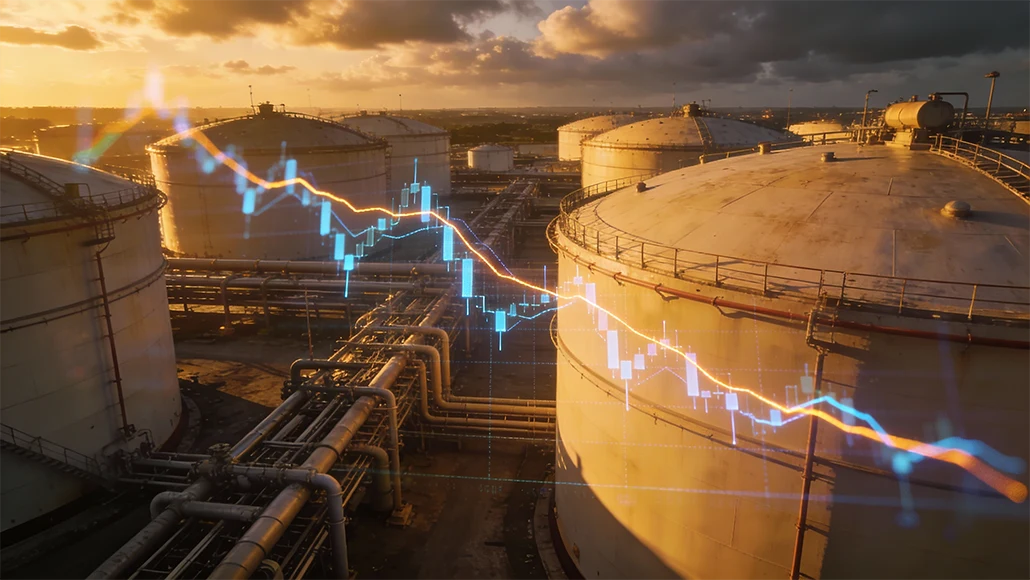
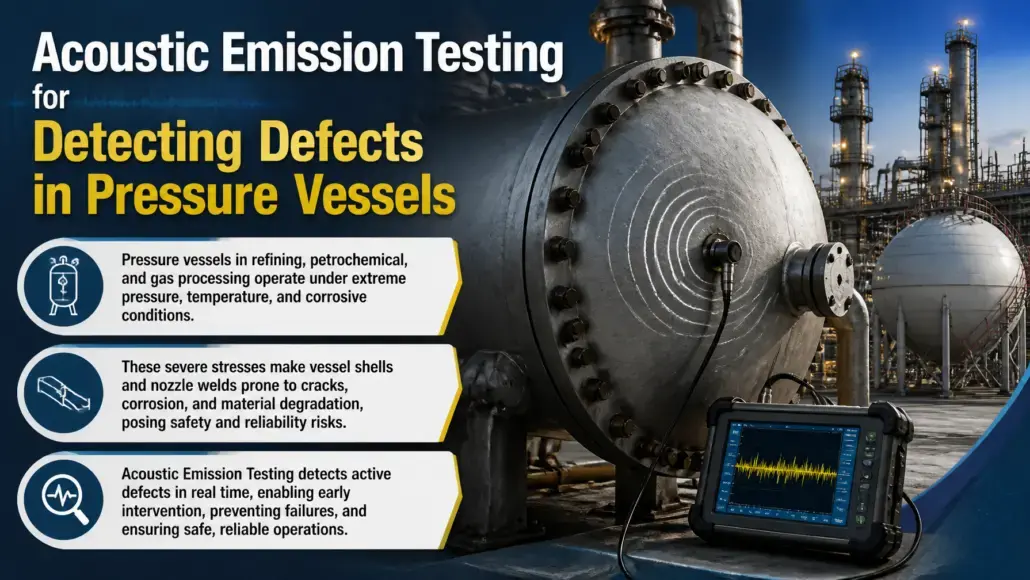
Downstream refining, petrochemical synthesis, and offshore gas processing depend heavily on heavy wall pressure vessels to contain volatile hydrocarbons under severe operational stresses. Catalytic reforming reactors, hydrocrackers, amine contactor columns, and spherical LPG storage tanks operate under high internal pressures, elevated thermal gradients, and aggressive chemical environments. These severe operating parameters make vessel shells and nozzle attachment welds susceptible to degradation mechanisms such as thermal fatigue, hydrogen-induced cracking, stress corrosion cracking, and weld embrittlement. A sudden structural breach in a high-pressure hydrocarbon separator risks catastrophic explosions, facility destruction, and tragic loss of human life.
Traditional non-destructive examination methods present significant operational hurdles when applied to massive industrial vessels. Ultrasonic scanning, magnetic particle testing, and radiography typically require full plant shutdowns, costly de-inventorying, chemical purging, internal scaffolding erection, and confined space human entry. Furthermore, conventional geometric methods scan small surface areas incrementally and cannot determine whether a detected discontinuity is stable or actively propagating under load.
To overcome these constraints, plant asset managers increasingly deploy acoustic emission testing. As a dynamic, passive sensing methodology, Oil & Gas Advancement observes that acoustic emission monitors the entire structural volume of a pressure vessel simultaneously during controlled pressure changes or normal operating cycles. Market research from Market Research Future reports that the global acoustic emission testing market reached 427.8 million dollars in 2025, expanding steadily as energy producers and chemical processors adopt non-intrusive asset health monitoring technologies.
Physics of Transient Stress Waves and Flaw Dynamics
Unlike active non-destructive testing methods that transmit external radiation or high-frequency sound pulses into a component, acoustic emission testing relies on the material itself to generate the diagnostic signal. When a solid metallic structure undergoes mechanical deformation or thermal stress, localized stress concentrations develop around microscopic defects.
As stress intensifies, localized micro-yielding, micro-crack initiation, crack face friction, or inclusion fracture causes a spontaneous, rapid release of stored elastic strain energy. This sudden redistribution of internal strain produces transient elastic stress waves that propagate outward through the steel vessel wall in all directions, similar to miniature subterranean seismic waves.
Sensitive piezoelectric sensors acoustically coupled to the vessel exterior detect these surface displacements. Operating typically within the 100 kHz to 300 kHz frequency range, these sensors convert sub-nanometer surface vibrations into microvolt electrical signals. Low-noise preamplifiers boost the signals immediately at the sensor head, transmitting conditioned high-frequency data to digital acquisition processors.
Signal analysis distinguishes between two primary acoustic emission waveforms:
- Burst emissions consist of discrete, high-amplitude acoustic events characterized by rapid rise times and exponential decays, typical of brittle crack propagation, fatigue crack extension, or weld cracking.
- Continuous emissions represent sustained, overlapping noise signals with fluctuating amplitudes, typical of turbulent fluid leaks through pinholes, high-velocity gas escaping through fittings, or massive plastic yielding in ductile alloys.
Digital processors quantify each detected acoustic hit across fundamental signal parameters, including arrival time, peak amplitude in decibels, signal rise time, duration, energy counts, and root mean square voltage. Analyzing these parameters enables data acquisition computers to distinguish genuine defect growth from background process noises such as pump cavitation, fluid flow turbulence, or external pipe vibration.
Material Behavior Principles and Stress Evaluation
Interpreting acoustic emission data requires an understanding of material behavior under mechanical loading. Two fundamental acoustic principles govern pressure vessel testing:
- The Kaiser Effect dictates that a metal undergoing cyclical loading will produce no detectable acoustic emissions until the applied stress exceeds the previous maximum stress level experienced by the component.
- The Felicity Effect occurs when a structurally damaged material produces significant acoustic emissions before the applied stress reaches the previous maximum load.
The ratio of the stress level at which acoustic emissions resume to the previous maximum stress level is defined as the Felicity Ratio. A Felicity Ratio significantly below unity serves as a direct indicator of structural degradation, signaling that active microcracking, delamination, or localized yielding is destabilizing the vessel wall.
During controlled hydrostatic or pneumatic proof testing, engineers slowly increase vessel pressure according to standardized step-pressurization schedules. Holding pressure at predetermined plateaus allows inspectors to monitor acoustic activity during load dwell periods. If acoustic emissions continue to emit while pressure remains constant, the material is undergoing active, time-dependent crack propagation, demanding immediate pressure relief and targeted investigation.
International Codes and Regulatory Mandates
Acoustic emission testing on metallic pressure equipment is strictly governed by global boiler and pressure vessel codes:
- ASME Boiler and Pressure Vessel Code Section V Article 12 provides comprehensive rules for the acoustic emission examination of metallic vessels during pressure testing, defining sensor spacing, calibration standards, and hit evaluation criteria.
- ASME Section V Article 11 defines testing procedures for fiber-reinforced plastic pressure vessels and storage tanks.
- ASME Section VIII Division 1 and Division 2 incorporate acoustic emission monitoring as a recognized alternative or supplement to standard hydrostatic pressure testing and internal visual examinations.
- ISO 16148 specifies acoustic emission testing procedures for seamless transportable gas cylinders and high-pressure tubes during periodic requalification.
- European Standard EN 12818 establishes qualification protocols for the in-service acoustic emission testing of buried and mounded liquefied petroleum gas storage tanks.
These consensus standards establish strict zonal grading criteria. Detected acoustic events are mathematically clustered based on their spatial origin. Clusters showing high event counts, high energy release, and activity during load holds receive immediate Category I or Category II severity rankings, mandating follow-up confirmation with complementary volumetric testing methods.
Global Commercial Deployments Across Industry Providers
Leading international inspection engineering organizations have introduced advanced multi-channel instrumentation and continuous monitoring services for critical pressure equipment:
- Mistras Group expanded its global pressure vessel integrity services through deployments of its Sensor Highway continuous on-line monitoring platforms and rugged 1283 USB node instrumentation. The systems provide real-time acoustic crack detection across operating refinery reactors, catalytic reformers, and coke drums under active thermal cycling.
- Baker Hughes incorporated acoustic sensing and advanced transient analysis into its Bently Nevada and Waygate Technologies asset condition monitoring suites, offering automated leak detection and early warning stress cracking surveillance for high-pressure gas processing facilities.
- TÜV SÜD advanced its acoustic emission testing portfolio across Europe and Asia, qualifying chemical reactors and high-pressure separators under the European Pressure Equipment Directive without requiring internal vessel entry.
- Bureau Veritas conducted comprehensive acoustic emission requalification campaigns on spherical LPG storage tanks and alkylation acid vessels, validating structural integrity without de-inventorying hazardous liquid hydrocarbons.
- DNV formulated structural health monitoring guidelines and delivered third-party acoustic emission qualification programs for offshore production separators and subsea pressure containment systems in deepwater environments.
These commercial milestones illustrate how high-speed digital sensor arrays and cloud-based analytics have elevated acoustic emission testing from a specialized laboratory technique into a mainstream industrial maintenance technology.
Zonal Localization and Triangulation Networks
One of the most powerful attributes of acoustic emission testing is its ability to locate active defects across large surface areas using spatial triangulation algorithms. Technicians mount an array of piezoelectric sensors across the vessel shell in calibrated geometric networks, such as triangular or rectangular coordinate grids.
When a localized crack event occurs, the resulting acoustic wave radiates outward at the speed of sound through steel, which is approximately 3,200 meters per second for shear waves and 5,900 meters per second for longitudinal waves. Because sensors are positioned at varying distances from the defect source, the wave arrives at each sensor at slightly different times.
High-speed digital clocks measure these microsecond arrival time differences between sensor pairs. Computer algorithms calculate hyperbolic arrival curves, and the intersection point of these hyperbolas pinpoints the precise two-dimensional coordinates of the defect on the vessel shell.
Whenever acoustic sensors register high-energy burst signals indicating localized stress corrosion cracking along vessel seams, engineers immediately verify the anomaly geometry using Phased Array Ultrasonic Testing for Oil and Gas Weld Inspection to determine critical flaw depth. This multi-technology synergy ensures that global acoustic listening guides precise localized ultrasonic sizing, optimizing inspection expenditure and ensuring reliable plant operations.
Continuous On-Line Surveillance and Future Integrity Trends
Industrial facilities increasingly move beyond periodic hydrotest monitoring toward continuous, permanent acoustic surveillance. Permanently mounted waveguide sensors installed on operational vessels survive surface temperatures exceeding 500 degrees Celsius, monitoring high-temperature hydrogen attack, thermal fatigue, and cyclic stress cracking in real time.
Modern acoustic emission monitoring consoles link directly into plant distributed control systems. Machine learning classification models filter out operational background vibrations, identifying subtle acoustic emission patterns characteristic of early stage stress corrosion cracking weeks before conventional inspection methods could detect physical wall separation. Oil & Gas Advancement notes that by combining passive acoustic listening with continuous cloud analytics, energy operators achieve true condition-based asset management, safeguarding critical pressure equipment against sudden structural failure.
References
- “Sensor Highway Acoustic Emission Monitoring Solutions” – Mistras Group
- “Bently Nevada Asset Condition and Acoustic Monitoring Systems” – Baker Hughes
- “Acoustic Emission Testing for Industrial Pressure Equipment” – TÜV SÜD
- “Pressure Equipment Certification and Requalification Services” – Bureau Veritas
- “Structural Health Monitoring Guidelines for Offshore Assets” – Det Norske Veritas
- “Acoustic Emission Testing Market Analysis 2025” – Market Research Future
- “Boiler and Pressure Vessel Code Section V Article 12 Acoustic Emission Examination” – American Society of Mechanical Engineers
- “Rules for Construction of Pressure Vessels Section VIII” – American Society of Mechanical Engineers
