




















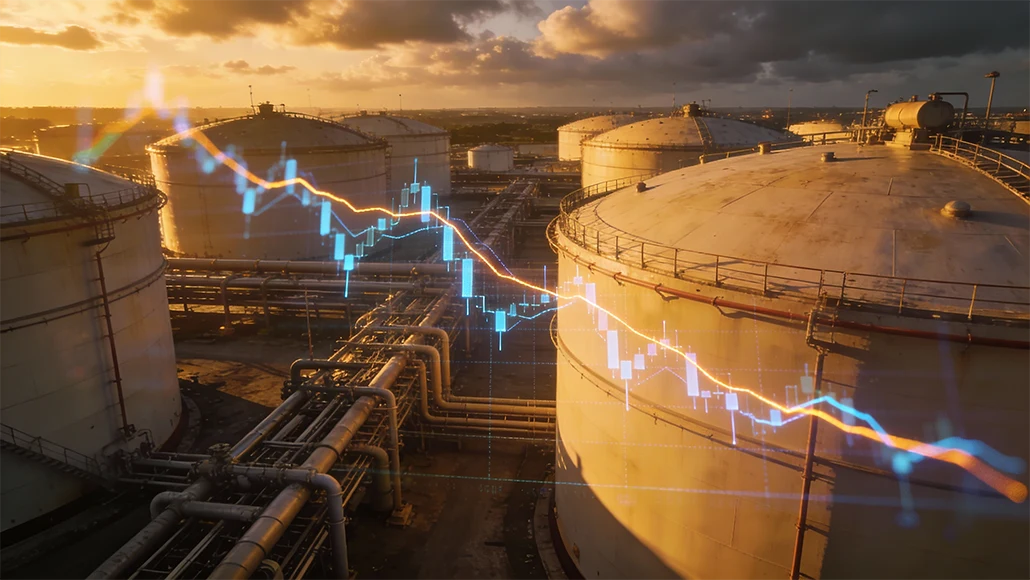
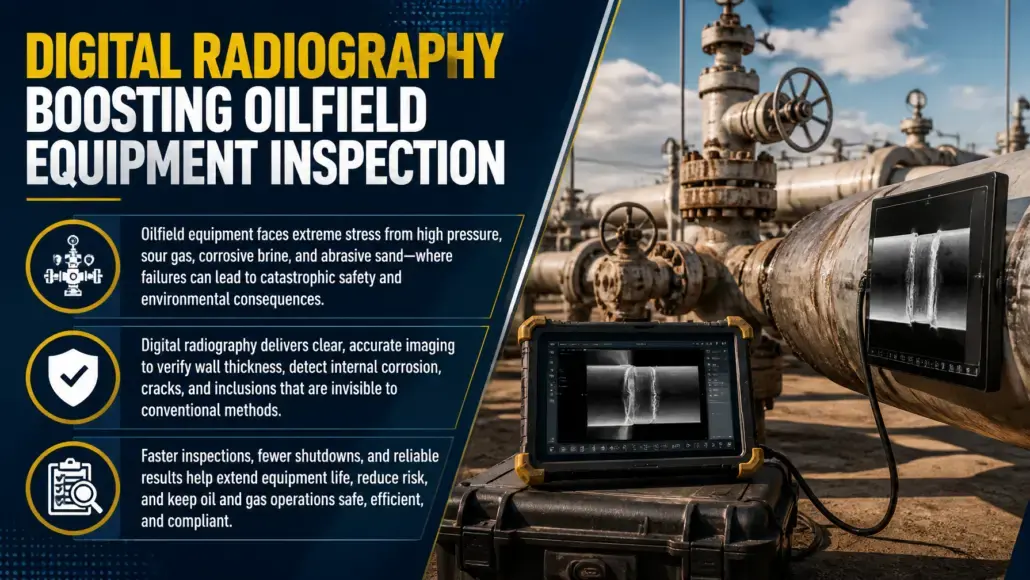
Field equipment across upstream production facilities and midstream terminals operates under extreme mechanical and environmental stress. High-pressure manifolds, choke valves, wellhead Christmas trees, and heavy wall flow lines face constant exposure to sour gas, corrosive brine, and abrasive formation sand. Equipment failures in these high-energy systems carry catastrophic safety and environmental consequences. Oil & Gas Advancement observes that verifying wall thickness, identifying internal erosion grooves, and validating weld integrity across operational oilfield equipment represents an essential operational discipline.
Historically, industrial radiography served as the primary volumetric inspection method for complex castings and valve bodies. That reliance imposed severe logistical penalties on oilfield maintenance operations. Conventional silver halide film required chemical darkroom processing, extended exposure times, and wide safety exclusion zones that halted surrounding construction or drilling operations. Today, modern digital radiography technologies replace chemical darkrooms with high-sensitivity digital sensors that deliver calibrated radiographic imagery to inspection monitors in seconds. Market research from Mordor Intelligence indicates that digital radiography adoption is expanding rapidly within the 15.93 billion dollar global non destructive testing sector, driven by operator demands to eliminate radiation downtime during offshore turnarounds and drilling pad maintenance campaigns.
Technological Architecture of Modern Digital Systems
Industrial digital radiography encompasses two primary methodologies, each tailored to distinct inspection requirements across oilfield assets:
- Computed Radiography employs flexible phosphor storage plates containing photostimulable barium fluorohalide crystals. When exposed to X-ray or gamma radiation, the phosphor plate traps latent radiation energy. An automated laser scanner then rasterizes across the plate, releasing the trapped energy as visible blue light that photomultiplier tubes convert into high-resolution digital image files.
- Direct Digital Radiography utilizes rigid or bendable flat panel detectors based on amorphous silicon or complementary metal oxide semiconductor sensor arrays. An internal scintillator screen, typically made of cesium iodide or gadolinium oxysulfide, converts incoming X-ray photons into visible light that photodiode arrays convert directly into digital signals.
Direct digital radiography represents the fastest methodology for routine oilfield equipment examination. Within three to five seconds of radiation exposure, a 16-bit grayscale digital radiograph displays on a field laptop screen. This immediate feedback eliminates the risk of incorrect exposure times or improper detector positioning that previously required repeat shots under film-based workflows. Technicians can immediately adjust source orientation or beam energy to capture subtle erosion profiles before moving to the next inspection location.
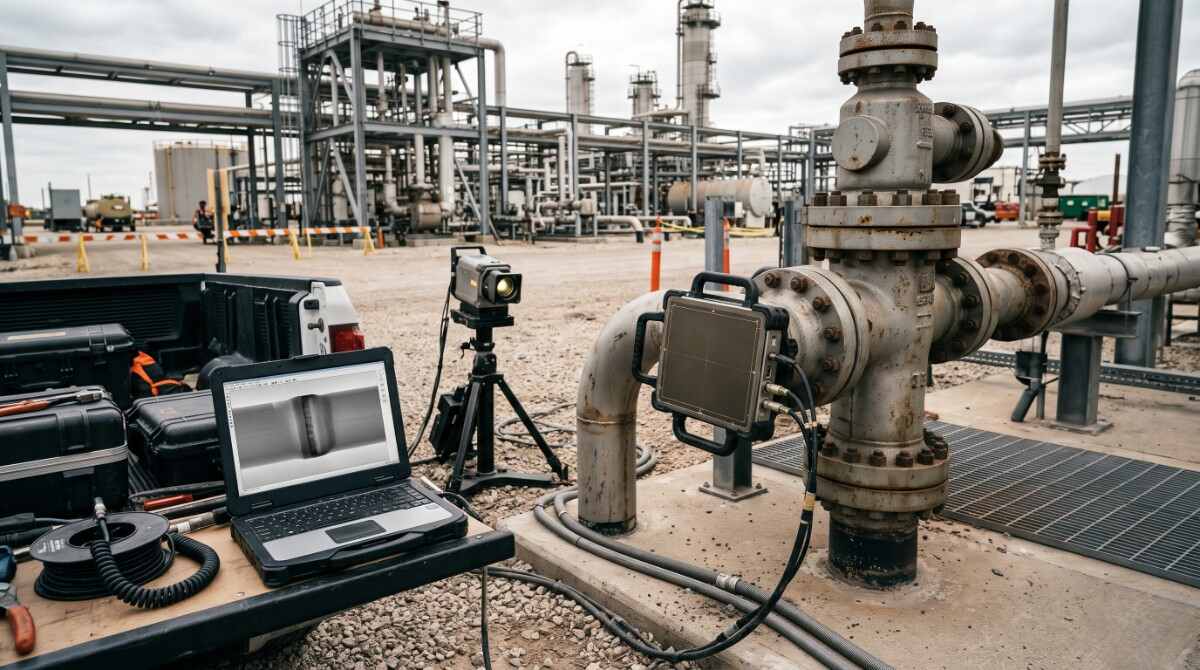
The introduction of high dynamic range detectors has transformed oilfield inspection productivity. Modern flat panel detectors capture a dynamic range exceeding 16,000 discrete gray levels, compared to the limited optical density range of industrial film. This broad dynamic latitude allows a single radiographic exposure to capture both thin pipe walls and thick forged valve flanges without overexposing or underexposing adjacent metal sections.
International Codes and Digital Radiographic Standards
The transition from physical film to digital radiography technologies is codified across recognized international engineering standards:
- ASME Boiler and Pressure Vessel Code Section V Article 2 establishes clear technical requirements for digital radiography, defining detector qualification, image quality indicator sensitivity, and contrast-to-noise ratios.
- ISO 17636-2 specifies standards for the non-destructive testing of welds using X-ray and gamma-ray techniques with computed radiography plates and digital detector arrays.
- ASTM E2033 provides standard practice for computed radiography, outlining laser scanning parameters, plate fading limits, and digital image processing protocols.
- ASTM E2597 defines standard practice for the manufacturing characterization of digital detector arrays used in industrial radiography.
- DNV-ST-F101 offshore standard provides qualification protocols for computerized and digital radiography applied to offshore pipeline tie-in spools and pressure equipment.
These standards mandate rigorous measurement of normalized signal-to-noise ratio and basic spatial resolution using duplex wire image quality indicators. By establishing objective digital image quality metrics, international codes ensure that digital radiographs deliver flaw detection sensitivity equal to or exceeding conventional Class I industrial film systems.
Global Equipment Innovations Across Major Technology Providers
Equipment manufacturers have developed rugged, portable digital imaging hardware engineered specifically for hazardous oilfield environments:
- Carestream NDT, an operating division of Carestream Health, launched its HPX-Bend bendable digital radiography detector alongside the rugged HPX-DR 3543 flat panel. The conformable detector curves around tight pipe elbows, manifold junctions, and valve bodies, capturing high-resolution radiographs in cramped offshore modules where rigid detectors cannot fit.
- Baker Hughes expanded its Waygate Technologies inspection portfolio with the DXR series of wireless flat panel detectors and the Rhythm software platform. The system incorporates automated wall thickness measurement algorithms that evaluate profile radiographs of operational piping, automatically calculating remaining service life.
- Varex Imaging developed specialized high-energy flat panel detectors optimized for penetrating heavy oilfield cast valves and blow-out preventer components. The sensors combine high radiation tolerance with sub-hundred-micron pixel pitches to resolve fine thermal fatigue cracks in dense alloy castings.
- DNV established advanced technical qualification guidelines for digital detector arrays used on offshore platforms, providing third-party verification that digital radiography workflows satisfy structural integrity mandates across floating production units.
- Bureau Veritas deployed fully digitized radiography crews across North Sea and Middle East offshore installations, replacing legacy film archives with cloud-based DICONDE repositories compliant with ASTM E2339 standards.
These commercial developments demonstrate how digital radiography hardware has shifted from clean manufacturing laboratory environments to explosion-rated oilfield production locations.
Operational Advantages Over Conventional Film Radiography
Replacing analog film with digital radiography technologies provides substantial operational and economic advantages across oilfield maintenance programs:
- Dramatic reduction of radiation exclusion zones achieved through the high quantum efficiency of digital detectors, allowing smaller isotope sources or low-power pulsed X-ray tubes that reduce safety barricades from fifty meters down to five meters.
- Elimination of chemical processing hazards, removing liquid developers, fixers, and hazardous heavy metal waste from remote offshore platforms and remote drilling desert sites.
- Immediate flaw interpretation and re-inspection capability, preventing hours of operational delays while waiting for mobile darkroom film development.
- Digital image enhancement tools, including high-pass filtering, edge sharpening, window-level adjustments, and digital measuring calipers that allow inspectors to measure wall loss down to fractions of a millimeter.
- Seamless integration with computerized maintenance management systems, enabling instant transmission of inspection imagery to onshore engineering teams via satellite links.
Safety improvements are especially pronounced during offshore turnaround campaigns. Because digital detectors require only a fraction of the radiation exposure time demanded by film, inspection teams can complete radiographic profile shots during active day shifts without evacuating platform personnel from adjacent work zones.
Core Oilfield Applications and Profile Radiography
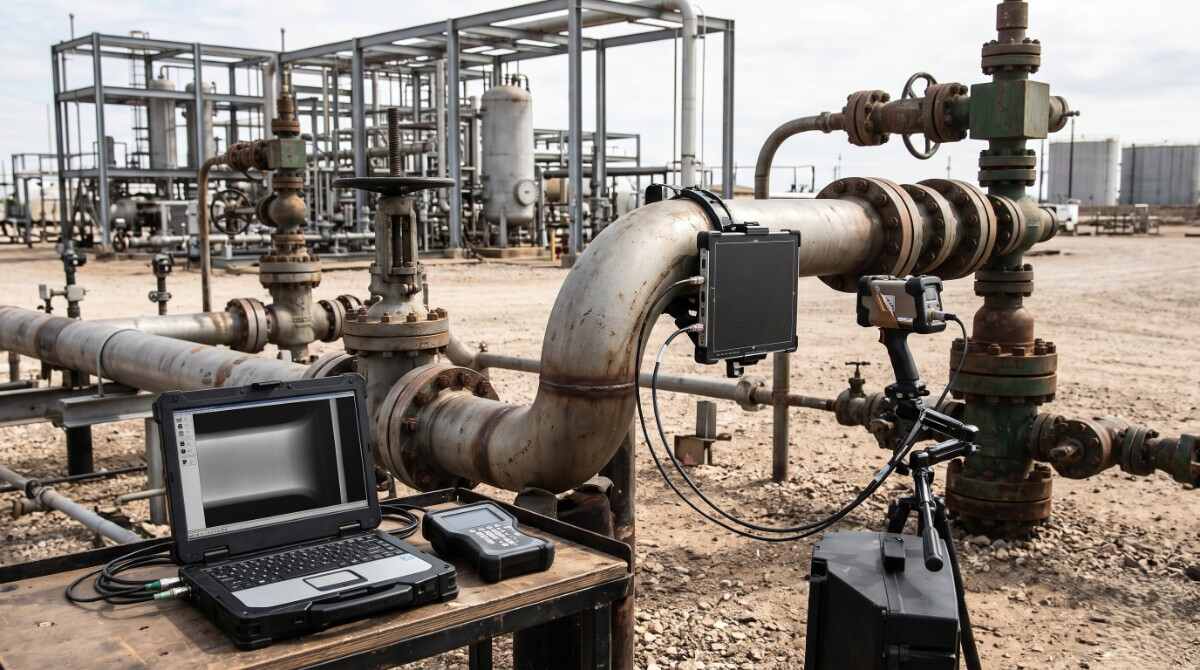
The most widespread oilfield application of digital radiography technologies is profile radiography on live process piping and manifold systems. Uninsulated and insulated pipes transporting abrasive hydrocarbons suffer severe erosion at flow directional changes, such as 90 degree elbows, reducer fittings, and tee junctions.
Inspectors position the digital flat panel detector tangent to the pipe wall, aiming the radiation beam through the pipe diameter. The resulting digital profile image reveals a clean cross-sectional silhouette of the pipe wall. Technicians use software calibration tools to measure remaining wall thickness through external insulation and weather jackets without removing cladding.
While radiographic flat panels excel on surface spools and wellheads, downhole well integrity requires specialized downhole Electromagnetic Testing Technologies for Oil and Gas Casing Inspection to evaluate concentric metal barriers through production tubing. Combining surface digital radiography with subsurface electromagnetic diagnostics establishes comprehensive integrity assurance from reservoir completion to surface export manifolds.
Digital Data Archiving and Artificial Intelligence Integration
Transitioning to digital radiography enables oil and gas operators to adopt the Digital Imaging and Communication in Nondestructive Evaluation standard, commonly known as DICONDE. Based on medical imaging communication protocols, DICONDE embeds metadata such as GPS coordinates, weld numbers, inspector credentials, and radiation exposure parameters directly into the image header.
Machine learning models trained on millions of historical oilfield radiographic scans now assist human inspectors by flagging potential flaws. Automated defect recognition software scans digital images for weld root undercut, slag lines, porosity clusters, and internal corrosion pitting. These software assistants highlight suspect regions with bounding boxes, allowing Level III radiographers to verify defect classifications rapidly and maintain complete data consistency across multinational operations.
References
- “HPX-Bend Bendable Digital Radiography Detector Specifications” – Carestream Health
- “Waygate Technologies DXR Industrial Flat Panel Detectors” – Baker Hughes
- “Industrial Digital Radiography X-Ray Imaging Solutions” – Varex Imaging
- “Submarine Pipeline Systems Standard DNV-ST-F101” – Det Norske Veritas
- “Digital Radiographic Testing and Asset Assurance Services” – Bureau Veritas
- “Non-Destructive Testing Services Market Analysis 2025” – Mordor Intelligence
- “Boiler and Pressure Vessel Code Section V Article 2 Radiographic Examination” – American Society of Mechanical Engineers
- “Non-Destructive Testing of Welds Radiographic Testing Part 2 Standard 17636-2” – International Organization for Standardization
