



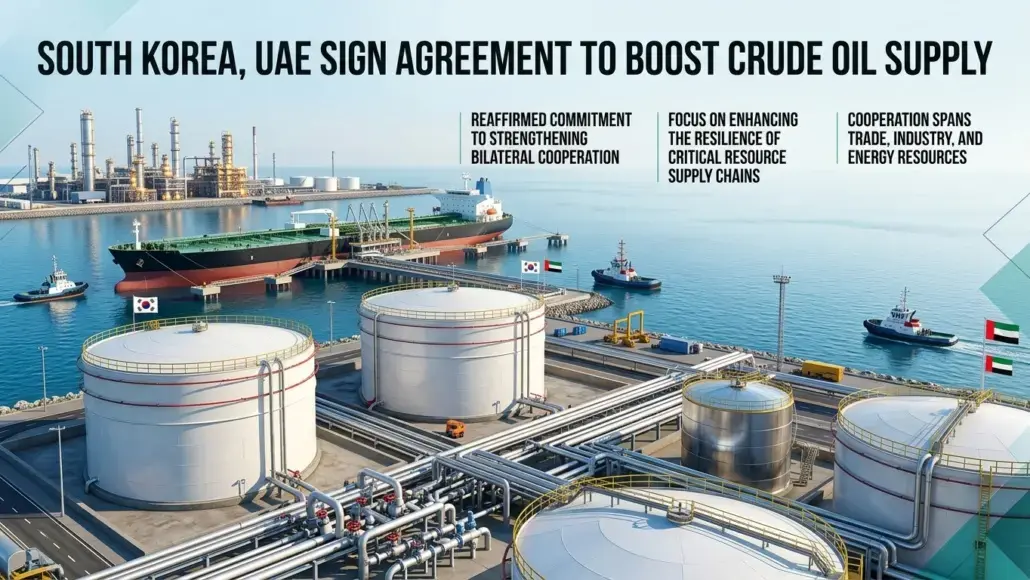
South Korea and the United Arab Emirates (UAE) have reaffirmed their commitment to strengthening bilateral cooperation following a meeting between Minister JK (Jung-Kwan) Kim of the Ministry of Trade, Industry and Resources (MOTIR) and Dr. Sultan Ahmed Al Jaber, Minister of Industry and Advanced Technology of the United Arab Emirates (UAE) and Group CEO of the Abu Dhabi National Oil Company (ADNOC). During the discussions, the two ministers focused on enhancing the resilience of critical resource supply chains while identifying opportunities to expand industrial collaboration between the two countries. The talks reflected the continued emphasis both governments are placing on long-term crude oil supply security and broader economic cooperation.
The meeting built upon a series of high-level engagements that have strengthened the Korea-UAE strategic partnership in recent months. These exchanges included the Korean President’s state visit to the UAE in November 2025, Minister Kim’s visit in June 2026, and the visit by the Presidential Special Envoy for Strategic Economic Cooperation in March 2026. Over this period, cooperation has steadily expanded across several strategic sectors, including crude oil, naphtha, nuclear power, energy infrastructure, and advanced industries.
With Minister Al Jaber visiting Korea, both sides reviewed the progress achieved so far and exchanged views on sustaining momentum while exploring additional collaboration in areas such as AI and energy infrastructure.
Agreement Signed to Strengthen Crude Oil Supply Chain Security
A major outcome of the meeting was the signing of a strategic cooperation agreement between MOTIR and ADNOC covering the crude oil supply chain. The agreement establishes a framework for cooperation on stable crude oil supply, emergency response measures, and joint stockpiling. It is designed to strengthen crude oil security cooperation and ensure reliable collaboration during periods of disruption, including conflicts in the Middle East. Both sides expect the new framework to further reinforce bilateral cooperation in energy and resource security while supporting a dependable crude oil supply relationship.
Beyond energy security, the ministers also explored opportunities to collaborate on AI adoption in the refining and petrochemical industries, where both countries have established capabilities. Minister Kim introduced Korea’s AI transformation project for the petrochemical industry in the Ulsan-Mipo Industrial Complex and highlighted examples of Korean refining and petrochemical companies implementing AI technologies.
He also pointed to the similarities between ADNOC’s strategy of expanding AI across all crude oil-related operations and Korea’s Manufacturing AI Transformation (M.AX) policy, proposing that companies and institutions from both countries identify practical joint cooperation projects.
Infrastructure Cooperation and Future Industrial Opportunities
The discussions also addressed energy infrastructure initiatives currently underway in the UAE, including projects to expand oil and gas storage and transport infrastructure designed to bypass the Strait of Hormuz. Minister Kim noted that Korean companies are evaluating multiple forms of participation in these developments, including EPC contracts, and requested the UAE’s consideration and support for their involvement in future projects.
“Although the situation in the Middle East is changing, securing stable supply chains for critical resources remains one of the most important tasks for Korea’s economic security. Korea needs to further strengthen its strategic partnership with the UAE, a major energy supplier,” Minister Kim said. “We also need to broaden the scope of cooperation beyond critical resource supply chains by exploring new possibilities and opportunities in advanced industries such as AI. Building on this meeting, MOTIR will work closely with the UAE to deliver concrete outcomes,” he added.
