














The ROI of Scaling Safety Technology Across Operations
Industrial environments face massive transformations regarding hazard management. Facilities transition away from reactive incident responses toward proactive prevention strategies. This shift relies heavily on advanced digital systems that identify risks before accidents happen. Expanding these platforms across entire organizations delivers measurable economic benefits alongside improved worker protection. Companies can now quantify the exact value generated through better risk mitigation.
Measuring Direct Financial Returns
Expanding danger management systems generates immediate cost savings for industrial businesses. Workplace injuries carry massive expenses, including medical bills, compensation claims, and lost labor hours. Implementing predictive analytics helps managers spot dangerous conditions early. Fixing those issues promptly prevents expensive accidents from occurring. Financial teams easily track these metrics to prove the worth of expanded software deployments.
Direct savings quickly offset initial software investments because fewer incidents mean lower operational costs. Insurance providers often offer favorable rates to companies demonstrating strong risk reduction programs. When organizations deploy continuous monitoring applications, they build a verifiable record of safe practices. This documented evidence becomes a powerful negotiation asset during policy renewals.
- Reducing insurance premiums through demonstrated risk reduction.
- Lowering workers compensation payouts since fewer injuries occur.
- Decreasing equipment repair costs by catching operational errors early.
- Minimizing legal fees associated with severe workplace incidents.
Beyond insurance benefits, avoiding equipment damage preserves capital budgets. Forklift collisions or machinery malfunctions require costly repairs and replacement parts. Automated alerts notify operators about potential hazards instantly, preventing physical damage to expensive assets. Preserving machinery extends its usable lifespan, which improves overall return on investment.
Indirect costs associated with accidents often exceed the direct medical expenses. When an incident occurs, operations halt while investigators determine the root cause. Surrounding workers lose focus, and overall morale drops significantly. Preventing these events preserves the natural rhythm of daily production schedules. Companies avoid the hidden financial drain of administrative delays and temporary labor replacements.
Boosting Operational Productivity
Accident avoidance and operational output share a deeply connected relationship. When facilities operate without interruptions, production numbers naturally rise. Advanced monitoring applications keep manufacturing sequences moving since they eliminate the need for manual hazard inspections. Supervisors spend less time filling out incident reports and dedicate more energy toward optimizing workflows.
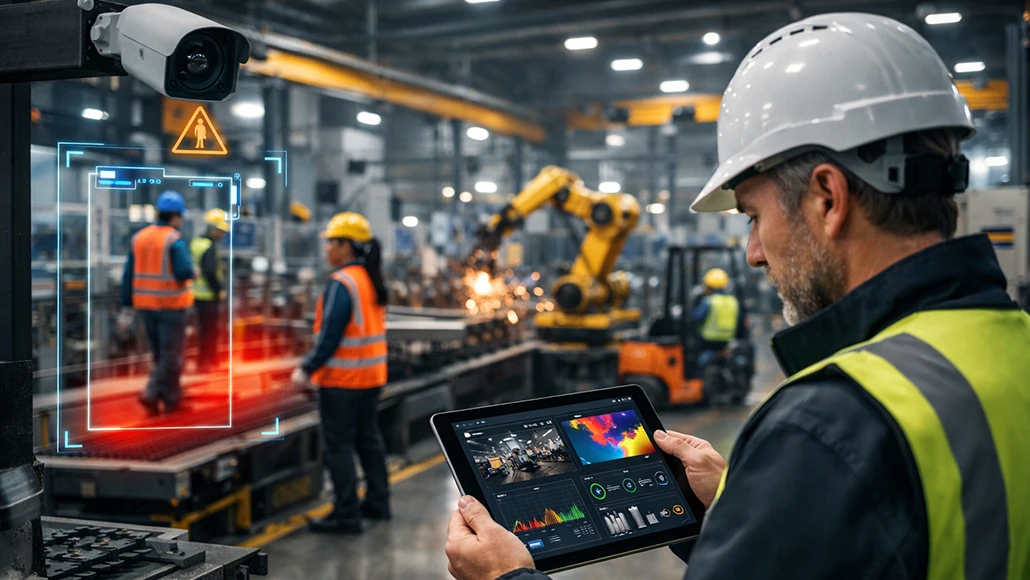
Rapid communication prevents minor issues from escalating into major shutdowns. Intelligent platforms process visual data continuously, identifying subtle risk patterns that humans might miss. Workers perform their tasks with greater confidence because they know smart systems monitor their environment. This peace of mind translates directly into faster, more consistent output.
Reducing downtime is a primary driver of increased profitability. Every minute an assembly workflow stops due to an accident represents lost revenue. Digital hazard applications minimize these stoppages by catching unsafe behaviors early. Maintaining continuous operations ensures companies meet their delivery deadlines and satisfy customer demands.
Improved danger management also positively impacts product quality control. Environments free from dangerous distractions allow employees to concentrate fully on their specific tasks. Precision increases when workers do not constantly worry about potential physical harm. Higher quality outputs lead to fewer customer returns and stronger brand reputation in competitive markets.
Enhancing Resource Allocation
Scaling digital risk platforms allows companies to distribute their workforce intelligently. Traditional inspection methods require dedicated personnel to walk the factory floor constantly. Automated cameras and sensors handle this continuous observation instead. Managers can reassign those employees to higher-value tasks requiring human problem-solving skills.
Information collected from these systems highlights specific areas needing immediate attention. Maintenance teams receive precise locations of failing equipment or structural hazards. This targeted approach prevents wasted effort on routine checks in low-risk zones. Facilities operate smoothly because resources go exactly where they are needed most.
Optimizing labor distribution reduces unnecessary overtime expenses. Safety professionals no longer need to stay late compiling manual audit reports. Automated dashboards generate comprehensive summaries instantly, freeing up valuable administrative hours. Reallocating this time toward strategic planning yields better long-term results for the entire organization.
Predictive maintenance schedules become highly accurate with continuous sensor data. Instead of replacing parts based on generic timelines, technicians service machinery exactly when wear becomes evident. This precise timing extends the life of expensive components and reduces inventory holding costs for spare parts. Economic efficiency improves when maintenance aligns perfectly with actual equipment conditions.
Standardizing Operations Across Sites
Managing multiple facilities presents unique challenges for corporate leadership teams. Different locations often develop isolated procedures, creating inconsistent risk levels across the company. Scaling technology provides a single source of truth for all operational data. Executives gain a unified view of hazard trends across every regional branch.
Standardization simplifies training programs for new hires and transferred employees. When every facility uses identical digital applications, workers adapt quickly to different environments. This consistency reduces the learning curve and minimizes errors during transition periods. A cohesive approach ensures high standards remain intact regardless of geographic location.
- Establishing uniform reporting metrics for all regional branches.
- Simplifying compliance audits through centralized data storage.
- Comparing performance benchmarks between different manufacturing plants.
- Identifying systemic issues that affect the entire corporate network.
Centralized data analysis reveals broad patterns that isolated managers might overlook. If several plants experience similar equipment failures, corporate leaders can implement a network-wide solution. Addressing root causes systematically prevents recurring problems and saves money on repeated fixes. Broad visibility enables better strategic planning and resource distribution.
Maintaining compliance across various jurisdictions becomes much simpler with unified digital records. Automated systems generate required documentation instantly, eliminating the panic of surprise regulatory audits. Accurate historical logs prove that the company takes proactive steps to protect its workforce. Avoiding compliance fines protects the bottom line and preserves corporate public image.
Building a Proactive Culture
Technology adoption transforms how employees view workplace hazards daily. Workers become active participants in accident avoidance when they have access to live information. Digital dashboards display current risk levels clearly, encouraging everyone to take ownership of their surroundings. Transparent communication builds trust between floor staff and upper management.
Objective data removes personal bias from safety observations. Instead of relying on subjective opinions, managers use concrete video evidence to guide coaching sessions. This factual approach makes feedback feel less critical and more constructive. Employees respond positively to guidance based on undeniable visual proof.
This cultural shift actively reduces employee turnover rates. People prefer working for organizations that prioritize their physical well-being. Retaining experienced staff saves massive amounts of money on recruitment and training. A stable workforce maintains high productivity levels and preserves institutional knowledge.
Continuous improvement initiatives thrive on accurate, real-time information. Safety committees use aggregated data to identify long-term trends and adjust policies accordingly. This iterative process ensures that protective measures evolve alongside changing operational demands. A dynamic approach prevents stagnant procedures from becoming obsolete as new manufacturing techniques emerge.
Achieving Long-Term Scalability
Expanding digital platforms from a single pilot program to a company-wide standard maximizes financial returns. Isolated systems offer limited benefits, while integrated networks provide comprehensive visibility. The transition requires careful planning, but the resulting efficiency gains are substantial. Organizations that embrace these advanced capabilities see dramatic improvements in their overall performance.
The integration of artificial intelligence accelerates these benefits significantly. Intelligent platforms process vast amounts of visual information to identify subtle risk patterns. According to Protex.ai, AI-exposed sectors show ~4 times productivity growth and ~3 times faster revenue-per-employee growth. These impressive figures highlight the massive financial advantage of comprehensive technological deployment.
Future-proofing operations means investing in adaptable software architectures. Scalable platforms grow alongside the business, accommodating new facilities and increased production volumes. Upgrading cloud-based systems requires minimal hardware changes, keeping expansion costs low. Continuous software updates ensure companies always have access to the latest hazard detection features.
Integrating hazard detection software with existing enterprise resource planning systems creates a holistic operational view. Data silos disappear, allowing different departments to share valuable insights seamlessly. Human resources can align training schedules with identified risk trends, while procurement can order better protective gear based on actual usage statistics. Cross-departmental collaboration maximizes the utility of every software investment.
Accessing the Right Support
Transitioning to advanced hazard management requires careful planning and execution. Facilities must evaluate their specific needs before selecting new digital applications. Partnering with experienced technology providers ensures a smooth implementation process. These experts help configure systems to match unique operational workflows.
Proper training guarantees that staff members utilize new platforms correctly. Vendors often supply comprehensive onboarding materials and dedicated support teams. Engaging with these resources accelerates the adoption timeline and minimizes initial friction. Investing in the proper infrastructure today builds a more resilient and profitable organization for tomorrow.
Evaluating system performance regularly guarantees sustained value generation. Managers should review incident rates and productivity metrics quarterly to confirm the technology delivers expected results. Adjusting camera angles or refining alert thresholds keeps the platform optimized for current conditions. Proactive system maintenance ensures the initial investment continues paying dividends for years.
