













International energy companies are significantly increasing their engagement in Venezuela’s oil sector, with multi-billion dollar deals being finalized. This renewed energy infrastructure investment coincides with a notable rise in Venezuela’s oil exports, reaching a seven-year peak in March, suggesting a substantial recovery for the nation’s vital energy industry.
The swift return of major international players to Venezuela’s oil and natural gas prospects occurred shortly after the United States’ management of the country’s oil resources. By January, prominent companies like Shell and BP had reportedly expressed interest in securing licenses to advance natural gas projects spanning both Venezuela and Trinidad and Tobago. Shell’s primary interest lies in the Dragon offshore gas field, estimated to hold approximately 4.5 trillion cubic feet of natural gas, with plans for future liquefaction and export through its Atlantic LNG facility.
BP has also been active, recently entering into an agreement with Venezuela’s state energy company, PDVSA, to develop the Cocuina-Manakin field. This field is situated along the maritime boundary between Venezuela and Trinidad and Tobago. The collaboration extends to joint exploration efforts in the Loran gas field. The Loran-Manatee deposit, a shared resource, contains an estimated 7.3 trillion cubic feet of gas in its Venezuelan portion and 2.7 trillion cubic feet in the Trinidadian section. The Cocuina-Manakin field alone is understood to possess around 1 trillion cubic feet in reserves.
Spain’s Repsol is also re-establishing its presence in Venezuela, having inked a new accord with the government. The company aims to increase its crude oil production in the country by 50% from current output levels. Reports from April indicated that Repsol had obtained the necessary licenses from the U.S. administration to resume operations in Venezuela and had entered into agreements with U.S. energy firms to bolster production, which presently averages about 45,000 barrels per day. Repsol’s ambition is to triple this production figure within the next three years.
Italy’s Eni is another significant player re-entering the Venezuelan energy landscape to boost the energy infrastructure investment. Last month, the company’s chief executive visited Caracas and met with President Delcy Rodriguez. This visit culminated in a deal with PDVSA and the Venezuelan oil ministry for the joint development of a heavy crude field. The Junin-5 field, located in the Orinoco Belt, holds an impressive 35 billion barrels of certified oil reserves, positioning it as one of Venezuela’s largest undeveloped heavy oil resources. Eni has a long-standing connection to this project, which began production in 2013 but has faced considerable challenges due to years of underinvestment, operational disruptions, and sanctions-related uncertainty.
The most recent international entities to join this resurgence in Venezuela’s oil industry are two U.S. companies: Hunt Overseas Oil Company and Crossover Energy. Both firms intend to operate within the Orinoco Belt, a region renowned for its heavy and extra-heavy crude oil reserves. The agreements were formalized in the presence of Jarrod Agen, President Trump’s energy adviser and executive director of the National Energy Dominance Council, who traveled to Venezuela at the end of April.
These U.S. companies will concentrate their efforts on three key areas within the Orinoco Belt: Monagas, Anzoategui, and Barinas. Their operations will focus not only on oil extraction but also on the production of associated natural gas. This gas is slated for use in power generation, potentially addressing critical supply security issues for Venezuela, which has experienced recurrent blackouts in recent years.
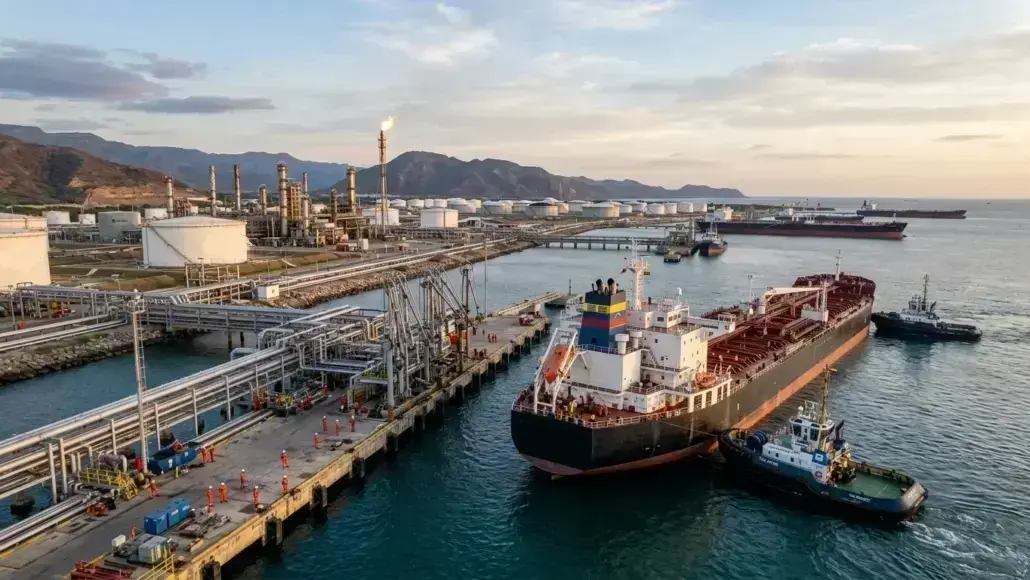
Concurrent with these energy infrastructure investment activities, production volumes are on the rise. Venezuela’s oil exports reached their highest point in over seven years last month, driven by global demand and the country’s increasing output. The average daily export rate stood at 1.23 million barrels, representing a 14% increase compared to the preceding month. This export volume is the highest recorded since the imposition of U.S. sanctions during the initial Trump administration term, highlighting a significant positive shift for Venezuela’s oil sector and underscoring the global importance of the Venezuela oil market. Venezuela’s oil sector resurgence is a key indicator of shifting energy dynamics.
