
























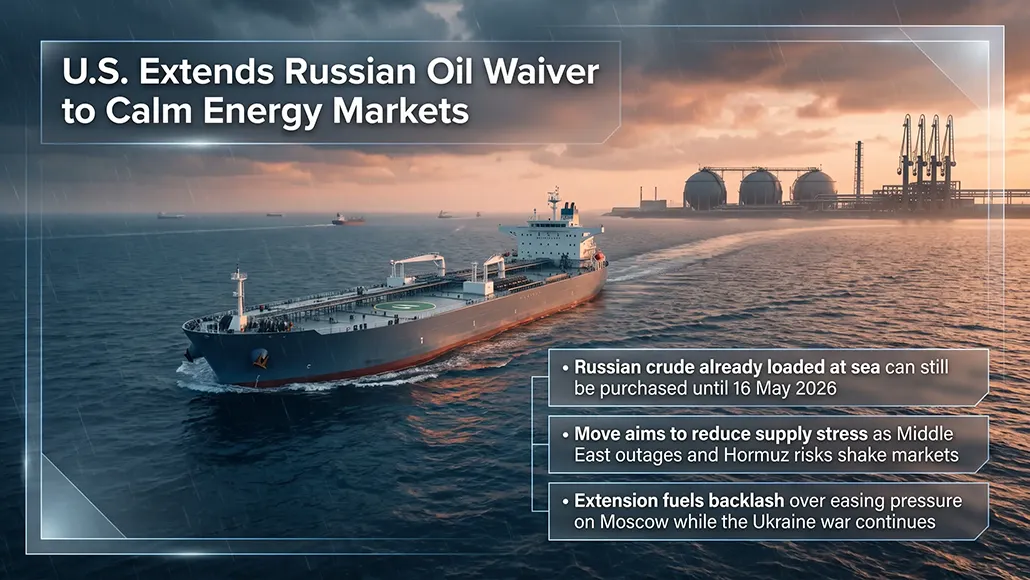
U.S. President Donald Trump’s administration on 17th April 2026 moved to extend a Russian oil waiver, granting countries continued access to sanctioned Russian crude loaded at sea for roughly another month. The decision allows purchases of Russian oil and petroleum products already on vessels as of 17th April to proceed through 16th May 2026. This Russian oil waiver replaces a prior 30-day measure that expired on April 11, while explicitly excluding transactions tied to Iran, Cuba, and North Korea. The step comes amid mounting criticism from lawmakers who argue the government is showing leniency toward Moscow as the war in Ukraine persists.
The renewed Russian oil waiver forms part of a broader strategy aimed at stabilizing global energy markets, which have experienced sharp volatility during the U.S.-Israeli war with Iran. Countries across Asia, grappling with the effects of a global energy shock, had urged Washington to facilitate alternative supply flows. Notably, just two days before the announcement, Treasury Secretary Scott Bessent had indicated that the U.S. would not extend the waiver for Russian oil or a similar provision for Iranian oil due to lapse on Sunday. Meanwhile, global oil prices dropped by 9% to about $90 per barrel following Iran’s temporary reopening of the Strait of Hormuz, a critical transit route. However, the International Energy Agency has warned that the conflict has already triggered the most severe disruption to global energy supplies on record.
The ongoing war, entering its eighth week on Saturday, has inflicted damage on more than 80 oil and gas facilities across the Middle East. Tehran has cautioned that it could again shut the Strait of Hormuz if the recent U.S. Navy blockade of Iranian ports continues. Elevated oil prices have emerged as a political concern for Republicans ahead of the November midterm elections. According to a U.S. source, partner countries engaged in meetings linked to the Group of 20, World Bank, and International Monetary Fund in Washington this week pressed for an extension of the Russian oil waiver. The issue was also raised during a call between Trump and Prime Minister Narendra Modi, given India’s position as a major buyer of Russian crude.
Separately, the waiver covering Iranian oil, issued on 20th March 2026, enabled approximately 140 million barrels to enter global markets, easing supply pressures, Bessent noted last month. Nevertheless, lawmakers from both parties have criticized such waivers, arguing they risk supporting the economies of Iran and Russia during active conflicts. Concerns have also been raised that these measures could weaken Western efforts to curb Russia’s war financing and create friction with allies. Ursula von der Leyen has stated that now is not the time to ease sanctions. Adding to the debate, Kirill Dmitriev said the extension could impact another 100 million barrels of Russian oil, bringing the combined total under both waivers to 200 million barrels.
