





Rolande, a market leader in building infrastructures for liquefied natural gas and bio-LNG for trucks in the Netherlands has entered the German market with its latest opening.
Before the end of this year, the company will open new LNG locations with partners in Dortmund, Duisburg, Grasdorf, Lübeck and Ziesar. A further expansion of the network is planned in Germany for 2021.
Rolande will operate exclusively public filling stations that can be used by any customer. Each of these filling stations are equipped for a later use of bio-LNG.
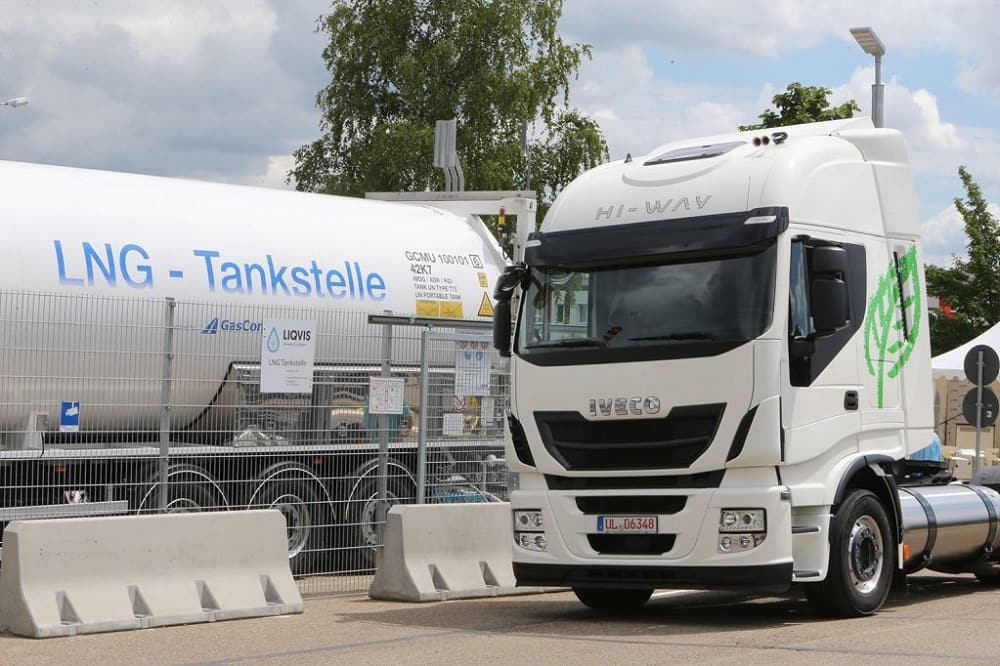
The new station with high and slender LNG tank was opened by Jolon van der Schuit, Rolande CEO, Director of Sales and Marketing of Iveco Magirus AG, Christian Sulser, and the Lord Mayor of the City of Ulm, Gunter Czisch.
“We believe that LNG not only makes transport more environmentally friendly but, at the same time, also more profitable. And everyone should get something out of that. This is why we want to supply all customers in Germany with the cleanest and most efficient deployable fuel of this time,” said Jolon van der Schuit, CEO of the LNG pioneer Rolande.
Public LNG subsidies in Germany
The use of CNG and LNG is state subsidised in Germany. Trucks that run on compressed or liquefied natural gas are exempted from the German road toll until 31 December 2023. The operators thereby save up to 18.7 cents in road tolls on each driven kilometre. Moreover, the operators profit from state subsidies for purchases of new vehicles until the end of 2020. The state subsidy amounts up to EUR 12,000 for an LNG truck and up to EUR 8,000 for a CNG truck. LNG trucks are not only economically attractive but also sustainable. Compared to a diesel truck, the NOx and particle emissions are significantly lower. Up to 95 percent of CO2 can be saved when using biogas.
“I have treated the subject of alternative drives for a few years. By now, we have switched 10% of our fleet to liquefied gas. With a mileage of 120,000 km per vehicle, this switch reduces the CO2 emission by several millions of kilograms in five years,” explains Bernhard Reichert, Managing Shareholder of BTK Befrachtungs- und Transportkontor GmbH.
