



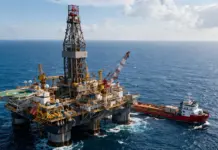

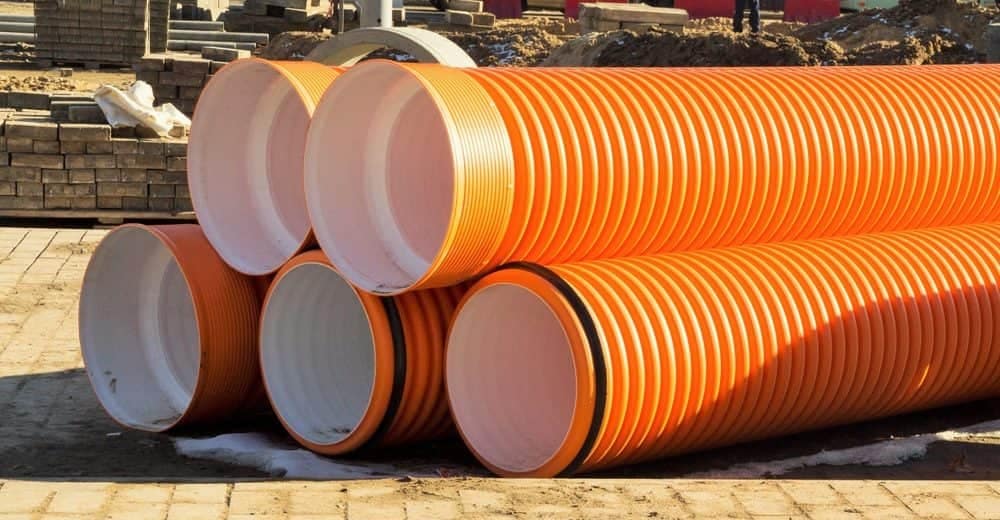



Oil and gas pipelines stretch thousands of kilometers across desert and tundra. Platforms sit a hundred miles out to sea. This raises a question: how do you watch over things that will never be physically trackable? The answer is in the orbit. Satellites, now paired with artificial intelligence, have gone from an experiment to the corner stone of the whole monitoring strategies.
What changed? The tech got cheap and good at roughly the same moment. Commercial satellite monitoring is widely available now, and energy companies can order satellite imagery tasking and integrate that view straight into how they manage their assets and respond when something goes wrong. And what they get is what the industry has wanted for decades a steady, current picture of the entire production chain from orbit.
Upstream: Redefining Exploration and Field Development
Finding oil is expensive and risky. Drilling a single onshore well in the US runs anywhere from $5 to $8 million, and offshore wells routinely climb past $100 million. In remote country, one dry hole can burn through that kind of money before anyone learns it was the wrong spot. Historically, exploration success rate was around 1 in 5 four misses for every hit. Highest quality satellite imagery has changed that math. Geologists can now “look beneath the Earth” without leaving their desks.
Detecting hydrocarbon seeps and vegetation stress
Oil rarely stays put. Tiny amounts of it find their way to the surface, where they change soil chemistry and stress the plants growing above. And this can be tracked from satellites. High resolution multispectral satellite imagery reads the spectral signatures of that stress. Thermal infrared sensors pile on another clue, catching the temperature abnormalities that can give away a reservoir.
This really works in practice. Natural oil seeps at California’s Coal Oil Point and the offshore slicks that helped point early geologists toward the Gulf of Mexico’s reserves are the best cases. The upside is hard to argue with: it costs less, covers far more ground, and reaches terrain no survey crew would willingly walk into.
Automating infrastructure mapping
Sharper images mean analysts can pick out individual pieces of oilfield kit, not just the general lay of the land. One study trained on more than 8,000 images and 30,000 annotated targets, and its two-stage detection models hit a mean Average Precision of 89.2% across well pads, production ponds, and storage tanks. Classifying a mix of targets across 100 square kilometers used to swallow a full working day. These models, based on real-time high-resolution satellite images, do it in about an hour. That speed matters in places like the Permian Basin, where tens of thousands of wells are spread across West Texas and New Mexico.
Midstream: A New Era of Pipeline Integrity
Pipelines are the bloodstream of the energy business, and this is where satellite monitoring really proves its worth.
AI-powered leak detection
Ground patrols and flyovers miss a lot of things. Industry data points to traditional methods overlooking critical risks up to 73% of the time. That’s not a rounding error that’s the gap between a leak you mop up quietly and one that lands on the evening news. Geospatial analytics is shrinking that gap. Run high-res satellite imagery, multispectral and hyperspectral both, through trained algorithms and operators can pin down where a leak is and hear about it almost immediately, instead of waiting for a rancher to phone it in.
The iPIPE success story
North Dakota is a relevant case. After a run of bad spills, a group of operators started the Intelligent Pipeline Integrity Program iPIPE and put their whole network under a weekly satellite watch. It caught dozens of confirmed crude and produced-water leaks while they were still small, often before SCADA systems or ground sensors noticed anything at all. Weekly eyes from orbit turned leak detection from a panicked scramble into something planned and preventative.
Monitoring ground subsidence
Sometimes the danger isn’t the pipe it’s the dirt holding it up. Satellite radar interferometry, InSAR for short, catches geological trouble before it bends any steel. One recent study ran 48 Sentinel-1A images along a pipeline corridor and mapped how the ground was shifting; most of the route was creeping along within ±10 mm a year. Pairing SBAS-InSAR with GIS analysis, the researchers flagged 100 possible hazard zones and crews later confirmed plenty of them on foot. Real-time high-resolution satellite images turn that kind of early warning into routine.
Downstream and Environmental Management: The ESG Imperative
ESG criteria push technology adoption about as hard as cost does these days. Proving your environmental performance is now a ticket to market and a condition for raising money. Investors and regulators want proof and they are possible with the high-quality satellite images.
The hunt for methane
Methane is a climate problem and a hole in the budget at the same time. Around 3% of the natural gas produced worldwide leaks away before anyone sells it roughly $60 billion gone every year. A new fleet of high-resolution satellites is built specifically to chase down those invisible plumes.
Newer algorithms like the Median-Based Multi-Reference (MBMR) method work through Sentinel-2 shortwave infrared high-res imagery and tease the methane signal out of cluttered ground. It’s found real leaks from the NGTL pipeline system and from Syncrude’s bitumen upgrader up in the Athabasca Oil Sands. What makes it work is the way the sensors stack:
- Sentinel-5P (European Space Agency) sweeps wide for the regional view.
- GHGSat, a commercial high-res satellite platform, drills down to the exact source, picking out leaks as small as ~100 kg per hour.
Offshore methane and flaring
Keeping tabs on offshore rigs used to be a logistical nightmare. Not anymore. The Tanager-1 satellite uses a “glint mode” imaging trick to catch methane super-emitters out over open water. In April 2025 it spotted two plumes from drillships in Brazil’s Santos Basin venting an estimated 2,427 kilograms of methane an hour about what you’d get burning 7,600 gallons of gasoline. China’s SDGSAT-1 is working the flaring angle, using a thermal infrared spectrometer to single out high-temperature spikes and smoke plumes. Very high resolution satellite imagery has left the ocean a much smaller place to hide a leak.
