







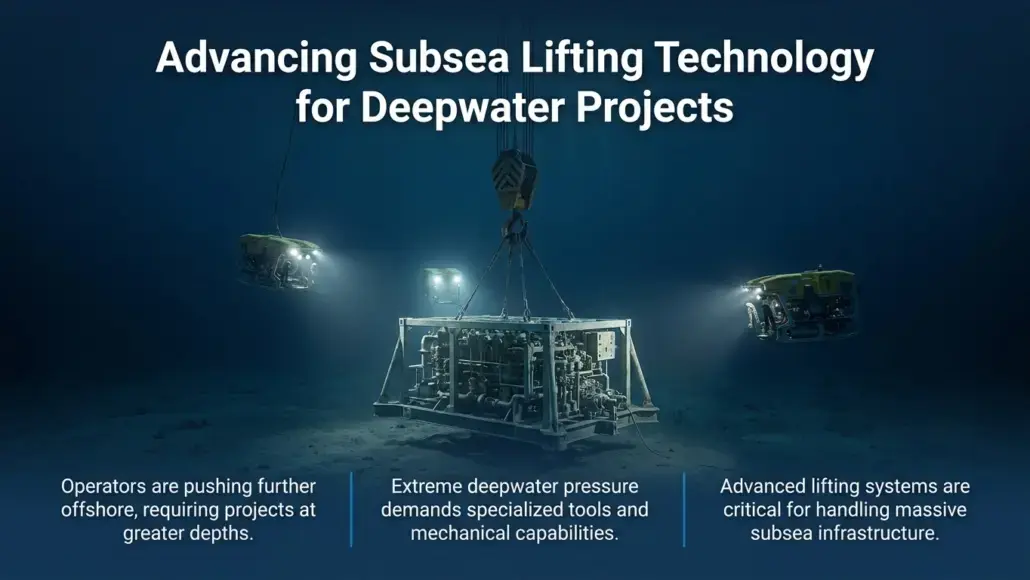
The final frontier of energy exploration is not found in the stars, but in the crushing depths of the world’s oceans. As the oil and gas industry moves further offshore, deepwater projects are increasingly pushing the boundaries of what is mechanically possible. Operating thousands of meters below the surface, where sunlight never reaches and pressures can exceed several hundred bar, requires a specialized set of tools. Among these, the systems used to lower, position, and recover massive subsea structures—such as wellheads, manifolds, and production modules—are of paramount importance. Improving subsea lifting tech for deepwater projects is no longer just an engineering goal. It is a fundamental requirement for the viability of next-generation energy extraction. The current wave of subsea lifting technology innovation is defined by a shift toward lighter materials, smarter control systems, and a deeper integration with robotic assets.
The complexity of deepwater lifting is compounded by the dynamic nature of the sea. A vessel on the surface is subject to the whims of the waves, and this motion is transmitted through thousands of meters of cable to a load that must be placed with millimeter precision. Traditional steel wire ropes, while strong, become a liability at these depths due to their own immense weight. This realization has sparked a revolution in material science and mechanical design, leading to the development of systems that can thrive in the most hostile environments on Earth. Oil & Gas Advancement notes that by rethinking the very fabric of subsea operations, engineers are creating a new era of deepwater capability that is safer, more efficient, and more resilient than ever before.
Overcoming Extreme Pressures with Advanced Materials
One of the most significant challenges in deepwater lifting is the sheer weight of the equipment required to reach the seabed. As a lifting cable descends, it must support not only the load but also its own increasing mass. For steel cables, there is a critical depth where the cable can no longer support its own weight, let alone a multi-ton subsea module. To overcome this, the industry has turned toward subsea lifting technology innovation in the form of synthetic fiber ropes. These high-performance materials, such as HMPE (High Modulus Polyethylene), offer a strength-to-weight ratio that is vastly superior to steel. Because these ropes are nearly neutrally buoyant in water, the lifting capacity of the vessel is preserved for the actual payload, allowing for the deployment of heavier modules at greater depths.
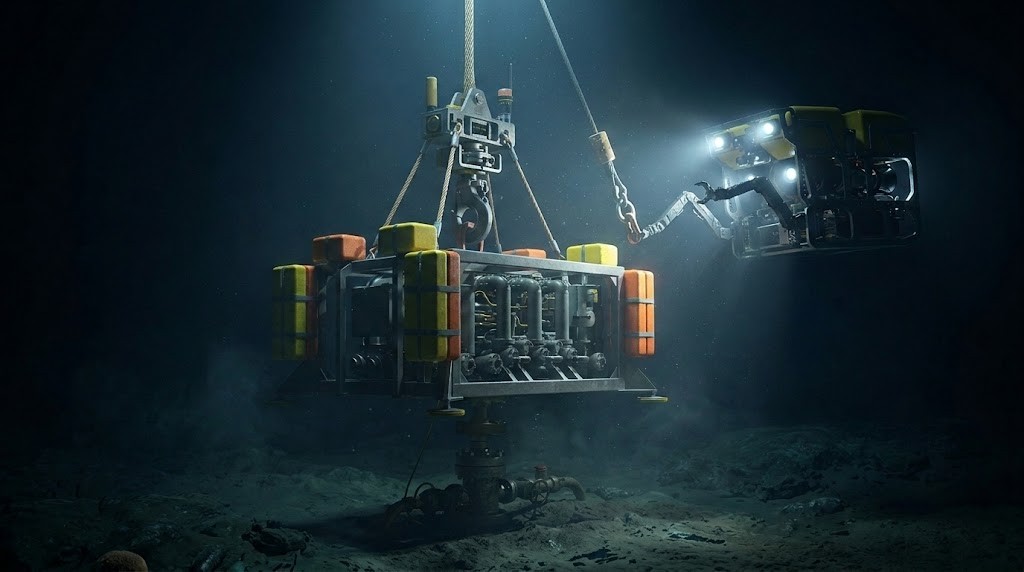
Beyond the cables themselves, the structures being lifted are also undergoing a material transformation. The use of advanced composites and high-strength alloys allows for the construction of subsea components that are lighter and more resistant to the corrosive effects of seawater. This weight reduction has a cascading effect on the entire lifting operation, reducing the size and power requirements of the surface vessels and the complexity of the seafloor foundations. By lightening the load from the design phase onward, operators can execute complex deepwater projects with a greater margin of safety and a lower overall environmental footprint.
The Transition to Composite Ropes and Buoyancy Systems
The adoption of composite ropes is not without its technical hurdles. Unlike steel, synthetic fibers can be sensitive to heat generated during rapid spooling and are more susceptible to abrasion, necessitating the use of advanced winch systems for deep sea drilling rigs that are specifically engineered to handle the unique thermal and frictional profiles of these advanced materials. Consequently, the latest subsea lifting technology innovation includes advanced cooling systems for winch drums and specialized coatings for the ropes themselves. These innovations ensure that the fiber integrity is maintained even during prolonged operations in deepwater environments. Furthermore, the use of active heave compensation (AHC) systems is essential to protect these ropes from the sudden tension spikes caused by vessel motion, ensuring a smooth and controlled descent regardless of surface conditions.
To further optimize the lifting process, engineers are deploying sophisticated buoyancy management systems. These systems involve attaching modular buoyancy units to subsea loads, effectively reducing their wet weight as they travel through the water column. By carefully balancing the weight of the module with the lift capacity of the cable, operators can perform extremely delicate maneuvers that were previously impossible. This controlled buoyancy is particularly useful during the landing phase, where a heavy manifold must be mated with a pre-installed wellhead. The ability to fine-tune the weight of the object in real time provides a level of control that is crucial for the success of deepwater projects.
Corrosion-Resistant Actuators and Hydraulics
The chemical environment of the deep ocean is as challenging as the physical pressure. Saltwater is highly corrosive, and at great depths, the presence of various minerals and microbial life can accelerate the degradation of metallic components. Improving subsea lifting tech for deepwater projects involves the development of specialized hydraulic systems and actuators that are hermetically sealed and filled with environmentally friendly fluids. These systems are designed to operate for years without maintenance, providing reliable power for the locking mechanisms and positioning arms that secure the load to the seafloor.
Innovation in this area also includes the use of ceramic coatings and non-metallic seals that can withstand the extreme pressure differentials. These materials ensure that the internal workings of the lifting tools remain protected from the ingress of seawater, which would otherwise lead to rapid failure. The reliability of these subsea actuators is a critical link in the safety chain. If a locking pin fails to engage or a hydraulic arm malfunctions during a lift, the entire project could be jeopardized. The focus on extreme durability is a testament to the high stakes of deepwater operations, where a single repair mission can cost millions of dollars.
Precision Control in Hostile Environments
Lifting a load in the deep ocean is only half the battle; the true challenge lies in placing it exactly where it needs to be. In the total darkness of the seabed, operators cannot rely on visual cues. Instead, they must depend on a sophisticated suite of sensors and robotic intermediaries. Subsea lifting technology innovation has led to the development of autonomous and semi-autonomous lifting hooks and frames that can identify their target and perform the final docking sequence with minimal human intervention. These systems use a combination of sonar, machine vision, and tactile sensors to navigate the final meters of the descent, ensuring that the load is aligned correctly every time.
This precision is further enhanced by the integration of ROVs (Remotely Operated Vehicles) into the lifting workflow. An ROV acts as the hands and eyes of the surface operator, providing high-definition video feeds and using its own robotic arms to assist with rigging and connection tasks. The latest generation of ROVs is more powerful and dexterous than ever, capable of working in tandem with the lifting cable to guide massive modules into place. This collaborative approach between surface-based lifting and seafloor-based robotics is the cornerstone of modern deepwater engineering, allowing for the construction of complex subsea factories that are the future of the industry.
Remote Operated Vehicle Integration and Autonomous Hooks
The synergy between the main lifting line and the ROV is a masterpiece of coordination. While the winch system manages the primary vertical movement, the ROV provides the lateral thrust and fine-tuned adjustments necessary for docking. Recent subsea lifting technology innovation has introduced intelligent lifting frames that communicate directly with the ROV. This allows for a shared data environment where both the surface vessel and the underwater robot are aware of each other’s movements and the exact status of the load. This prevents accidental collisions and ensures that the forces acting on the module are always balanced.
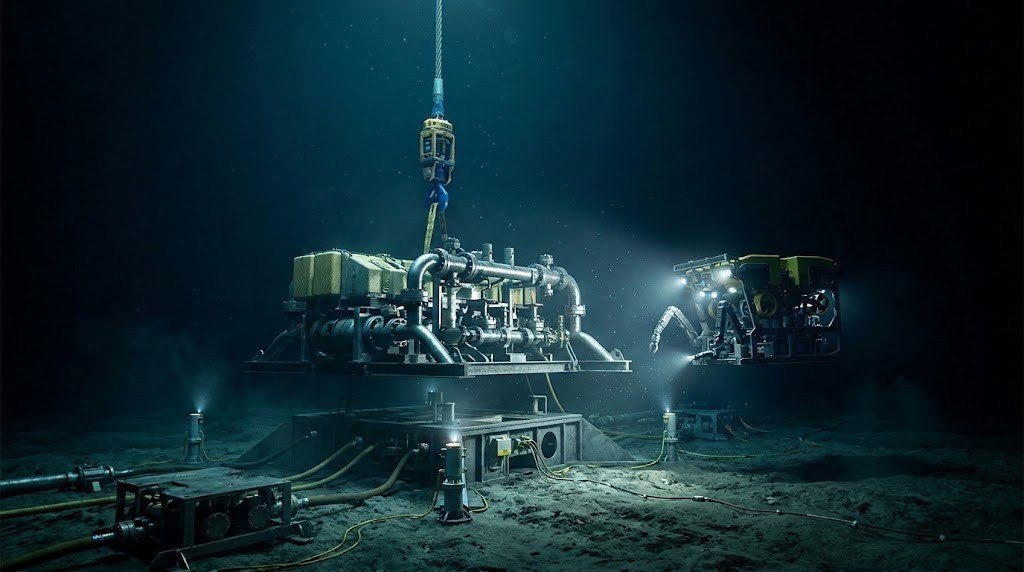
Autonomous hooks represent the next step in this evolution. These devices can automatically release the load once it is securely seated on the seafloor, eliminating the need for a risky manual disconnection by an ROV. By using pressure-sensitive triggers or acoustic commands, these hooks improve safety by reducing the time that personnel and expensive robotic assets must spend in the immediate vicinity of a suspended load. This automation not only speeds up the lifting process but also minimizes the window of vulnerability during which something could go wrong, making deepwater projects more resilient to unexpected events.
Real-Time Acoustic Positioning for Millimeter Precision
To achieve the necessary precision, deepwater lifting systems rely on Long Baseline (LBL) and Ultra-Short Baseline (USBL) acoustic positioning. These systems involve a network of transponders pre-installed on the seabed that send and receive sound pulses to track the exact position of the lifting frame. By triangulating these signals, the surface vessel can determine the coordinates of the load within a few centimeters, even three kilometers below the surface. Improving subsea lifting tech for deepwater projects has involved increasing the frequency and accuracy of these acoustic updates, allowing for a real-time digital display of the descent path.
The latest acoustic systems are designed to operate in noisy environments, filtering out the sound of the vessel’s thrusters and the movement of the water. This ensures a clean data stream that is fed directly into the vessel’s dynamic positioning (DP) system. If the load drifts slightly off course, the DP system can automatically adjust the vessel’s position to bring it back in line. This closed-loop control system is what allows engineers to build subsea infrastructure with the same level of accuracy as they would on dry land, paving the way for increasingly complex and ambitious deepwater developments.
Sustainability and Economic Viability in Deepwater Lifting
As the world focuses on the energy transition, the subsea industry is also under pressure to reduce its carbon footprint. Subsea lifting technology innovation is playing a key role here by enabling smaller, more fuel-efficient vessels to perform tasks that previously required massive heavy-lift ships. By reducing the weight of the lifting gear and improving the efficiency of the winch systems—often through power-regenerative braking—operators can significantly lower the fuel consumption of their offshore campaigns. This not only benefits the environment but also improves the economic viability of deepwater projects by reducing operational expenditures.
Furthermore, the increased reliability of modern subsea lifting tech means fewer failed attempts and less time spent on site. In an industry where a single day of vessel time can cost hundreds of thousands of dollars, these efficiency gains are substantial. The focus on durability and low maintenance also ensures that subsea infrastructure has a longer service life, reducing the need for frequent and expensive intervention missions. Oil & Gas Advancement believes that by combining high-tech innovation with a focus on long-term value, the subsea sector is proving that it can continue to meet the world’s energy needs in a responsible and sustainable manner.
