


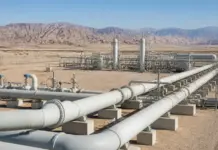














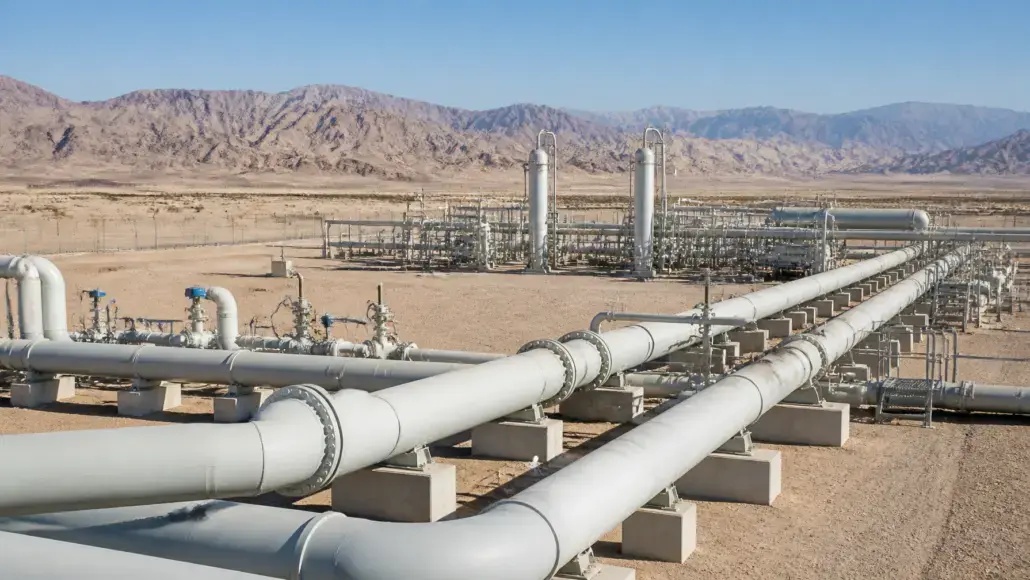
Three major gas pipeline projects being developed in Oman as per OQ Gas Networks (OQGN), the Sultanate of Oman’s exclusive operator of the natural gas transmission network. The three gas pipeline projects are expected to be completed by the end of 2027. The projects are intended to strengthen gas supply capacity for key industrial and economic growth hubs across Oman.
Details of the development of the three gas pipeline projects were presented by OQGN to review its financial and operational performance for the first half of 2026. The company was represented by Eng. Mansoor Ali Al Abdali, Chief Executive Officer; Eng. Saif Al Hosni, Chief Business Development & Commercial Officer; and Sultan Al Balushi, Acting Chief Financial Officer. The projects are being developed as part of an OMR 294 million capital expenditure programme allocated for infrastructure growth during the current Price Control period.
Fahud–Sohar and Budoor–Tayseer projects progress
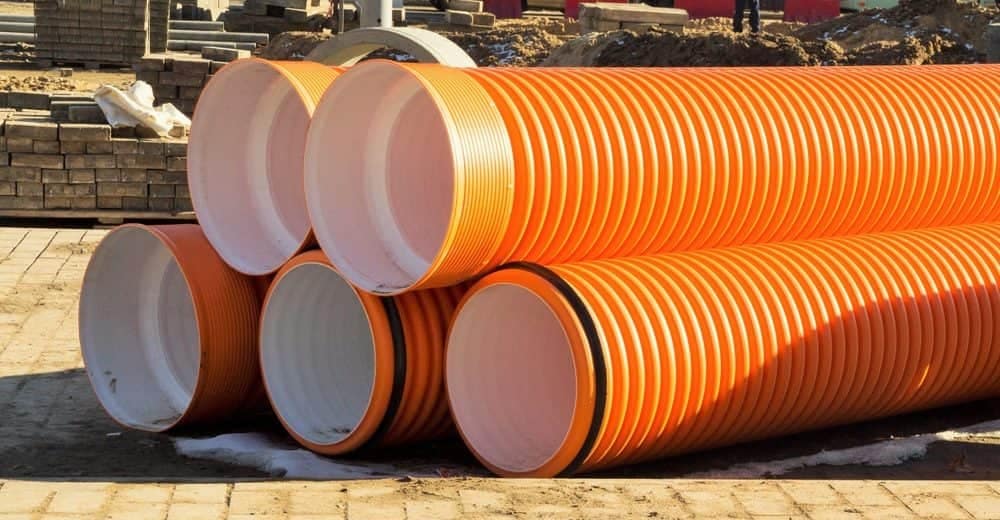
The largest development currently under construction is the 193-km, 42-inch Fahud–Sohar Loop Line. The capacity-expansion project is intended to debottleneck the northern gas network while addressing increasing industrial demand in Suhar and Ibri. The line will extend from the Fahud Compressor Station towards Suhar, following a route parallel to the existing Fahud–Suhar pipelines. Once completed, it is expected to provide around 11 million standard cubic metres per day (MMSCMD) of additional transmission capacity to the northern network.
OQGN is also progressing with the 31-km, 14-inch Budoor–Tayseer pipeline. Designed as a gas-supply integration project, the pipeline will connect the Budoor Tayseer Gas Plant with OQGN’s national transmission network. The development is expected to add approximately 2 MMSCMD of transmission capacity.
Duqm Growth pipeline to support expanding demand
In southeast Oman, OQGN is advancing the 13-km, 32-inch Duqm Growth pipeline. The project is designed to increase gas supplies to the Port of Duqm area and support the expanding cluster of industries that require natural gas.
With the three gas pipeline projects forming part of the company’s infrastructure-growth programme, OQGN expects its overall pipeline network to reach 4,717 km by 2027, compared with 4,368 km at the end of 2025. Total network capacity is projected to increase to 80.3 billion standard cubic metres (bn scm), up from 76.3 bn scm in 2025. Gas transportation volumes are also forecast to reach 47.1 bn scm, compared with 42.4 bn scm in 2025.
