



















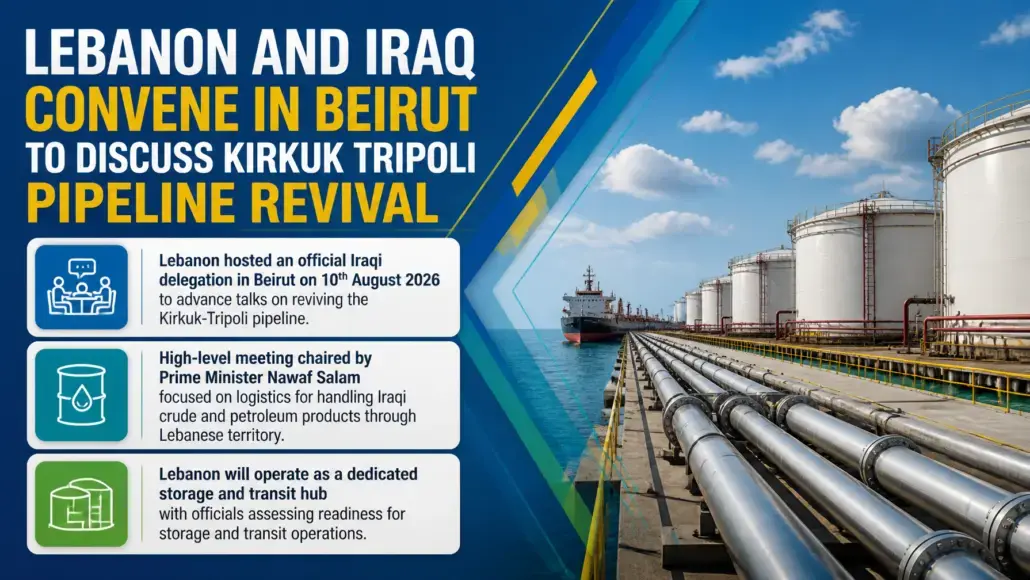
Lebanon hosted an official delegation from Iraq in Beirut on 10th August 2026 to advance discussions regarding the Kirkuk-Tripoli pipeline revival. Lebanon’s Prime Minister Nawaf Salam chaired the high-level meeting, which focused on establishing logistics for handling Iraqi crude and various petroleum products scheduled to transit through Lebanese territory.
Lebanese Officials Assess Readiness for Storage and Transit Operations
Under initial plans, Lebanon will operate as a dedicated storage and re-export center for incoming shipments of crude and petroleum products. Officials reviewed the operational readiness of multiple state bodies. The meeting assembled Lebanon’s Energy and Water Minister Joe Saddi, Interior and Municipalities Minister Ahmad al-Hajjar, Public Works and Transport Minister Fayez Rasamny, alongside representatives from Customs and General Security.
Infrastructure Upgrades and Operational Protocols
Inter-ministerial preparations encompass several technical and logistical steps. Work includes upgrading road infrastructure to accommodate heavy tanker movement, expanding border crossing capacities, and structuring secure transport routes leading to storage facilities. Officials also addressed safety requirements, operating protocols, and storage capacities ahead of the expected deliveries. Participating ministries agreed to maintain close coordination to ensure all remaining tasks meet established deadlines.
Historical Background of the Transit Corridor
The Kirkuk-Tripoli pipeline talks align with recent field inspections conducted by Lebanon’s energy minister at site facilities. These inspections support long-term framework plans aimed at attracting international investment to rehabilitate the Kirkuk-Tripoli pipeline. Originally constructed and commissioned between 1932 and 1934, the transit route formed an essential segment of an early network delivering Iraqi crude across Syria to Lebanon’s Mediterranean port. Subsequently, a refinery was constructed in Tripoli in 1940 to process incoming supply, operating in parallel with other regional terminals servicing Mediterranean markets. Future steps aim to restore structural viability to facilities connected to the Tripoli refinery.
Iraq Expands Regional Pipeline Infrastructure
Simultaneously, Iraq has initiated construction on the new Basra-Haditha pipeline. Designed with a capacity of up to 2.5 million barrels per day, this conduit features planned connection points extending toward Syria’s Baniyas port, Türkiye’s Ceyhan terminal, and Jordan’s Aqaba port. This project reflects Baghdad’s broader strategy to expand its export routes. By establishing alternative export routes, Iraq aims to reduce reliance on the Strait of Hormuz following the near-total disruption of oil shipments through the waterway since late February. 2026
