









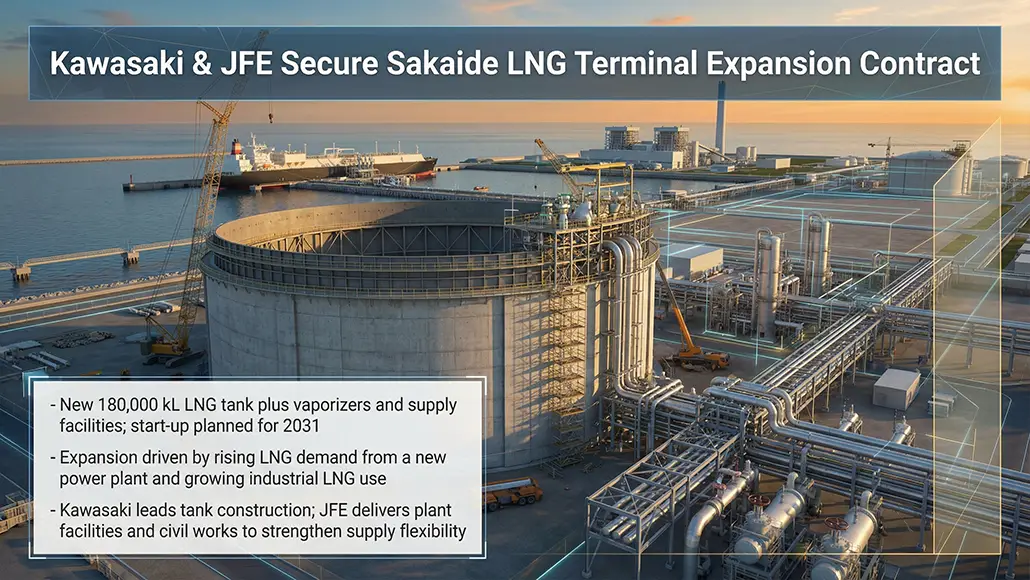
A joint venture formed by Tokyo-headquartered Kawasaki Heavy Industries and JFE Engineering has secured a major contract tied to a Japanese LNG project, involving LNG tank construction and expansion works at the Sakaide LNG terminal. The award, granted by Kagawa-based Sakaide LNG Company, covers the development of LNG storage infrastructure and associated facilities. This Japanese LNG project is viewed as a step toward supporting the country’s broader energy transition objectives. Rising demand for natural gas, driven by the planned construction of the Sakaide No.5 power plant by Shikoku Electric Power and ongoing conversion to LNG fuel across factories and other consumers, has prompted Sakaide LNG to pursue expanded storage capacity, improved system flexibility, and a stronger gas supply framework.
Under the scope of the Japanese LNG project, a 180,000 kiloliter (kL) above-ground PC LNG tank will be installed alongside supply infrastructure, including LNG vaporizers, at the Sakaide LNG terminal. Operations are scheduled to begin in 2031. Kawasaki Heavy Industries will oversee construction of the LNG tank, while JFE Engineering will handle plant facilities, civil engineering, and construction work. Both companies bring extensive experience to the Japanese LNG project, with Kawasaki having delivered more than 70 cryogenic tanks domestically and internationally, and JFE Engineering contributing to the construction and expansion of LNG receiving terminals across Japan. The companies have stated their intention to continue supporting energy transition efforts aimed at achieving a carbon neutral society.
Sakaide LNG Company, which owns the terminal, is backed by Shikoku Power (70%), Cosmo Oil (20%), and Shikokugas (10%). The project site is located in Bannosumidoricho, Sakaide-shi, Kagawa. Currently, the Sakaide LNG terminal has a storage capacity of 180,000 cubic meters (cbm) and an annual throughput capacity of 1.2 million metric tonnes per annum. The facility began its operational journey with its first commissioning cargo in January 2010, followed by the start of commercial operations in March 2010. At that time, Kawasaki Heavy Industries acted as the sole contractor, delivering the full scope of engineering, procurement, construction, and subcontracting works.
