













Acting on the directive of President Ferdinand R. Marcos Jr., Philippines’ Department of Energy (DOE), working alongside the Department of Budget and Management (DBM), has moved to activate a 20 billion Peso allocation, equivalent to around $333 million, to reinforce the Philippines’ fuel security. The decision comes as global oil markets remain volatile amid ongoing tensions linked to the Middle East conflict. By mobilizing the $333 million emergency fund, the government is aiming to shield the domestic market from external supply disruptions and ensure the stable availability of fuel nationwide. The move reflects what officials describe as a firm commitment to maintaining continuous, adequate, and reliable fuel access for the Filipino population.
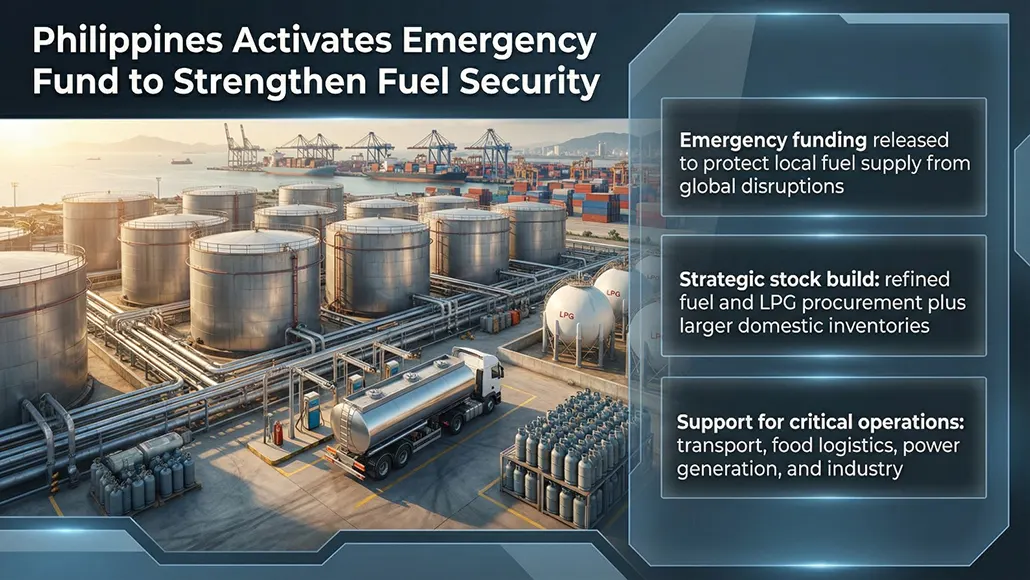
The $333 million emergency fund will support the rollout of the DOE’s Emergency Energy Security Program, a framework designed to address supply vulnerabilities. Key measures under the program include the procurement of refined petroleum products, augmentation of LPG supply, and the buildup of domestic fuel inventories. Authorities have set a target volume of up to 2 million barrels of fuel, intended to meet local demand while cushioning the effects of global supply fluctuations. To operationalize the initiative, funds will be channeled to the Philippine National Oil Corporation (PNOC) and PNOC Exploration Corporation (PNOC EC), which will serve as implementing agencies.
Officials emphasized that the $333 million emergency fund enhances the government’s capacity to respond swiftly to disruptions in global petroleum markets. It is also expected to help maintain market stability and ensure the uninterrupted functioning of critical sectors such as transport, food logistics, power generation, and industry. “This is a strong intervention by the President to strengthen the country’s fuel security amid global oil market disruptions,” Energy Secretary Sharon Garin said. “The government is taking concrete and proactive steps to secure fuel supply, maintain orderly market conditions, and protect the welfare of every Filipino motorist.”
The department highlighted that protecting fuel supply goes beyond economic considerations, underscoring its role in enabling daily mobility, work, and essential services. The DOE added that it is closely coordinating with relevant government bodies and industry stakeholders to track supply conditions, enforce compliance with existing regulations, and take necessary steps to prevent supply constraints, unjustified price increases, and market abuse. As part of efforts to strengthen transparency and accountability, the department said it will disclose compliance results of government entities through its official website and other communication platforms.
