








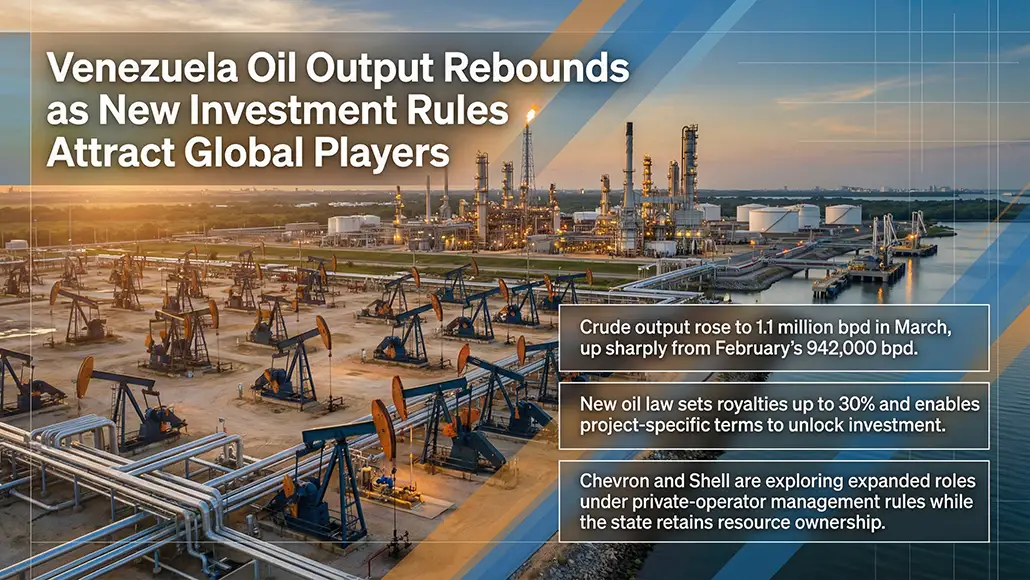
Venezuela’s crude output climbed to an average of 1.1 million barrels per day (bpd) in March 2026, marking a sharp increase from 942,000 barrels per day recorded in February, according to a PDVSA presentation. The rise to 1.1 million bpd follows a major geopolitical shift, after the United States selectively lifted sanctions, removed President Nicolas Maduro from power, and transferred him to the U.S. to face trial for drug trafficking, while assuming effective control over Venezuela’s oil industry. Despite the rebound to 1.1 million bpd, the country’s longer-term recovery remains gradual. During the 1990s, Venezuela produced around 3 million barrels per day, but years of poor management combined with U.S. sanctions significantly curtailed output.
Since the U.S. intervention, the outlook has improved, with international oil companies beginning to re-engage with the country. This renewed interest is partly driven by a legislative overhaul designed to provide greater operational clarity and stability. The newly enacted law caps royalty rates at 30% while allowing flexibility for project-specific adjustments depending on investment requirements and competitiveness. Following its approval earlier this year, Venezuela’s interim president Delcy Rodriguez said she anticipated fresh oil investments reaching as much as $1.4 billion this year. The policy shift underpins expectations that production levels such as 1.1 million bpd could be sustained or gradually expanded.
The legislation also outlines a revised operational framework for private sector participation. Under the new rules, companies “will assume full management of the activities at its own expense, account, and risk, after demonstrating its financial and technical capacity through a business plan” subject to approval by the Venezuelan oil ministry. While operational control is extended to private firms, ownership of the underlying resources will remain with the Venezuelan state. This structure is intended to balance foreign investment incentives with state control of reserves.
In response, major energy companies are exploring expanded involvement. Chevron is reportedly in discussions to broaden its Petropiar joint venture with PDVSA, while Shell is evaluating opportunities in eastern Venezuela, particularly in the Monagas North area, which contains some of the country’s limited light and medium crude reserves. Shell is also considering natural gas developments both offshore and onshore. These developments highlight a cautious but notable return of international players as Venezuela seeks to rebuild output levels around 1.1 million bpd.
