















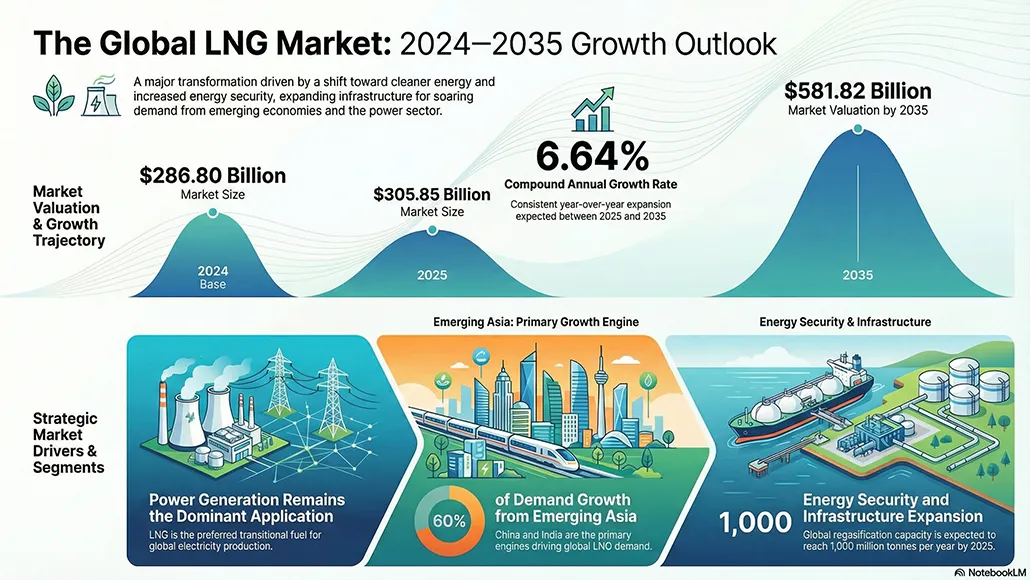
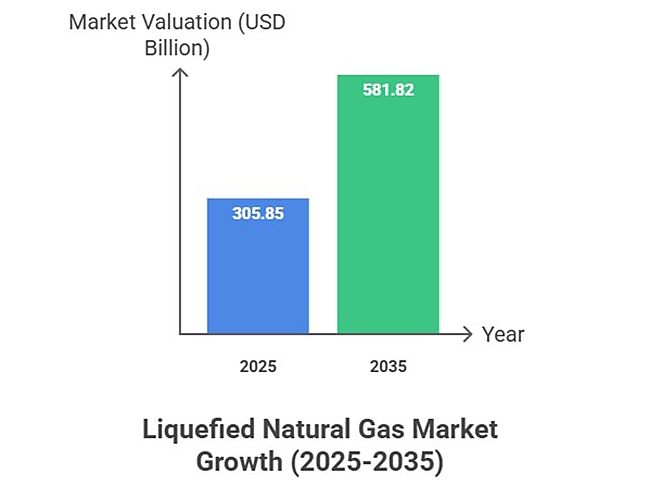
The global energy landscape is currently undergoing a significant transformation as nations seek to balance growing power requirements with the urgent need for sustainable and lower-carbon alternatives. At the heart of this transition is the Liquefied Natural Gas Market, which is increasingly viewed as a critical bridge toward a cleaner energy future. From projections of 305.85 USD Billion in 2025, the market is poised to grow to a substantial 581.82 USD Billion valuation by 2035. This growth represents a steady compound annual growth rate (CAGR) of 6.64% over the ten-year forecast period.
Market Dynamics and Core Drivers
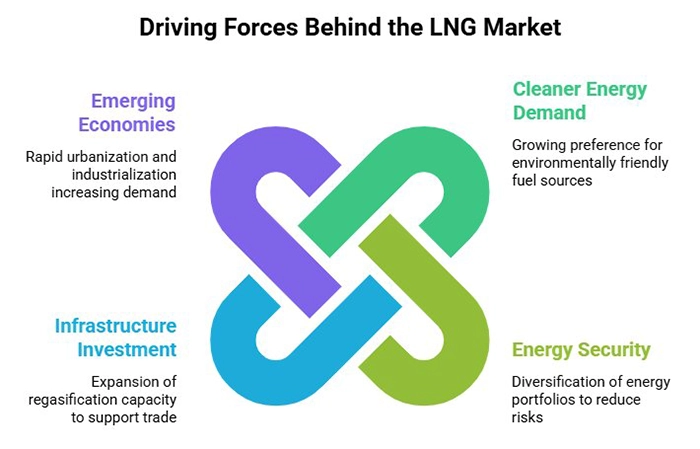
The Liquefied Natural Gas Market Report 2025-2035 shows an upward trajectory propelled by several interlocking factors, ranging from geopolitical necessity to environmental mandates. One of the primary catalysts is the increasing global demand for clean energy sources. As international policies tighten around carbon emissions, natural gas, specifically in its liquefied form, is favored for its combustion properties, which are cleaner than traditional fossil fuels like coal or oil. This “transitional fuel” status is further supported by the International Energy Agency, which suggests that this energy source could be pivotal in achieving long-term climate targets.
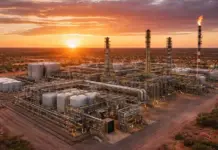
Energy security has also emerged as a dominant driver. Many nations are actively diversifying their energy portfolios to mitigate risks associated with over-reliance on single suppliers or volatile geographic regions. This strategic shift is expected to be so profound that by 2025, liquefied natural gas could represent more than 30% of the entire global natural gas trade. To support this volume, massive investments are being funneled into infrastructure. Global regasification capacity, for instance, is anticipated to reach approximately 1,000 million tonnes per year by 2025, facilitating smoother international trade flows and potentially lowering logistical costs over time.
Furthermore, the rise of emerging economies is reshaping demand patterns. Rapid urbanization and industrialization in regions such as Asia are creating a massive appetite for reliable power. Specifically, China and India are projected to account for nearly 70% of the growth in global demand by 2025. These nations are increasingly turning toward liquefied gas to fuel their expanding industrial sectors while simultaneously addressing local air quality concerns.
Technological Innovation and Industry Trends
Technological advancements are revolutionizing the efficiency of the entire supply chain. Innovations in liquefaction processes, such as the development of floating liquefaction technology, are making projects more economically viable by lowering breakeven prices. These advancements not only increase total output but also allow for the extraction of gas from more remote or challenging locations.
The market is also witnessing a trend toward digitalization and the integration of advanced technologies like artificial intelligence to optimize supply chain operations. These digital tools are designed to enhance operational capabilities, improve efficiency, and reduce the carbon footprint of the production and transportation processes themselves. Additionally, the industry is exploring new opportunities in maritime and heavy-duty transportation, where liquefied gas is becoming a viable alternative to traditional fuels. The expansion of bunkering infrastructure in major global ports and the development of small-scale facilities for remote areas are key examples of these emerging trends.
Detailed Segment Analysis
The Liquefied Natural Gas Market is categorized by application, feedstock, production process, and end-user industry, each showing distinct growth characteristics and valuation ranges.
Application and End-User Insights of LNG Market
Power Generation remains the dominant application, holding the largest share of the market. This dominance is due to the widespread shift toward gas-fired power plants to replace coal. In terms of end-users, the power industry leads, but the Industrial Sector is recognized as the fastest-growing segment. Industries such as manufacturing and chemicals are increasingly adopting gas to improve production efficiency and meet stringent environmental regulations.
While Power Generation is the largest, the transportation sector is identified as the fastest-growing application. Driven by the need for cleaner automotive and maritime fuels, the transportation segment is projected to have a great jump.
Feedstock and Production Process Insights of LNG Market
In terms of feedstock, natural gas remains the cornerstone. Associated gas is also seeing growth due to enhanced extraction techniques, while biogas, though currently at a nascent stage, is gaining traction as a sustainable alternative that aligns with renewable energy goals.
Regarding production processes, cryogenic liquefaction continues to be the dominant technology due to its high efficiency and established history. However, mixed-refrigerant liquefaction is emerging as the fastest-growing process, particularly favored by new projects for its flexibility and adaptability to various climatic conditions.
Regional Market Forecasts
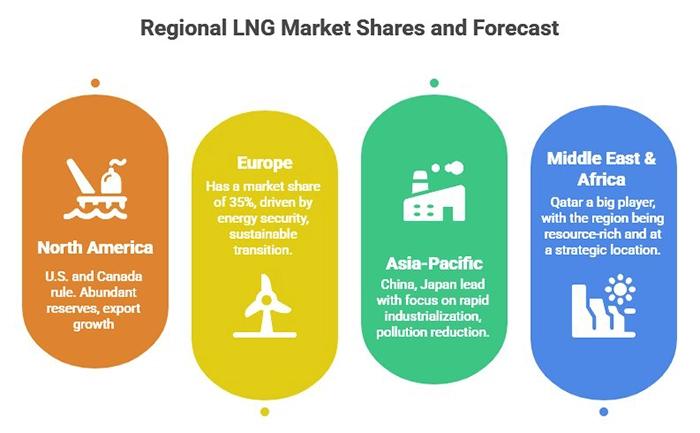
The growth of the Liquefied Natural Gas Market is a global phenomenon, though regional drivers vary significantly.
- North America: This region is a leader in the energy transition, characterized by abundant natural gas reserves and advanced technology. The United States holds approximately 45% of the global share, with Canada accounting for 15%. Growth here is driven by both high domestic demand and expanding export opportunities, supported by significant investments in liquefaction and export terminals.
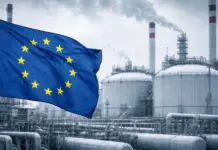
- Europe: With a market share of roughly 25%, Europe is focused on energy security and a sustainable transition. Regulatory frameworks such as the European Union’s Green Deal are pivotal, as countries like Germany and the Netherlands invest heavily in infrastructure to diversify their energy sources away from traditional pipelines.
- Asia-Pacific: This region is witnessing “unprecedented growth,” with China and Japan collectively holding over 60% of the regional share. The transition here is fueled by rapid industrialization and government initiatives aimed at reducing air pollution.
- Middle East and Africa: This region remains a resource-rich powerhouse. Qatar alone holds approximately 30% of the global market share. Strategic geographic locations and massive ongoing investments in production facilities ensure the region remains a dominant exporter to meet rising global demand.
Future Outlook to 2035
As the market approaches 2035, it is expected to solidify its position as a cornerstone of the global energy mix. The transition will be characterized by a move away from traditional price-based competition toward a focus on innovation, technological reliability, and sustainability. New opportunities are expected to flourish in small-scale distribution networks and integrated renewable energy projects. By the end of the forecast period, the continued expansion of infrastructure and the adoption of more efficient production methods will likely lead to a more dynamic, competitive, and sustainable global market.
