






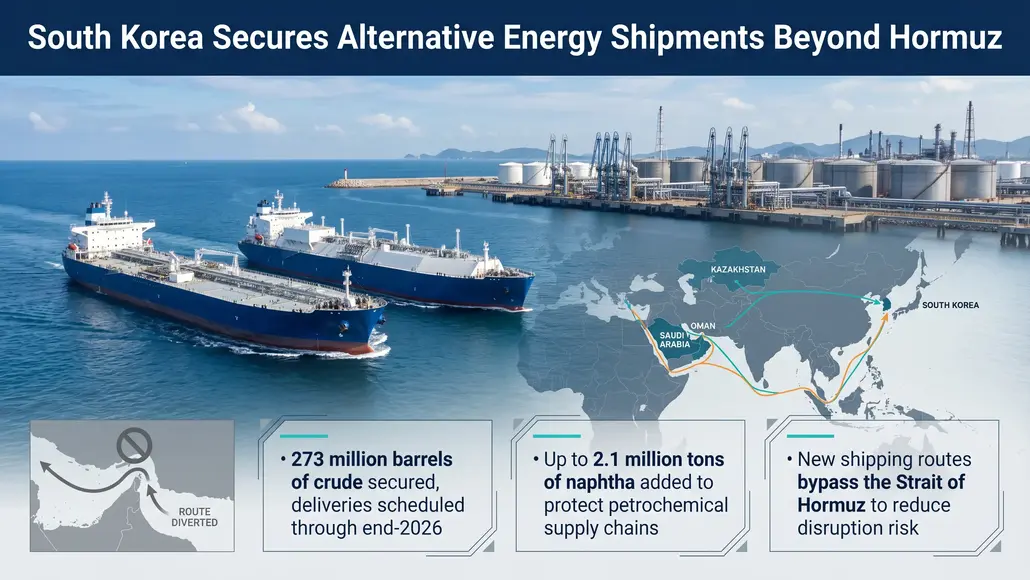
South Korea has arranged alternative energy shipments amounting to 273 million barrels of crude along with fresh naphtha supplies sourced from Kazakhstan, Oman, and Saudi Arabia, according to the president’s chief of staff. These volumes are set to be transported via routes that bypass the blockaded Strait of Hormuz, reflecting a strategic shift in logistics. Kang Hoon-sik stated that the total package includes 273 mn barrels of crude oil and up to 2.1 million tons of naphtha, all scheduled for delivery by the end of 2026. The diversification effort brings together supplies from multiple producers to ensure continuity amid disruptions tied to regional instability.
Breaking down the figures, Kang Hoon-sik said that Kazakhstan will supply 18 million barrels of crude oil, while Oman will provide 5 million barrels of crude oil alongside 1.6 million tons of naphtha. Saudi Arabia’s contribution forms the largest share, with 50 million barrels of oil earmarked for shipment in April-May, followed by an additional 200 million barrels extending from June through the end of the year. In addition, Saudi Arabia has committed to delivering 500,000 tons of naphtha. Combined, these allocations reinforce the scale of the 273 mn barrels of crude secured under the plan, ensuring that South Korea can maintain inflows through alternative channels.
The move comes as South Korea accelerates efforts to diversify energy sources and stabilize imports of key petrochemical materials after the crisis in the Middle East exposed the risks associated with heavy dependence on the Strait of Hormuz. The country imports nearly all of its energy requirements, with around 70 percent traditionally passing through the strait. The ongoing Iran conflict has intensified pressure on the energy-importing nation, affecting both households and businesses. Against this backdrop, the government’s arrangement for 273 mn barrels of crude underscores the urgency of securing supply resilience.
Since the conflict began in February 2026, South Korean President Lee Jae Myung has consistently urged restraint in fuel consumption, reflecting mounting concern over energy security. He has described the situation as one of the most severe threats to the country’s energy stability in decades, as authorities work to mitigate the broader economic impact of prolonged supply disruptions and heightened volatility in global oil markets.
