










Indonesia has gone on to commit to buying $15 billion of US energy as per the new reciprocal trade agreement with Washington, in a move that will cut the flows from Southeast Asia, its energy minister confirmed on February 20, 2026.
The fact is that buying $15 billion of US energy pledge, which is a part of a forecasted $33 billion in US goods purchases that has been promised by Jakarta, goes on to include $3.5 billion of LPG and $4.5 billion when it comes to crude oil, as well as $7 billion of gasoline, as per the agreement that was released on February 19, 2026, by the Office of the US Trade Representative.
Apparently, at a press conference following the announcement, Bahlil Lahadalia, the energy and mineral resources minister of Indonesia, said that the deal is going to cut imports from its neighbors.
Lahadalia said that “the $15 billion we have allocated to buy energy from the United States does not mean we are increasing imports. We are shifting import volumes from several countries, and the biggest portion will likely come from Southeast Asia, followed by the Middle East and Africa.”
Lahadalia remarked that the procurement mechanism is indeed going to take economic considerations into account so as to make sure of a mutual benefit for both Indonesia as well as the US, and hence described it as a win-win.
Interestingly, the LPG imports of Indonesia averaged around 241,900 barrels per day in 2025, which includes 166,100 b/d from the US, confirming the data from S&P Global Commodities at Sea. The total crude as well as condensate imports touched at around 380,500 b/d in 2025, with 15,100 b/d from the US.
Platts, which is a part of S&P Global Energy, evaluated AGS, which is the value for barrels of West Texas Intermediate Midland crude that’s loaded on a free-on-board basis at $67.51/b on February 19, 2026.
It is well to be noted that Indonesia happens to be structurally dependent on gasoline imports and has received 268,700 b/d of gasoline in 2025 alone, with Singapore as well as Malaysia being its top suppliers. Interestingly, US-origin gasoline volumes to Indonesia were pretty low that year.
The government is going to assign Pertamina, the state energy firm in order to carry out the imports, confirmed Lahadalia. Details pertaining to the scale of supply shifts from the Middle East, Southeast Asia, and Africa are going to be set within three weeks, whereas the $15 billion US energy spending commitment is indeed final, he confirmed.
The president director of Pertamina, Simon Aloysius Mantiri, who also happened to be present at the press conference, remarked that the state-owned company goes on to view the new import scheme as a move towards energy self-sufficiency. It is estimated that around 57% of the current LPG imports of Pertamina come from the US, and that share could as well rise to 70%, he added.
When it comes to crude oil and, along with it, other products, discussions along with the US partners are still ongoing, Mantiri remarked, adding that finalization of the deal is most likely going to take place within 90 days of the agreement getting signed.
One of the Singapore-based market participants said that the transition towards US supply could also alter the sourcing patterns that are already established from the Middle East and, along with it, regional hubs like Singapore; however, the final effect is going to depend on the implementation details, in addition to the contract duration and schedules for delivery.
Mantiri further said that “the planned energy imports from the United States will be carried out on a business-as-usual basis, through open and transparent tender and bidding processes, without any direct appointments. Supply diversification will be pursued to safeguard energy security and secure the most competitive prices.”
It is worth noting that Pertamina initiated memorandums of understanding – MoU in July 2025 with many prospective US partners, including the likes of ExxonMobil, KDT Global Resources, and Chevron, says Mantiri.
Apart from buying the US-origin goods, Indonesia also went on to agree to grant permission and support the US investment when it comes to exploration, refining, and processing, as well as transportation pertaining to energy resources and critical minerals, with possible funding assistance from US institutions.
Jakarta, on the other hand, has also agreed not to have any restrictions on imports of US bioethanol and outlined plans so as to introduce E5 fuel blending by 2028 and also E10 by 2030, with a possibility of E20 depending upon the infrastructure readiness.
The Upstream Push
Apart from this, when it came to the upstream front, Lahadalia remarked that the government plans to extend the ExxonMobil-operated Cepu Block contract till 2055, with another set of investments of almost $10 billion. Numerous technical issues, which include the cost recovery scheme, are getting ready, and production is at present 170,000-185,000 b/d, Lahadalia confirmed.
Notably, the Cepu Block exploration contract is due to expire in 2035. ExxonMobil went on to first discover the Banyu Urip field located in East Java, having reserves of almost 450 million barrels.
Mantiri confirmed that Pertamina had also inked an agreement with Halliburton pertaining to oilfield recovery at mature domestic fields that are experiencing natural production reductions.
The fact is that Indonesia has indeed struggled to raise its crude output after years without any sort of major new discoveries. The country produced around 605,300 b/d of crude oil in 2025 and is now targeting 610,000 b/d in 2026, reports Platts.
And then there are authorities who have also said that they plan to reactivate idle wells and push exploration across the eastern part of Indonesia by way of more attractive terms.
Tariff Barriers
Also, the bilateral deal is going to see Indonesia eradicate tariffs on more than 99% of US products, while on the other hand, the US is going to maintain a 19% reciprocal tariff when it comes to imports from Indonesia; however, certain textiles as well as apparel goods are going to have a 0% tariff rate.
The US, at present, has its 15th-largest goods trade deficit with Indonesia, which totals $23.7 billion in 2025.
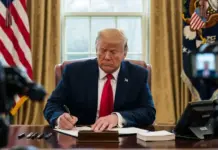
As per the statement from the White House, President Trump has gone on to deliver a forward-looking and expansive trade deal in one of the biggest markets in Southeast Asia, and it is going to be benefiting American workers, exporters, and farmers, as well as digital innovators.
Jakarta, ahead of Prabowo Subianto, the Indonesian president’s meeting with Trump so as to finalize the trade agreement, went on to announce that both Indonesian and US companies have inked around 11 deals of $38.4 billion on February 18, 2026, that take into account mining, agribusiness, energy, textiles, and furniture, as well as technology verticals.
