














The global oil and gas industry is undergoing a significant transformation as companies face mounting pressure to reduce greenhouse gas emissions, strengthen environmental stewardship, and comply with increasingly stringent regulations. Governments, investors, and stakeholders now expect operators to deliver greater transparency in emissions reporting while maintaining operational efficiency and profitability. Traditional emissions monitoring techniques, although valuable, often struggle to provide the continuous visibility and rapid response capabilities required in today’s complex operational environment.
This challenge has accelerated the adoption of AI-powered emissions monitoring, a technological advancement that combines artificial intelligence, machine learning, industrial sensors, satellite imagery, drones, and cloud computing to create intelligent environmental monitoring systems. Rather than relying solely on periodic inspections or manual data collection, AI continuously analyzes massive volumes of operational data, identifies abnormal emission events in real time, predicts equipment failures, and enables operators to respond before environmental incidents escalate.
Oil & Gas Advancement notes that as digital transformation becomes a strategic priority across upstream, midstream, and downstream operations, artificial intelligence is emerging as one of the most valuable tools for improving sustainability performance. Beyond regulatory compliance, intelligent emissions monitoring helps organizations reduce operational costs, enhance asset reliability, protect corporate reputation, and accelerate progress toward net-zero commitments.
The Growing Need for Intelligent Emissions Monitoring
Oil and gas operations involve numerous sources of greenhouse gas emissions, including methane leaks, flaring activities, venting systems, compressor stations, storage tanks, pipelines, and processing facilities. Methane, in particular, presents one of the industry’s most pressing environmental challenges because of its significantly higher global warming potential compared to carbon dioxide over shorter timeframes.
Historically, operators have depended on scheduled inspections using handheld gas detectors, fixed monitoring equipment, or periodic aerial surveys. While these methods remain useful, they frequently leave extended periods during which leaks can develop unnoticed. Even relatively small methane leaks may continue for weeks before detection, leading to environmental damage, product loss, regulatory penalties, and reputational risks.
This evolving landscape has created the need for AI-powered emissions monitoring, enabling continuous surveillance instead of periodic assessments. Artificial intelligence analyzes thousands of operational variables simultaneously, detecting subtle changes that human inspectors may overlook while dramatically reducing response times.
Continuous monitoring also aligns with global initiatives aimed at reducing methane emissions, making intelligent monitoring systems an essential component of modern environmental management strategies.
How Artificial Intelligence Is Reshaping Emissions Detection
Artificial intelligence excels at identifying patterns within complex datasets. In oil and gas facilities, thousands of sensors continuously generate information related to pressure, temperature, flow rates, vibration, gas concentrations, weather conditions, and equipment performance. AI algorithms integrate these diverse data streams to create a comprehensive operational picture.
Machine learning models establish baseline operating conditions for each asset and recognize deviations that may indicate leaks or equipment malfunctions. Instead of waiting for alarms triggered by predefined thresholds, AI identifies emerging anomalies through predictive analytics, often before emissions become significant.
Computer vision technologies further expand monitoring capabilities. Cameras installed throughout facilities can automatically identify visible gas plumes, abnormal flare behavior, smoke patterns, or equipment deterioration. Combined with infrared imaging, AI systems can detect methane leaks that remain invisible to the human eye.
These capabilities transform emissions management from reactive problem-solving into proactive environmental risk prevention.
Integrating IoT Sensors, Drones, and Satellite Intelligence
The effectiveness of AI-powered emissions monitoring increases significantly when artificial intelligence is integrated with multiple monitoring technologies.
Industrial Internet of Things (IoT) sensors continuously collect environmental and operational measurements from pipelines, compressor stations, production wells, offshore platforms, and processing plants. These sensors provide high-frequency data that AI platforms analyze instantly.
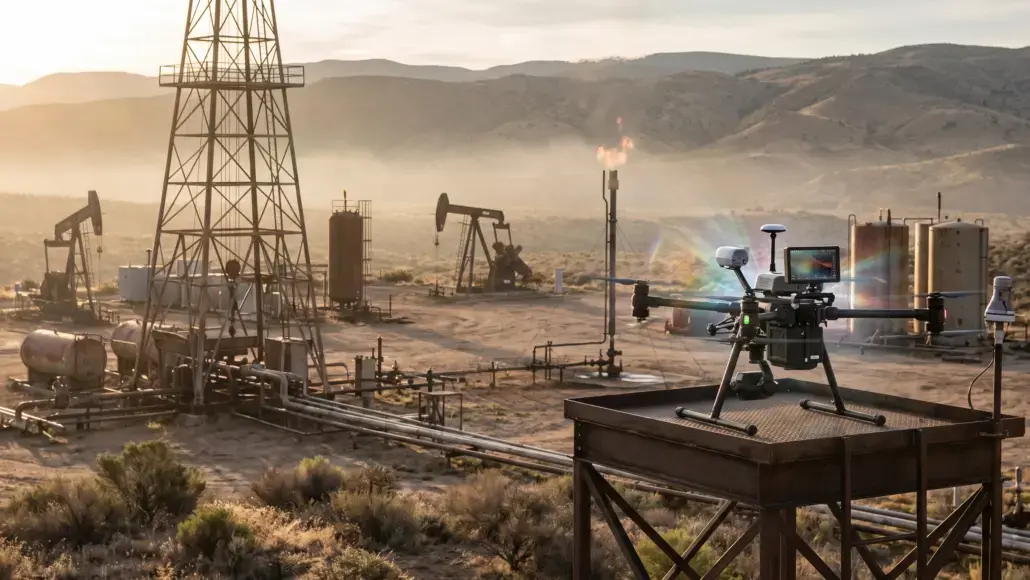
Drones equipped with thermal cameras, laser-based methane detectors, and multispectral imaging systems offer rapid inspections across remote or hazardous locations. AI processes drone imagery in near real time, automatically highlighting suspected emission sources and prioritizing maintenance activities.
Satellite technology has also become increasingly important for large-scale methane monitoring. Modern satellite constellations can identify major emission events across vast geographic regions, providing independent verification of facility performance. Artificial intelligence enhances satellite observations by filtering atmospheric interference, correlating detected emissions with facility operations, and improving measurement accuracy.
Together, these technologies establish comprehensive monitoring ecosystems that provide visibility from individual valves to entire production regions.
Predictive Analytics Enables Proactive Environmental Management
One of artificial intelligence’s greatest advantages lies in prediction rather than detection alone.
Traditional emissions programs often identify leaks after they occur. AI-driven predictive analytics shifts the focus toward preventing emissions before they happen.
Machine learning models analyze historical maintenance records, equipment operating conditions, weather patterns, corrosion data, vibration signatures, and asset performance trends to forecast which components are most likely to fail. Maintenance teams can then repair or replace equipment during scheduled shutdowns rather than responding to unexpected failures.
Predictive maintenance offers several operational advantages:
- Reduced methane emissions
- Lower maintenance costs
- Improved equipment reliability
- Fewer production interruptions
- Enhanced worker safety
- Better regulatory compliance
- Extended asset lifespan
Instead of treating emissions monitoring as a standalone compliance activity, operators integrate environmental intelligence directly into broader asset management strategies.
Supporting Regulatory Compliance and ESG Reporting
Environmental regulations governing methane emissions continue to evolve worldwide. Governments increasingly require operators to demonstrate continuous monitoring, rapid leak detection, accurate reporting, and measurable emissions reductions.
Manual reporting processes often involve significant administrative effort while introducing opportunities for human error. AI automates much of this workflow by collecting emissions data, validating measurements, generating compliance reports, and maintaining comprehensive audit trails.
The adoption of AI-powered emissions monitoring also strengthens Environmental, Social, and Governance (ESG) reporting. Investors increasingly evaluate companies based on sustainability metrics, emissions reduction targets, and climate risk management.
AI platforms provide organizations with reliable emissions inventories supported by continuous measurements rather than estimates. This higher level of transparency improves stakeholder confidence while supporting voluntary initiatives related to methane reduction and carbon management.
As sustainability reporting standards become more rigorous, intelligent monitoring systems will play an increasingly central role in corporate ESG strategies.
Operational Benefits Beyond Environmental Compliance
Although emissions reduction remains the primary objective, AI-generated operational intelligence delivers numerous additional business benefits.
Early identification of equipment degradation minimizes costly emergency repairs. Optimized maintenance schedules reduce unnecessary inspections while directing resources toward higher-risk assets. Better process visibility improves production efficiency and reduces product losses associated with undetected gas leaks.
Artificial intelligence also assists operators in optimizing flare performance. Excessive or inefficient flaring not only increases emissions but also represents lost commercial value. AI continuously evaluates combustion efficiency and recommends operational adjustments that reduce fuel consumption while lowering environmental impact.
In large integrated operations involving thousands of assets, AI enables centralized monitoring across multiple facilities through unified digital platforms. Decision-makers receive comprehensive dashboards displaying emissions trends, equipment health indicators, maintenance priorities, and compliance status in real time.
This integrated operational awareness creates measurable financial returns while simultaneously supporting sustainability objectives.
Challenges in Implementing AI-Based Emissions Monitoring
Despite its considerable advantages, deploying artificial intelligence within oil and gas operations presents several challenges.
Data quality remains one of the most important considerations. AI systems depend upon accurate, calibrated, and consistently maintained sensors. Incomplete or inconsistent datasets may reduce model accuracy and increase false alarms.
Legacy infrastructure can also complicate implementation. Many facilities continue operating equipment installed decades ago, making integration with modern digital platforms more complex. Organizations often require phased modernization strategies that combine existing assets with new intelligent technologies.
Cybersecurity represents another critical concern. As monitoring systems become increasingly connected through cloud infrastructure and industrial networks, operators must protect sensitive operational data against evolving cyber threats.
Workforce readiness also plays a major role. Engineers, environmental specialists, and operations personnel require training to interpret AI-generated insights and incorporate intelligent recommendations into day-to-day decision-making.
Organizations that successfully address these implementation challenges typically realize significant long-term operational and environmental value.
The Future of AI-Powered Emissions Monitoring for Oil and Gas
The future of AI-powered emissions monitoring extends well beyond current capabilities. Rapid advances in artificial intelligence, edge computing, autonomous robotics, quantum sensing, and satellite observation will further enhance monitoring accuracy and operational responsiveness.
Edge AI will enable real-time decision-making directly at remote facilities without relying exclusively on cloud connectivity. Autonomous inspection robots may continuously patrol industrial sites, identifying leaks, corrosion, or abnormal emissions without human intervention.
Digital twins will become increasingly sophisticated by integrating live emissions data into virtual facility models. Operators will simulate operational changes, maintenance scenarios, and emissions reduction strategies before implementing them in the field.
Generative AI may further simplify environmental reporting by automatically producing regulatory documentation, maintenance recommendations, executive summaries, and operational forecasts based on continuously updated monitoring data.
As governments strengthen methane reduction initiatives and climate commitments, intelligent emissions monitoring will evolve from an innovative technology into an operational necessity across the global energy industry.
Building a Sustainable Digital Energy Future
Artificial intelligence represents far more than another digital technology within oil and gas operations. It is fundamentally reshaping how organizations understand, monitor, and manage environmental performance.
AI-powered emissions monitoring enables continuous visibility into complex industrial operations, allowing companies to detect emissions earlier, predict equipment failures, optimize maintenance, improve regulatory compliance, and strengthen sustainability performance. By combining machine learning, IoT sensors, satellite intelligence, drone inspections, and predictive analytics, operators gain actionable insights that were previously impossible using conventional monitoring methods.
The industry’s transition toward intelligent environmental management reflects a broader commitment to operational excellence and responsible energy production. Organizations investing in AI-driven emissions monitoring today are positioning themselves for greater resilience, improved stakeholder trust, and long-term competitiveness in an increasingly sustainability-focused global energy market.
As environmental expectations continue to rise, Oil & Gas Advancement believes that artificial intelligence will remain at the center of the industry’s efforts to reduce emissions, improve efficiency, and support the transition toward a cleaner and more transparent future.
