




















Shanghai Zhenhua Heavy Industries Co., Ltd. (ZPMC) has launched a next-generation deepwater offshore engineering vessel built for CNOOC Shenzhen Offshore Engineering Technology Service Co., Ltd. This marks a significant step forward in the company’s high-end shipbuilding capabilities. The vessel was launched in Qidong, Jiangsu Province, and represents an important development in ZPMC’s expanding role in offshore construction and deepwater resource development. The project reflects the growing demand for specialized vessels capable of supporting complex offshore engineering activities while strengthening ZPMC’s position in the global market for advanced offshore vessels.
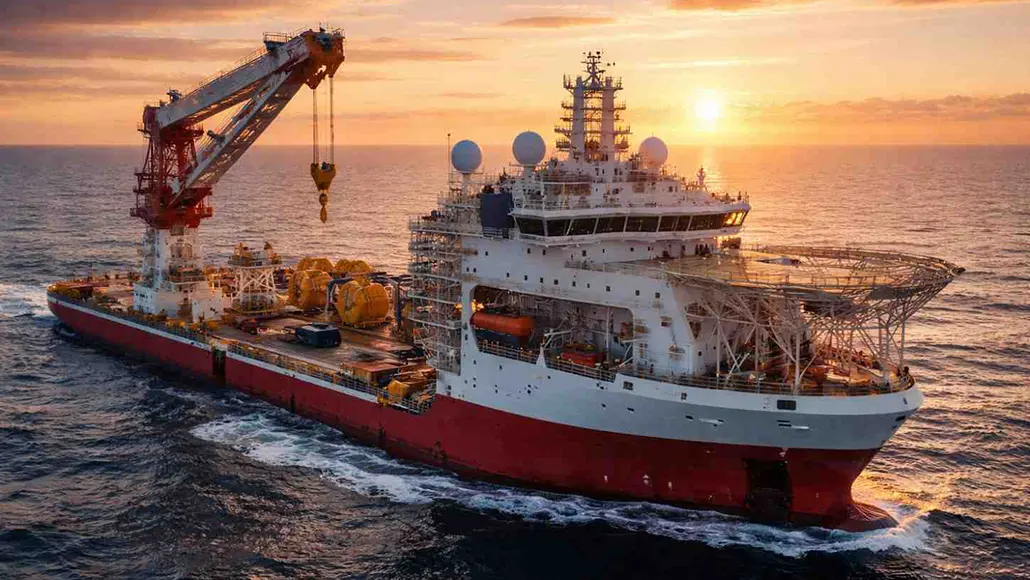
The newly launched deepwater offshore engineering vessel incorporates a double-deck structure and a streamlined monohull design. The ship measures 126 meters in length with a beam of 28 meters and offers roughly 2,000 square meters of deck space. A central moon pool measuring 7.2 × 7.2 meters enables the deployment of saturation diving systems and remotely operated vehicles (ROVs). Built to operate at depths of up to 300 meters, the vessel is also equipped with an electric azimuth thruster and a DP2 dynamic positioning system that enables accurate station-keeping during operations while supporting unrestricted navigation worldwide. The vessel can accommodate up to 100 personnel, ensuring adequate capacity for offshore engineering teams.
Engineered to handle a wide range of offshore tasks, the deepwater offshore engineering vessel integrates multiple operational functions across its lifecycle. It is fitted with a 400-ton offshore crane designed for lifting heavy marine structures and assisting with platform maintenance. In addition, the ship carries a 3,000-ton-class powered cable reel used for subsea cable deployment. A 12-person saturation diving system supports subsea intervention work, while a 1,600-HP trencher launch and recovery unit enables pipeline repair, umbilical installation and trenching operations. To expand operational flexibility, three to four auxiliary cranes can also be installed along the port side, strengthening the vessel’s ability to perform pipeline servicing and emergency response tasks.
To manage the vessel’s complex engineering systems and construction requirements, the project team applied a modular shipbuilding approach using multiple work sites and phased integration. The hull of the deepwater offshore engineering vessel was divided into three main sections bow, midship and stern and constructed from 93 prefabricated blocks. Designs for each section were optimized according to equipment configuration and operational needs while addressing technical feasibility, quality control, safety requirements and construction timelines. Final assembly followed a block-by-block integration process, which improved efficiency and achieved a 100 percent success rate in first-time hull alignment.
The vessel was fully developed using 3D modeling technology to integrate hull construction, outfitting and coating processes. Foundations for major equipment were pre-installed, and piping and cabling were installed simultaneously during assembly. This construction methodology reflects the shipbuilding industry’s wider shift toward digitalized and modular manufacturing processes. Once operational, the vessel is expected to support various offshore engineering missions, contributing to the development of deepwater energy resources and subsea infrastructure.
