















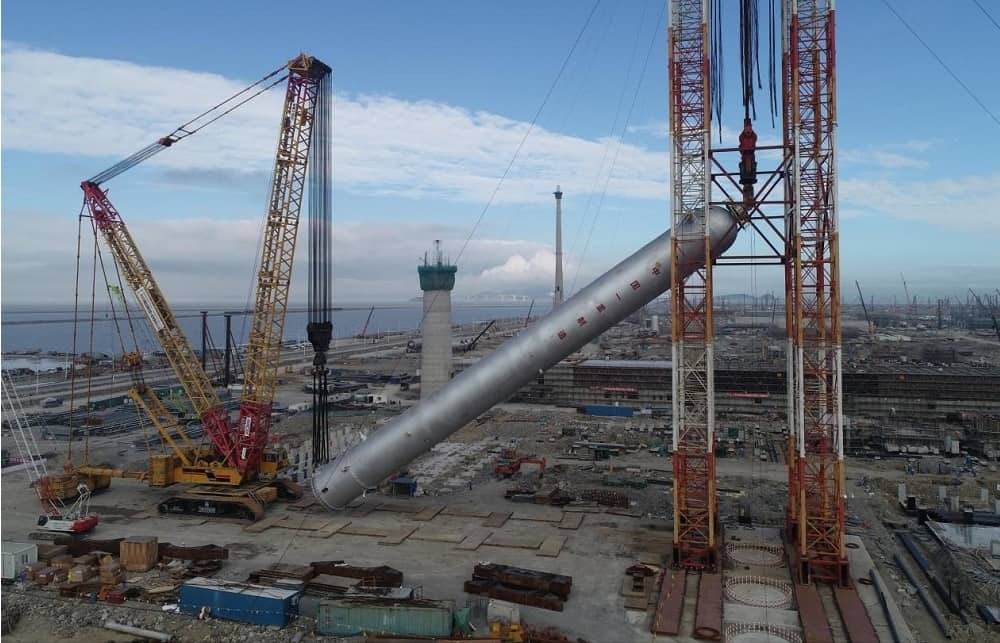
China Petroleum & Chemical Corporation, China’s leading energy and chemical company, has successfully installed the world’s first and largest slurry-bed residue hydrogenation reactor of 3,000 tonnage in 15 hours on June 10 in Zhoushan, China, setting China’s new record of highest integral hoisting weight by a single equipment.
Designed by Sinopec Engineering, the largest single-unit hydrogenation reactor in the world weighs 3,025 tons, which is the equivalent of 17 blue whales, the biggest animal on earth, and has a height of 72 meters (236.2 feet) that corresponds to a 26-story building. The reactor’s outside diameter is 6.156 meters (20.2 feet) and has a wall thickness of 320mm. It’s the core equipment of Zhejiang Petroleum & Chemical’s 40-million-ton/year refining-chemical integration project, phase II.
The record-breaking installation adopted the 5,200-ton slidable hydraulic gantry lifting system for the main hoisting task, and a 2,000-ton XGC28000 crawler crane coordinated the lift from the other end.
The 5,200-ton hydraulic gantry lifting system has the advantages of lifting heavy weights, shifting integrally, and requiring fewer steps of assembly & disassembly of the middle tower, this solution effectively minimized the impact on the construction site and shortened the overall construction period.
The 5,200-ton hydraulic gantry lifting system will be relocated integrally to prepare for the lifting and installation of the second hydrogenation reactor, it will complete six more similar hoisting tasks in the coming months.
