










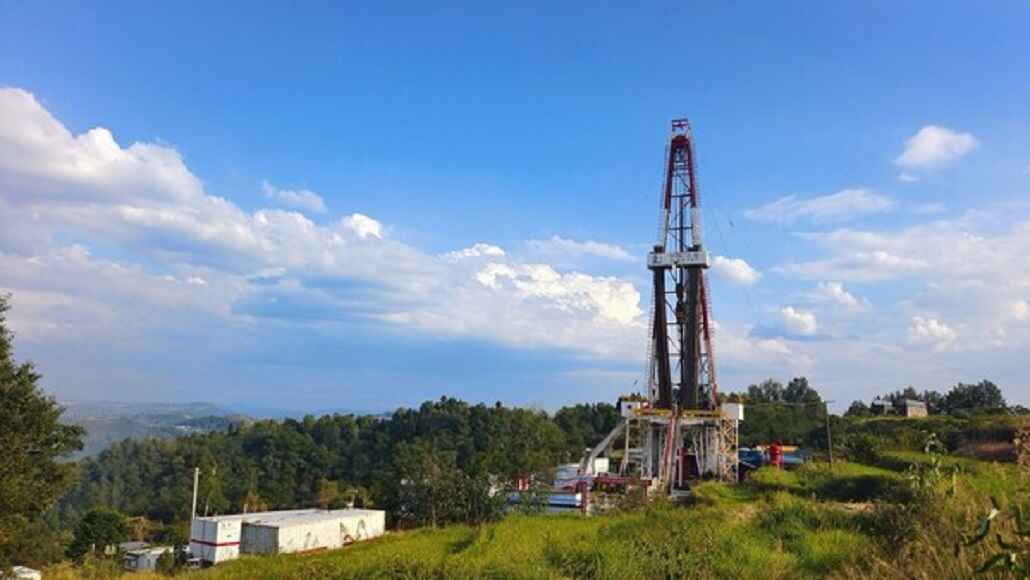
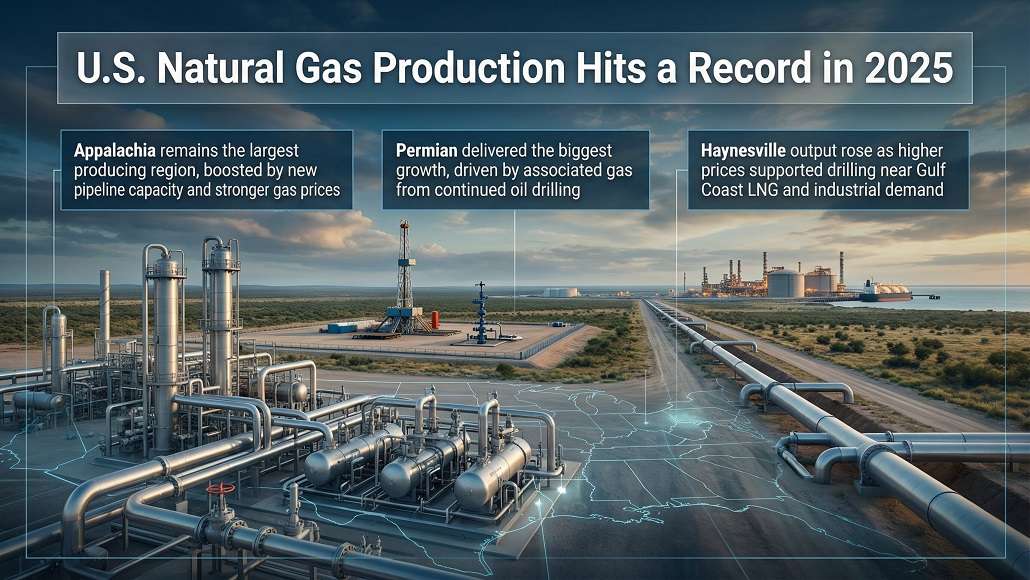
The Energy Information Administration (EIA) reported that the United States achieved record natural gas production in 2025, with marketed output rising by 5.3 billion cubic feet per day (Bcf/d) to average 118.5 Bcf/d. Much of that increase came from three major producing regions, Appalachia, Permian, and Haynesville, which together represented 67% of total marketed gas production across the country and accounted for 81% of the growth in 2025. Data from the Short-Term Energy Outlook shows U.S. Lower 48 (L48) marketed natural gas production broken out across Appalachia, Bakken, Eagle Ford, Haynesville, and Permian, along with additional supply from Alaska and the Gulf of America. The rise in Henry Hub spot prices, the primary benchmark price for natural gas in the United States, climbed 60% to $3.52 per million British thermal units (MMBtu) in 2025 to support higher production levels nationwide. The Appalachia, Permian, and Haynesville regions together delivered 4.2 Bcf/d of the total growth, while other producing areas contributed the remaining 1.1 Bcf/d, helping drive record natural gas production across the United States.
The Appalachia region in the Northeast remained the country’s largest producing area in 2025, accounting for 31%, or 36.6 Bcf/d, of total marketed output. However, expansion in the region has slowed in recent years due to limited pipeline takeaway capacity needed to move gas to demand centres. A key development occurred in June 2024, when the Federal Energy Regulatory Commission authorized the Mountain Valley Pipeline to begin operations. The added infrastructure capacity, combined with stronger Henry Hub prices in 2025, helped increase production in the region by 1.1 Bcf/d compared with a much smaller rise of 46 million cubic feet per day Bcf/d in 2024. Despite infrastructure challenges, Appalachia remains central to sustaining record natural gas production levels nationwide.
Strong output growth was also recorded in the Permian region of Texas and New Mexico, which represented 23% of U.S. marketed natural gas production in 2025 and delivered roughly half of the country’s annual increase. Production in the basin rose 11%, or 2.7 Bcf/d, to average 27.7 Bcf/d. Much of the increase stems from associated gas generated during oil extraction. While West Texas Intermediate (WTI) crude oil prices declined from $77/barrel (b) in 2024 to $65/b in 2025, the price level continued to support oil-focused drilling activity in the region. According to the Dallas Fed Energy survey, industry executives reported breakeven prices of $61/b (Midland Basin) and $62/b (Delaware Basin) in 2025, while a steadily rising gas-to-oil ratio further contributed to expanding supply and reinforcing record natural gas production.
In the Haynesville region spanning Louisiana and Texas, output averaged 14.9 Bcf/d in 2025, representing a 4% increase compared with the 2024 annual average. The rise in Henry Hub prices between 2024 and 2025 enabled drilling to remain economically viable despite deeper and more expensive well development. Wells in the Haynesville formation typically reach depths of 10,500 feet to 13,500 feet, significantly deeper than the 4,000 feet to 8,500 feet common in the Appalachia region. Even with those higher costs, the formation’s proximity to liquefied natural gas export terminals and major industrial consumers along the U.S. Gulf Coast continues to attract operators.
