
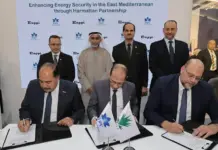



Greece is stepping up its ambitions to become a leading European gas hub for central and southeastern Europe as the region accelerates efforts to phase out Russian energy supplies, Prime Minister Kyriakos Mitsotakis said. Mitsotakis highlighted how the country has transitioned from “a country which was sitting on the periphery of the European energy system into a core player when it comes to southeastern Europe.”
This transformation comes as Europe restructures its energy network, replacing Russian pipeline gas with liquefied natural gas and elevating the importance of transit countries. Greece’s strategic location at the crossroads of the Balkans and the eastern Mediterranean is central to its emergence as a European gas hub, even as nations like Poland, Croatia and Lithuania expand their own LNG capabilities.
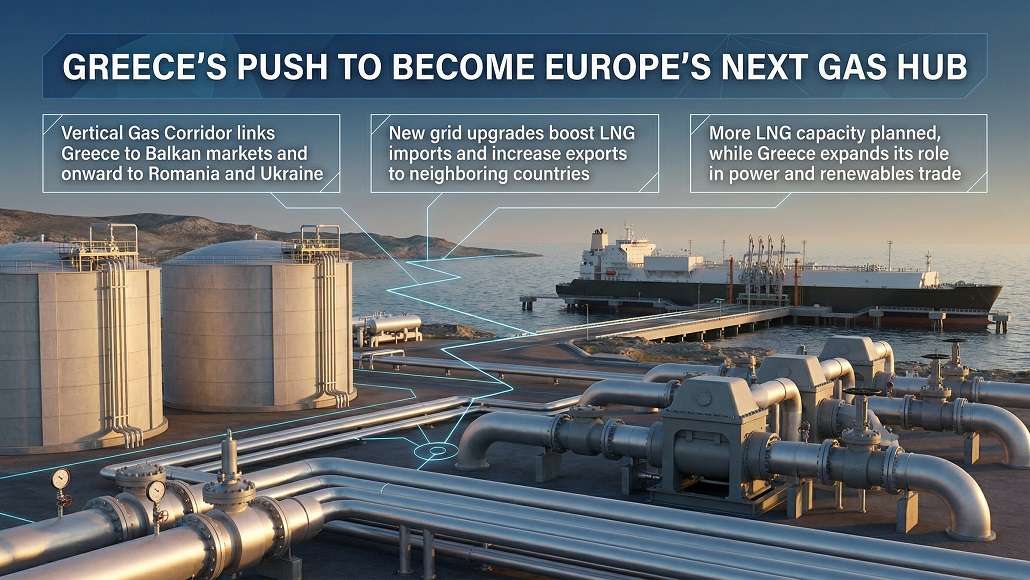
State-backed gas-grid operator Desfa SA is driving this shift through the development of the Vertical Gas Corridor, designed to connect Greece’s system with networks in countries such as Romania and Ukraine while enhancing regional transport capacity. A new compressor station launched in northern Greece in November has already strengthened LNG import volumes and boosted exports to neighboring markets. According to Mitsotakis, the infrastructure has enabled Greece to deliver gas to Ukraine during periods of acute strain, reinforcing its role as a European gas hub and a pillar of energy security in southeastern Europe. It also “ties us geopolitically with the U.S.,” he said.
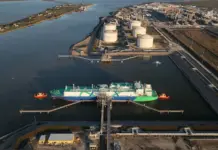
The country’s LNG imports underline this growing role. The United States emerged as Greece’s main supplier in 2025, with volumes reaching 26.56 terawatt-hours, nearly double the previous year and accounting for more than 86% of total imports. Industry leaders say the increasing reliance on LNG is cementing Greece’s standing as a European gas hub.
“The use of LNG is picking up pace and making up a much larger share of supply in our region, and Greece has become a hub,” said Helleniq Energy Holdings SA Chief Executive Officer Andreas Shiamishis. He also added that there is potential for a third LNG import facility. Helleniq Energy Holdings SA is advancing plans for a floating storage and regasification unit in Thessaloniki, with a final investment decision expected in 2026, complementing existing infrastructure at Revithoussa and offshore Alexandroupolis.
Beyond gas, executives see broader opportunities tied to Europe’s energy transition. Chief executive of Public Power Corp., Georgios Stassis noted, “We’re in the heart of the energy transition in the region and we can have the best returns,” pointing to operations spanning Greece, Romania, North Macedonia, Italy and Bulgaria.
With expanding solar and wind capacity turning Greece into a net electricity exporter, the country is also positioning itself to import and transmit renewable energy into Europe, including through projects such as Gregy.
