






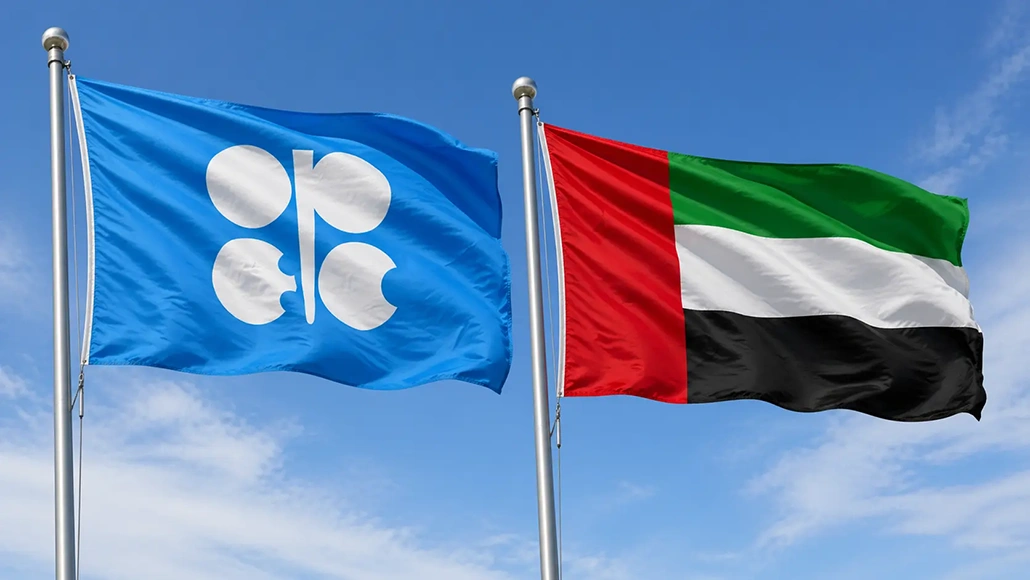
In a move that caught global energy markets off guard, the United Arab Emirates announced on 28th April 2026 that it will formally withdraw from the Organization of Petroleum Exporting Countries (OPEC) and the broader OPEC+ alliance effective May 1, 2026. UAE’s OPEC exit ends a 59-year membership that dates back to Abu Dhabi’s original accession in 1967 and strips the cartel of its third-largest producer at one of the most volatile moments in recent oil market history.
The departure is effective in just days and removes 4.8 million barrels per day of production capacity from the OPEC+ coordination framework, a capacity that Abu Dhabi’s national oil company, Adnoc, now intends to deploy without quota constraints.
The timing of this decision is not incidental. Three converging structural factors shaped the UAE’s move.
The most immediate driver is capacity expansion. Adnoc’s US$150 billion investment programme has accelerated the UAE’s production ramp-up significantly. The 5 million barrels per day target, previously set for 2030, has now been pulled forward to 2027, three full years ahead of schedule. Inside the OPEC+ quota system, the UAE has been producing approximately 30 percent below its current capacity, a constraint that has grown increasingly difficult to justify as infrastructure investment matures.
The second driver is the current market disruption stemming from the Iran war. OPEC production fell 27 percent to 20.79 million bpd in March 2026, the largest supply collapse on record. The Hormuz crisis has created a substantial demand gap in global supply. For Abu Dhabi, operating outside a quota framework means Adnoc can move directly to fill that gap rather than waiting for coordinated OPEC+ decisions.
The third driver is longer-term demand trajectory. The UAE’s decision reflects that calculus directly. It wants to maximise output and revenue now, rather than defer to cartel discipline.
The exit of the UAE deals a significant structural blow to OPEC’s market coordination authority. The country represents approximately 4 percent of total global oil production and has historically been one of three Gulf swing-producer pillars alongside Saudi Arabia and Iraq.
This is not the first Gulf state exit. Qatar departed OPEC in 2019, citing its identity as a gas-focused economy where OPEC membership had become increasingly irrelevant. Bahrain and Oman remain outside OPEC but continue to participate in supply coordination informally. The broader pattern that emerges is clear: Gulf producers beyond Saudi Arabia and Iraq are progressively distancing themselves from the OPEC framework.
With the UAE’s departure, Saudi Arabia and Iraq stand as the only remaining major OPEC producers in the Gulf. The cartel’s credibility as a unified pricing bloc is now under direct pressure from within its own region.
Riyadh now faces the full weight of OPEC market discipline without one of its most significant partners. Saudi Arabia, with a 12 million barrels per day capacity target, has historically been the cartel’s anchor of supply discipline. That role becomes considerably more difficult when a neighbouring producer of the UAE’s scale operates freely outside the quota system.
The UAE-Saudi competitive dynamic has been building for years. Both countries target overlapping Asian export markets, operate in adjacent waters, and both have large sovereign wealth funds with similar regional investment mandates. Political tensions also surfaced late last year when Saudi Arabia bombed weapons shipments bound for UAE-backed separatist forces in Yemen, a visible sign of a fracturing relationship.
Saudi Crown Prince Mohammed bin Salman now faces a difficult set of choices: absorb the burden of production discipline alone, match UAE output increases and accept global oversupply, or seek bilateral arrangements with Abu Dhabi outside the OPEC structure. The OPEC meeting scheduled for Wednesday in Vienna has taken on considerably greater strategic significance in this context.
For Latin American oil exporters , none of whom are OPEC members, a less coordinated OPEC creates meaningful market share opportunities.
Brazil’s Petrobras stands to benefit most directly, with pre-salt production growing toward 4 million barrels per day by 2030 and the Argonauta acquisition in progress. Argentina’s YPF is accelerating Vaca Muerta development under the government’s RIGI incentive framework. Colombia’s Ecopetrol continues to export at strong margins despite structural output declines. Venezuela’s PDVSA is restarting production under US oil revenue audit oversight.
Mexico, however, faces a more challenging outlook. Pemex’s already-declining production sits against a medium-term backdrop of weakening OPEC supply discipline and increasing global supply. Given that Mexico is the third-largest supplier of oil to the United States, shifts in global pricing dynamics carry direct implications for US-Mexico energy trade.
For businesses operating across the energy supply chain , from upstream E&P companies to refiners, traders, and logistics providers, UAE’s OPEC exit comes at a moment that creates simultaneous bearish and bullish pressures.
The near-term outlook remains constructive for prices. Brent crude was trading above US$110 per barrel at the time of the announcement, supported by Hormuz disruption and the broader Iran war. The World Bank’s Commodity Markets Outlook, published on the same day, projected 2026 energy prices to surge 24 percent on the back of the conflict. As long as the Hormuz crisis persists, the UAE’s incremental barrels will take time to reach markets regardless of quota freedom.
