

















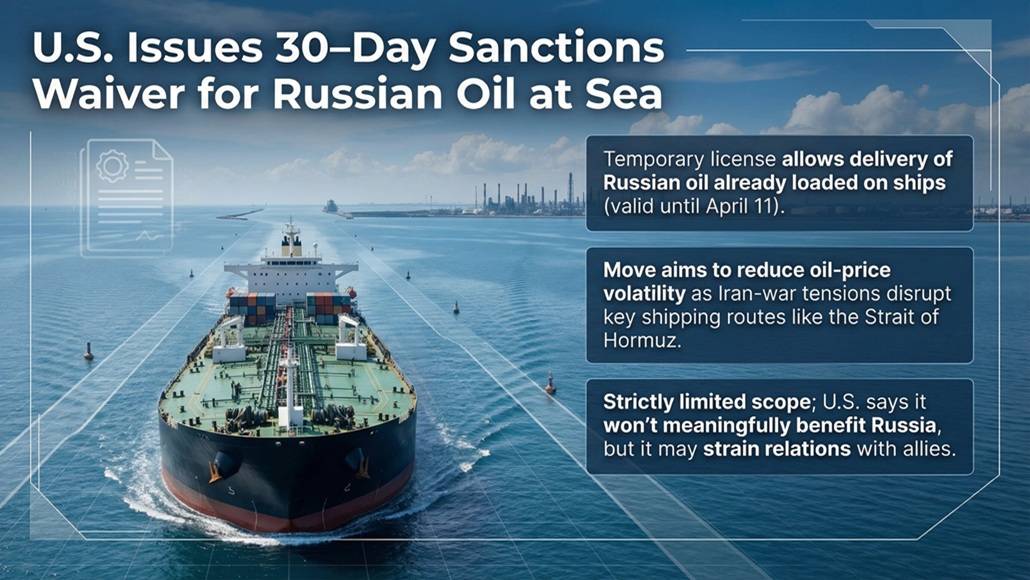
The United States of America has introduced a 30-day sanctions waiver allowing countries to purchase sanctioned Russian oil and petroleum products that are currently stranded at sea, a move aimed at easing pressure on global energy markets unsettled by the Iran war. The measure was confirmed by U.S. Treasury Secretary Scott Bessent, who described it as an effort to calm volatility that has intensified following heightened geopolitical tensions. The license, issued by Washington on March 12th 2026, authorizes the delivery and sale of Russian crude oil and petroleum products that were loaded on vessels as of March 12. It remains valid until midnight Washington time on April 11, according to the text published on the Treasury Department’s website. The White House moved forward with the 30-day sanctions waiver amid concerns that a sharp rise in oil prices, triggered after nearly two weeks of U.S. and Israeli strikes on Iran, could place additional strain on U.S. businesses and consumers.
Although the policy temporarily eases restrictions, officials emphasized that the step is strictly limited in scope. Washington has signaled caution about the possibility of Russia benefiting financially from the arrangement. In a statement on X, Bessent said the measure was “narrowly tailored” and “short-term” and would not provide significant financial benefit to the Russian government. The 30-day sanctions waiver represents the latest move by President Donald Trump’s administration to manage energy price pressures that emerged after the U.S. and Israeli strikes on Iran and Tehran’s subsequent response escalated regional tensions. The conflict has disrupted shipping routes through the Strait of Hormuz, a critical artery for Middle East oil and gas flows, contributing to higher global energy prices.
The waiver coincides with broader efforts by Washington and its partners to stabilize supply. The U.S. recently announced a release of 172 million barrels of oil from the strategic petroleum reserve to counter surging prices linked to the war in Iran. That action forms part of a wider initiative by the 32-nation International Energy Agency, which has committed to releasing 400 million barrels of oil. According to available data, approximately 124 million barrels of Russian-origin oil were on water across 30 different locations globally as of 12th March 2026. The newly granted 30-day sanctions waiver could add roughly five to six days of supply when factoring in the daily disruption of oil flows through the Strait.
Despite its potential to boost supply, the move could complicate Western efforts to limit Russia’s revenue from its war in Ukraine while causing friction with allied governments. European Commission President Ursula von der Leyen, after participating in a call with G7 leaders to assess the Iran war’s impact on oil and gas markets, expressed disapprovingly on Russian oil sanctions. Meanwhile, Russian presidential envoy Kirill Dmitriev said he had discussed the current energy crisis with a U.S. delegation at a meeting in Florida.
